
Ultra-Dense Server Deployment in Racks

Compaq Ultra-Dense Server Deployment in Compaq Racks 17
128H-0400A-WWEN
2.2.3. Input Power Budget De-rating
If a deployment plan limits the future expansion beyond certain configurations, then adjustments may be
made to the input current and thermal requirements based on the worst-case configuration for a specific
site deployment.
This section explains how to de-rate the input power budget. Assume that the power supply rated input
power of 292W is for the “maximum” configuration. For initial availability of ProLiant DL360, the
maximum configuration (with remote console management) can be assumed to be as follows:
2x800MHz, 4x1GB, 2x18.4GB, SA4200, Remote Insight Lights-Out Edition
The peak input power of a subsystem/component is added to or subtracted from the rated (peak) input
power when the subsystem is added or removed, respectively. When a subsystem is added to a
configuration, either the typical or the peak input power of the subsystem will be added depending on
whether the server input power budget or the thermal dissipation is to be calculated. Following are some
rules of thumb for calculating the power budget and the thermal dissipation for both methods when a
subsystem is added:
1. To calculate the power budget, the peak power should be added.
2. To calculate thermal dissipation, the typical power should be added for the hard disk drives and peak
power should be added for all other components.
3. To calculate either the power budget or the thermal dissipation, only the typical input power should
be added when the 2
nd
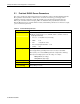
drive is added. Typical input power is listed in Table 2-4. The reasons for this
suggestion are:
• The peak input power for each drive is for the beginning of the spin-up duration, which is
relatively short, for example, 10 seconds. During normal operation, that is, while an application is
running, the power consumption of a disk drive varies.
• The drives are spinning up at different times. Therefore, only one drive will consume “peak”
power at a time within a server. Note that the only time that up to 42 drives can be spinning up
simultaneously in a 42U rack is if all the servers regain power simultaneously, after having lost
power. Then all of them will restart automatically and almost simultaneously.
• There is almost no activity in the processors or memory DIMMs when the drives are spinning up.
Example
Assuming the desired server configuration is: 1x550MHz, 2x128MB, 2x18.4GB
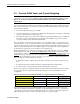
The rated input power for the ProLiant DL360 power supply is 292W. Therefore, the power budget for a
maximum configuration is 292W, and the thermal dissipation will be approximately (292*3.41=) 996
BTUs/hour.
After removing the 4x1GB DIMMs, 1x800MHz processors, the SA4200 and the Remote Insight Lights-
Out Edition from the maximum configuration:
The peak input power of the server will be (292-(4*5)-(1*26)-11-16) = 219W. Since we used the
800MHz processor’s input power instead of the 550MHz processor's, the 219W is a more
conservative number.
Adding back 2x128MB DIMM:
The peak input power of the server will be (219+(2*3)) = 225W. Therefore, the new power budget
for this configuration is 225W (compared to the rated 292W), and the thermal dissipation will be
approximately (225*3.41=) 765 BTUs/hour (compared to the rated 996 BTUs/hour).