
Technologies for HP ProLiant 100-series G5 (Generation 5) servers, 2nd edition




Abstract
This paper describes the major technologies implemented in the latest generation of HP ProLiant
100-series servers. These technologies include dual-core and quad-core processors, Double Data
Rate-2 (DDR2) and Fully-Buffered memory modules, Lights-Out 100 management, multifunction
network interface cards, the most recent server deployment utilities, and the latest serial input/output
(I/O) technologies.
Introduction
HP constantly advocates, tests, and adopts new industry-standard server technologies that improve the
performance, capacity, and reliability of ProLiant servers. This paper summarizes the processor,
memory, I/O, and management technologies implemented in the latest generation of the ProLiant
100-series servers.
For complete specifications of all ProLiant 100-series servers, see the HP website at
www.hp.com/products/servers/platforms.
Processor technologies
ProLiant 100-series servers use the latest multi-core technologies from Intel and AMD. A multi-core
processor has two or four separate execution cores on the same physical die so that it can perform
more work within a given clock cycle. To take advantage of multi-core processing, software must be
“multi-threaded” so that the processor work load can be distributed across multiple execution cores.
Intel® Xeon® processors
The dual-core Intel Xeon 3100 and 5200 sequence processors and quad-core Intel Xeon 3300 and
5400 sequence processors are based on the Intel® Core™ microarchitecture. The Core
microarchitecture uses less power and produces less heat than previous generations of Intel
processors.
Using Hyper-Threading technology, these multi-core processors offer wide execution paths
for highly efficient instruction processing. Intel Xeon 5000 sequence processors can simultaneously
execute four software threads, thereby increasing processor utilization. To avoid saturation of the front
side bus (FSB), the Intel 5000 chipset widens the interface by providing dual independent buses. The
Intel Core microarchitecture includes these additional technologies that improve per-watt performance
and energy efficiency: Hardware Virtualization, Enhanced Intel Speed-Step® Technology,
Supplemental Streaming SIMD Extension 3 (SSSE3), and Intel Execute Disable Bit technology.
1
Xeon dual-core processors
The 64-bit Intel Xeon 3100 and 5200 sequence processors combine performance and power
efficiency to enable smaller, quieter systems. Xeon 3100 processors include 6 megabytes (MB) of L2
cache per core and a maximum front side bus speed of 1333 megahertz (MHz).
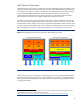
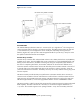
The Intel Xeon 5200 sequence processors are similar in architecture to the Xeon 3100 sequence
processors (Figure 1). The Xeon 5200 processors use 45-nanometer (nm) technology resulting in high
performance (up to 1666-MHz FSB speed) and enhanced power efficiency. Both the Xeon 3100 and
the 5200 sequence processors are compatible with IA-32 software and support single-processor
operation.
1
For additional information about Intel processors, see the HP technology brief titled “AMD Opteron™ and
Intel® Xeon® x86 processors in industry-standard servers” at
http://
h20000.www2.hp.com/bc/docs/support/SupportManual/C02731435/C02731435.pdf.
2