
HP ProLiant AMD-based 100-series G7 servers
5
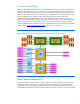
The G34 socket infrastructure features four, 16-bit HT3 links operating at up to 6.4 GT/s per link. Of
the four HT3 links, three are shared processor to processor links and one link on each processor is
available for I/O communication.
HT Assist
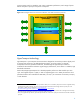
HT Assist reduces cache coherence traffic on the HT links. By tracking where data is stored in cache
and guiding the processor directly to the caches of other processors, HT Assist reduces cache probe
traffic between processors, especially in 4- socket servers. Therefore, HT Assist results in faster queries
that can increase performance for cache-sensitive applications such as database, virtualization, and
compute-intensive applications.
Memory technologies
In the AMD Opteron 6100-series architecture, the memory controller is integrated into the processor
chip to optimize memory performance and bandwidth per CPU. The memory controller reduces
latency inherent in front side bus architectures by eliminating the bus contention between memory and
I/O cycles. AMD's memory bandwidth increases as processors are added to a configuration, unlike
legacy designs that scale poorly because access to main memory is limited by external Northbridge
chips. HP designed specific BIOS and BIOS Setup Utility (BSU) functions to manage memory
configurations, letting the customer optimize configurations for maximum performance while reducing
power consumption and cooling requirements. These management options also include memory
protection and latency reduction. All of these options are examined later in this section.
DDR3 DIMM choices
HP ProLiant G7 100-series servers with Opteron 6100 series processors support double data rate
(DDR3) dual inline memory modules (DIMMs). DDR3 has several key enhancements including an 8-bit
prefetch buffer for storing data before it is requested. By comparison, DDR-2 has a 4-bit buffer. For
DDR3, the data signal rate can increase to 1333 Megatransfers per second (MT/s). While this is
commonly referred to as having a speed of 1333 MHz, the maximum clock speed for the DIMMs is
actually 667 MHz and the signal is double-pumped to achieve the 1333 MT/s data rate. DDR3-1333
DIMMs can operate at clock speeds of 667 MHz, 533 MHz, and 400 MHz with corresponding data
rates of 1333, 1066, and 800 MT/s.
HP DDR3 DIMM modules incorporate an integrated thermal sensor that signals the chipset to throttle
memory traffic to the DIMM if its temperature exceeds a programmable critical trip point. Using the
data from these thermal sensors, ProLiant AMD 100-series G7 servers can reduce fan speed when
memory is idle, effectively reducing power consumption. The BIOS in ProLiant G7 servers verifies the
presence of the thermal DIMM sensor during POST. Some third-party DIMMs may not include this
thermal sensor. If it is absent, a POST message will warn that the DIMM does not have a thermal
sensor, and the fans will be forced to run at higher speeds (requiring more power).
DDR3 is available as both Unbuffered Dual In-line Memory Modules (UDIMMs) and Registered
(buffered) Dual In-line Memory Modules (RDIMMs). Both RDIMMs and UDIMMs support error
correcting code (ECC).
There are three types of standard voltage DDR3 available for ProLiant 100 series G7 servers:
PC3-8500R- DDR3 (RDIMM, ECC compliant)—1333 or 1066 MT/s data rate depending on
memory configuration.
PC3-10600R DDR3 (RDIMM, ECC compliant)—1333 or 1066 MT/s data rate depending on
memory configuration.
PC3-10600E DDR3 (UDIMM, ECC compliant)—1333 MT/s data rate