
Technology and architecture of HP ProLiant AMD-based 100 - series G6 (Generation 6) servers
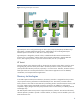

• SAS wide port operations — Wide ports contain four single lane (1x) SAS connectors and the
cabling has all four lanes bundled together. SAS wide ports allow balanced SAS traffic distribution
across the links for enhanced performance. In addition, wide ports provide redundancy by
tolerating up to three physical link failures while maintaining the ability to communicate with the
disk drives. The most common use of these wide links is to a JBOD or to an internal server expander
connecting to large numbers of drives. No special configuration is required for this functionality.
• SAS expanders — Low-cost, high-speed switches called expanders can combine multiple single
links to create wide ports and increase available bandwidth. SAS expander devices also offer
higher system performance by expanding the number of hard drives that can be attached to an
HP Smart Array controller. SAS expanders are an aggregation point for large numbers of drives or
servers providing a common connection. By cascading expanders, administrators can chain
multiple storage boxes together. For more information on the HP SAS Expander Card, go to
http://h18004.www1.hp.com/products/servers/proliantstorage/arraycontrollers/sas-expander/index.html.
SAS-2 standard
The second-generation SAS (SAS-2) link speed
5
of 6 Gb/s is double the SAS-1 transfer rate. SAS-2
link speeds require SAS-2 compliant hard drives. SAS-2 eliminates the distinction between fanout and
edge expanders by replacing them with self-configuring expanders. SAS-2 enables zoning for
enhanced resource deployment, flexibility, security, and data traffic management.
SAS-2 connections have the potential to deliver peak raw data bandwidth of up to 600 MB/s per
physical link in each direction. SAS-2 devices are capable of sending and receiving data
simultaneously across each physical link, which is known as full duplex. When effectively
implemented, full duplex, 6 Gb/s SAS connections can deliver peak raw data bandwidth of up to
1200 MB/s between the controller and storage device. It is important to note that the SAS-2 data
bandwidths described here are theoretical speeds identified by the SAS-2 standard. Actual
performance will be affected by the performance of storage devices attached to the SAS-2
connection.
Smart Array controllers, with releases beginning in the first quarter of 2009, incorporate SAS-2
connections. The SAS-2 standard is compatible with both Serial SCSI and Serial ATA protocols for
communicating commands to SAS and SATA devices. SAS-2 compliant controllers are fully
compatible with 1.5 Gb/s and 3 Gb/s SATA technology.
For the most up-to-date listing of HP Smart Array controllers that support the SAS-2 specification, see
the Smart Array controller matrix:
http://www.hp.com/products/smartarray
Battery backed write cache
T
he battery backed write cache (BBWC) is required for capacity expansion (adding one or more
physical disks to an existing array). The controller recalculates parity and balances the data across all
the disks. During the expansion, the BBWC preserves data and logical structures on the array. The HP
650 mAh P-Series battery extends battery life up to 48 hours before recharging is necessary.
NOTE:
In the ProLiant DL165 G6 server, the Smart Array P212 controller cache size is limited
to 256 MB
Zero Memory RAID
Using Zero Memory RAID (ZMR), administrators can create a RAID 0-1 configuration without
additional memory. ZMR uses memory embedded in the controller, approximately 1K in size, and
5
Serial Attached SCSI-2 (SAS-2) is an American National Standards Institute (ANSI) standard from the INCITS T10 Technical
Committee on SCSI Storage Interfaces. SAS-2 is the successor to SAS-1.1 and SAS-1.
8