
Technology and architecture of HP ProLiant AMD-based 100 - series G6 (Generation 6) servers

PCI Express technology
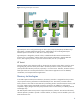
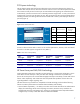
The PCI Express (PCIe) serial interface provides point-to-point connections between the chipset I/O
controller hub and I/O devices. Each PCIe serial link consists of one or more dual-simplex lanes. Each
lane contains a send pair and a receive pair to transmit data at the signaling rate in both directions
simultaneously. ProLiant 100-series servers with AMD processors support PCIe 1.0 slots, which have a
signaling rate of 2.5 Gb/s per direction per lane. After accounting for 20% serializing/deserializing
encoding overhead, the resulting effective maximum bandwidth is 2 Gb/s (250 MB/s) per direction
per lane (Figure 3).
Figure 3. PCIe data transfer rates
Link
size
Max. bandwidth
(Send or receive)
Total
(Send and
receive)
x1 250 MB/s 500 MB/s
x4 1 GB/s 2 GB/s
x8 2 GB/s 4 GB/s
x1 250 MB/s 500 MB/s
Switch
Send 250 MB/S
Receive 250 MB/S
Send 250 MB/S
Receive 250 MB/S
}
Lane
Endpoint
}
Lane
Switch
Send 250 MB/SSend 250 MB/S
Receive 250 MB/S
Send 250 MB/SSend 250 MB/S
Receive 250 MB/S
}
Lane
Endpoint
}
Lane
A PCIe 2.0 device can be used in a PCIe 1.0 slot. For
best performance, however, each card should
be used in a slot that supports its logical link size (Table 1).
Table 1. PCIe device interoperability
PCIe
device type
x4 Connector
x4 Link
x8 Connector
x4 Link
x8 Connector
x8 Link
x16 Connector
x8 Link
x16 Connector
x16 Link
x4 card x4 operation x4 operation x4 operation x4 operation x4 operation
x8 card Not allowed x4 operation x8 operation x8 operation x8 operation
x16 card Not allowed Not allowed Not allowed x8 operation x16 operation
HP Smart Array and SAS/SATA technology
Present generation Smart Array controllers use SAS technology, a point-to-point architecture in which
each device connects directly to a SAS port rather than sharing a common bus as parallel SCSI
devices do. Point-to-point links increase data throughput and improve the ability to locate and fix disk
failures. More importantly, SAS architecture solves the parallel SCSI problems of clock skew and
signal degradation at higher signaling rates.
The latest Smart Array controllers are compatible with SATA technology and include the following
features to enhance performance and maintain data availability and reliability:
• SAS and SATA compatibility — the ability to use either SAS or SATA hard drives lets administrators
deploy drive technology that fits each computing environment. HP Smart Array controllers can
manage both SAS arrays and SATA arrays. Smart Array configuration utilities help administrators
configure arrays correctly so that data remains available and reliable.
7