
Technology and architecture of HP ProLiant AMD-based 100 - series G6 (Generation 6) servers

• Write bursting to minimize read/write transitions for greater throughput
• Optimized DRAM paging algorithm for greater throughput
• DRAM prefetcher to intelligently predict and retrieve needed data from main memory
• Core prefetchers that fetch data directly to L1 cache to decrease latency and reduce L2 bandwidth
Double data rate memory
HP ProLiant G6 100-series servers with AMD processors support PC2 Registered double data rate
(DDR-2) DIMMs. These 100-series G6 servers use 1-GB, 2-GB, 4-GB, or 8-GB registered DDR-2
DIMMs across 8 DIMM slots. DDR-2 memory devices operate at 1.8V. They use high clock
frequencies to increase data transfer rates and on-die termination control to improve signal quality.
For example, at a clock frequency of 400 MHz, the data transfer rate is 800 megatransfers per
second (MT/s), which translates to a memory bandwidth of 6400 MB/s per DIMM
4
.
Determining memory bus speed
Depending on the quantity and speed of installed DIMMs, memory bus speeds on the 100-series G6
servers can be 533-MHz, 667-MHz, or 800-MHz. The memory bus speed is determined by the BIOS
and BSU using the following two-step process:
Step 1- The BIOS interrogates each DIMM that is installed in the system and sets the memory bus
speed to the least common denominator of the DIMM speeds detected, regardless of the BSU menu
option selected. For example, with 667-MHz and 800-MHz DIMMs installed, this first step should
complete with the memory bus speed set to 667 MHz regardless of how many DIMMs are installed
on each processor.
Step 2- The following BSU menu option settings determine the actual memory bus speed that is
selected.
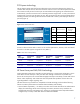
• Menu Option 1 (Auto default) – Memory bus speed is determined by the number of DIMMs installed
for each processor:
– Auto Case 1: Four or fewer DIMMs = 800-MHz memory bus speed provided that all DIMMs
detected in step 1 are rated for 800 MHz.
– Auto Case 2: Six DIMMs = 667-MHz memory bus speed provided that all DIMMs detected in
step 1 are rated for 667 MHz or greater.
– Auto Case 3: Eight DIMMs = 533-MHz memory bus speed provided that all DIMMs detected in
step 1 are rated for 533 MHz or greater.
• Menu Option 2 – Memory bus speed is set to 533 MHz regardless of how many DIMMs are
installed provided that all DIMMs detected in step 1 are rated for 533 MHz or greater.
Memory management technologies
Memory interleaving on the AMD Opteron 2400-series processors can occur between the processor
memory banks, memory channels, and between processor nodes in a multiprocessor system. All three
memory interleaving technologies are supported on the ProLiant AMD 100-series G6 servers. These
technologies are independent of each other and can operate simultaneously.
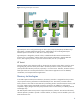
Memory bank interleaving
When memory bank
interleaving is engaged, data is routed alternately to memory banks through the
common memory channel connecting the DIMM banks and the integrated memory controller.
4
For additional information, refer to the HP technology brief titled “Memory technology evolution: an overview of system
memory technologies": http://h20000.www2.hp.com/bc/docs/support/SupportManual/c00256987/c00256987.pdf
5