
Technologies in HP ProLiant G7 c-Class server blades with AMD Opteron™ processors, 3rd Edition





2
Introduction
This paper describes the architecture and major technologies implemented in HP ProLiant G7 c-Class Server Blades
based on AMD Opteron™ processors. Specifically, the paper applies to the BL465 G7 and BL685c G7 Server
Blades updated with the AMD Opteron 6200 series processors.
To gain the most value from this paper, you should be familiar with HP ProLiant server technology and be somewhat
acquainted with BladeSystem architecture. You can find more information about the infrastructure, components, and
complete specifications of each HP server blade and enclosure at
www.hp.com/go/bladesystem/.
ProLiant server design principles
We design industry-standard servers with a balanced architecture to use all subsystems effectively under a broad
range of applications and workloads. For example, we distribute memory capacity across processors and I/O
devices instead of increasing memory capacity asymmetrically. Many applications have improved performance
when the memory is closely coupled to the processor. Asymmetric memory, on the other hand, can be inefficient
and contribute to increased power consumption and cost.
We develop balanced architecture through superior engineering of fundamental elements such as mechanical
infrastructure, power, cooling, processor, memory, I/O devices, storage, boot, networking, and interconnecting
components. A balanced architecture includes the following characteristics:
• Computing capability based on processor core count, cache size per processor, and processor socket count
• Low-latency processor-to-memory bandwidth commensurate with core count
• Memory footprint and capacity that maximize bandwidth and capacity with power efficiency and performance
without compromising quality or reliability
• Application-appropriate I/O devices
• Closely-coupled and balanced processor-to-memory and processor-to-I/O ratios
• Mechanical design that ensures optimum levels of cooling, stability, and serviceability through space-efficient,
modular partitioning
ProLiant c-Class server blade architecture
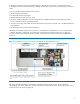
HP ProLiant c-Class server blades can slide into either c7000 or c3000 HP BladeSystem c-Class Enclosures to meet
the needs of large or small IT environments (Table 1).
Table 1: Characteristics of c-Class BladeSystem chassis
Enclosure Height in Data Rack Units Server Blade Capacity Blade position
C7000 rack enclosure 10U 8 c-Class full-height
16 c-Class half-height
server blades
Vertical
C3000 rack enclosure 6U 4 c-Class full-height
8 c-Class half-height
server blades
Horizontal
The rack enclosures fit in HP 10000 series racks and can operate with as few as one server blade installed. A
major advantage of blade architecture is the ease of adding and changing server blades. We build ProLiant c-Class
server blades in standard form-factors, referred to as half-height (1 chassis slot) and full-height (2 chassis slots). Both
half-height and full-height server blades fit into any device bay in a BladeSystem c-Class enclosure.