
R2511-HP MSR Router Series Voice Configuration Guide(V5)




196
Configuring SIP trunk
This chapter describes how to configure SIP trunk.
Background
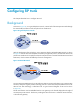
As shown in Figure 58, on a typical telephone network, internal calls of the enterprise are made through
the internal PBX, and external calls are placed over a PSTN trunk.
Figure 58 Typical telephone network
With the development of IP technology, many enterprises deploy SIP-based IP-PBX networks as shown
in Figure 59. Inter
nal calls of the enterprise are made by using the SIP protocol, and external calls are still
placed over a PSTN trunk. The problem is that the enterprises have to maintain both the SIP network and
PSTN trunk, which increases the difficulty of network management.
Figure 59 SIP+PSTN network
As more enterprise IP-PBX networks run SIP and more ITSPs use SIP to provide basic voice communication
structures, enterprises urgently need a technology that can connect the enterprise IP-PBX network to the
ITSP over SIP. This technology is called SIP trunk. A typical network diagram of SIP trunk is shown
in Figure 60.
T
he SIP trunk function can be embedded into the voice gateway or the firewall deployed at the edge of
an enterprise private network. The device providing the SIP trunk function is called the SIP trunk device,
or the SIP trunk gateway.