
Administrator's Guide



ENWW TCP/IP Overview 92
IP Address: (Host Portion)
Host addresses numerically identify specific network interfaces on an IP
network. Usually a host has only one network interface; thus, only one IP
address. Because no two devices can share the same number at the same time,
administrators typically maintain address tables to assure correct assignment
of addresses in the host network.
IP Address Structure and Class
An IP address is comprised of 32 bits of information and divided into 4 sections
containing 1 byte each section or 4 bytes total: xxx.xxx.xxx.xxx
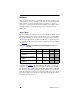
For efficiency in routing, networks were broken down into three classes, so
routing can begin simply by identifying the leading byte of information in the
IP address. The three IP addresses that InterNIC assigns are class A, B, and
C. The network class determines what each of the four IP address sections
identify as shown in Table A.1
:
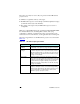
As illustrated in Table A.2
, each network class differs by the leading bit
identifier, the address range, the number of each type available, and the
maximum number of hosts each class allows.
Table A.1 IP Address Class Format
Class First Address
Byte xxx.
Second
Address
Byte xxx.
Third Address
Byte xxx.
Fourth
Address
Byte xxx
A Network. Host. Host. Host
B Network. Network. Host. Host
C Network. Network. Network. Host
Table A.2 Network Class Characteristics
Class Leading
Bit
Identifier
Address Range Maximum
Number of
Networks in the
Class
Maximum
Hosts in the
Network
A 0 0.0.0.0 to
127.255.255.255
126 Over 16 Million
B 10 128.0.0.0 to
191.255.255.255
16,382 65,534
C 110 192.0.0.0 to
223.255.255.255
Over 2 Million 254