
NonStop NS16000 Series Planning Guide (H06.11+)
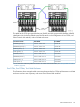
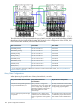

IOAM Enclosure and Disk Storage Considerations
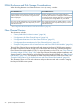
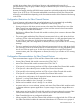
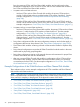
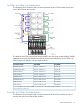
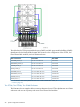
When deciding between one IOAM enclosure or two (or more), consider:
Two IOAM EnclosuresOne IOAM Enclosure
Greater availability because of multiple redundant
ServerNet paths and FCSAs. Installing the IOAM enclosures
in separate cabinets prevents application or system failure
if a localized power outage affects only one cabinet.
High-availability and fault-tolerant attributes of NonStop
S-series systems with I/O enclosures using tetra-8 and
tetra-16 topologies.
Four FCSAs split between four IOAM modules, so loss of
one module takes down only alternate primary or mirror
Fibre Channel loop.
1
Two or four FCSAs split between only two IOAM modules,
so loss of one module takes down all primary or mirror
Fibre Channel loops.
1
1
See “Configuration Recommendations for Fibre Channel Devices” (page 95).
Fibre Channel Devices
This subsection includes:
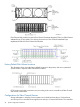
• “Factory-Default Disk Volume Locations” (page 94)
• “Configurations for Fibre Channel Devices” (page 94)
• “Configuration Restrictions for Fibre Channel Devices” (page 95)
• “Configuration Recommendations for Fibre Channel Devices” (page 95)
• “Example Configurations of the IOAM Enclosure and Fibre Channel Disk Module” (page 96)
The only Fibre Channel device used internally with Integrity NonStop NS16000 series systems is
the Fibre Channel disk module (FCDM). An FCDM and its disk drives are controlled through the
Fibre Channel ServerNet adapter (FCSA). For more information on the FCSA, see “Fibre Channel
ServerNet Adapter (FCSA)” (page 128) or the Fibre-Channel ServerNet Adapter Installation and
Support Guide. For more information on the Fibre Channel disk module (FCDM), see “Fibre Channel
Disk Module” (page 130). For examples of cable connections between FCSAs and FCDMs, see
“Example Configurations of the IOAM Enclosure and Fibre Channel Disk Module” (page 96).
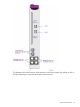
This illustration shows an FCSA with indicators and ports that are used and not used in Integrity
NonStop NS16000 series systems:
92 System Configuration Guidelines