
iTP Secure WebServer System Administrators Guide (Version 7.5+)
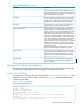
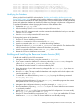

The table has at least one row for each Web server RLS can contact. Each row includes these
columns:
• Filename
• Ip_addr
• Port
• Tcpip
• No_Servers
• Relative_ID
Where:
Filename
is the prefix (the first part of the URL path name) shared by a set of replicated Web
servers. Its value identifies the root directory, or the alias name of the root directory
for an Windows NT IIS Web server. This field cannot exceed 200 characters and
cannot include wildcard characters. The value must be the same for all Web servers
to be considered replicated; for example, to define a set of three replicated servers,
you need three database records, all with the same value of Filename. To map
multiple prefixes to the same Web server you need multiple records for the server,
with different values in this field.
Ip_addr
specifies the address of the remote server. The value of Ip_addr can be either an
address in dotted decimal format or a domain name; it cannot exceed 40 characters.
Port
specifies the port of the remote server.
Tcpip
is the name of the local TCP/IP process that RLS must use to connect to the remote
Web server. You can use any TCP/IP process on your system. If the Web server
described in this record is on the same system as RLS, you must still specify a TCP/IP
process name, but RLS will ignore it. Specify the process name in Guardian format:
a dollar sign ($) followed by up to five characters.
No_Servers
is the number of replicated servers in the set. Each replicated server must be
represented by its own record. The value of No_Servers is the same in each
record. The value must not exceed 50.
Relative_ID
assigns a record number. No two records in the table can have the same value for
this field. The first record is numbered 0. The maximum record number is
4294967295. You do not have to list the records in order in dbload.sqlci, but in
most cases, HP recommends that you do not leave gaps in the numbering; for
example, if you create five records, they should be numbered 0, 1, 2, 3, and 4.
Example
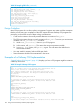
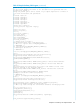
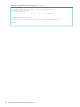
In the following example, the prefixes /WEB and /Images will cause invocation of the Web server
whose domain name is net.myco.com. Similarly the prefixes /samples and /index1.html
will cause invocation of the Web server at IP address 172.16.10.22. RLS will use a different
TCP/IP process to reach each server. The prefix /MlplSrvs can cause invocation of either of two
Web servers, whichever RLS predicts will offer better response time. In this case, the Web servers
are both on the same system (as indicated by their common IP address).
168 Using the Resource Locator Service (RLS)