
Integrated Lights-Out 3 technology




5
Power/fault isolation
The power and fault isolation logic splits iLO 3 into two separate areas: one operating under normal
system power; the other connected to the auxiliary power plane of the server. Even when you power
down the server, iLO 3 continues to operate, although the portions of iLO 3 that communicate with the
system processor are isolated.
Power and fault isolation logic also monitors the system for any unexpected behavior such as a system
power fault or PCI bus fault. iLO 3 records power faults and operates normally on auxiliary power to
provide key functions such as web browser access, alerting, and access to event logs. The power and
fault isolation logic lets iLO 3 or the system processor reset independently of the other. This means that
you can upgrade the iLO 3 firmware without resetting or affecting the server.
Digital Video Redirection (DVR) engine
The iLO first generation processor acquired management console video by monitoring the PCI bus for
data sent to the video controller. That video monitoring process was simple, cost effective, and adequate
for emergency or part-time management console operation.
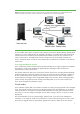
iLO 3 uses a DVR engine for video capture that significantly improves video monitoring performance. The
DVR engine includes a video capture buffer that monitors the digital video output (DVO) of the host video
controller (not the PCI bus). The DVR engine captures the screen image one stripe at a time. The iLO 3
encoding process reviews video characteristics such as changed/unchanged data and
repetition/alternation to compress the video efficiently. Before iLO 3 sends the data over the network to
the remote console, it encrypts and packetizes the video (see Figure 2). With most of the video processing
off-loaded from the management processor, overall performance substantially increases.
Figure 2: Overview of the iLO 3 digital video redirection (DVR) engine operation