
HP iLO 4 Scripting and Command Line Guide
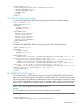
Normally, HP ProLiant Management Agents are used to forward the server name attribute to iLO.
This command can be used in instances where management agents are not used. However, the
host operating system remains unaffected.
GET_SERVER_NAME return message
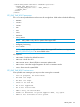
GET_SERVER_NAME returns the currently stored server name, operating system name, and the
operating system version, if available. The server name is a quoted ASCII string and cannot be a
network name.
For example:
<SERVER_NAME VALUE="WIN-DPOHJLI9DO8" />
<SERVER_OSNAME VALUE="Windows Server 2008 R2, x64 Enterprise Edition
Service Pack 1"/>
<SERVER_OSVERSION VALUE="6.1"/>
GET_SERVER_NAME runtime errors
None
SERVER_NAME
The SERVER_NAME command is used to assign the Server Name attribute shown in the user
interface and host RBSU. This setting is not forwarded to the host operating system and does not
affect the host operating system.
You must have the Configure iLO Settings privilege to change this attribute using the scripting
interface. The SERVER_INFO section must be set to WRITE mode or an error is returned.
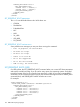
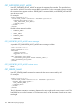
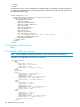
For example:
<RIBCL version="2.0">
<LOGIN USER_LOGIN="Administrator" PASSWORD="password">
<SERVER_INFO MODE="write" >
<SERVER_NAME VALUE = "Exchange05" />
</SERVER_INFO>
</LOGIN>
</RIBCL>
SERVER_NAME parameters
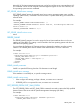
VALUE is a quoted ASCII string less than 50 characters in total length.
SERVER_NAME return message
If this attribute is successfully set, no specific message returns.
SERVER_NAME runtime errors
• If the configure iLO settings privilege is absent, a runtime error is returned.
• If SERVER_INFO is not opened for write, a runtime error is returned.
GET_SERVER_FQDN/GET_SMH_FQDN
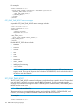
The GET_SERVER_FQDN and GET_SMH_FQDN commands are used to retrieve the fully qualified
domain name of the server and HP System Management Homepage (HP SMH).
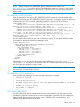
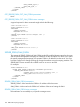
For example:
<RIBCL VERSION="2.0">
<LOGIN USER_LOGIN="adminname" PASSWORD="password">
<SERVER_INFO MODE="read">
SERVER_INFO 157