
Understanding endurance and performance characteristics of HP solid state drives

3
far more prevalent than SLC, but it has a significantly shorter lifespan in terms of erase cycles. Typically,
you can erase and re-write SLC NAND up to 100,000 times before it wears out. MLC NAND comes in
both consumer grade (cMLC) and enterprise grade (eMLC) implementations. You can erase and re-write
eMLC NAND about 30,000 times before it wears out, while cMLC has a lifespan of about 5,000
erase/write cycles. Clearly, the use of MLC or SLC NAND significantly affects the endurance of an
SSD.
Wear–leveling and Over–provisioning
Wear–leveling and over-provisioning are two design technologies that engineers use to increase the
endurance of SSDs.
Wear–leveling works by continuously re-mapping the SSD’s logical blocks to different physical pages in
the NAND array. This helps achieve the goal of evenly distributing NAND block erasures and writes
across the NAND array, preventing the premature wearing out of a NAND block and maximizing the
SSDs endurance. Wear–leveling is a background task that uses SSD controller cycles but remains
invisible to the application reading/writing to the SSD’s SATA or SAS interface.
Over-provisioning the NAND capacity on an SSD also increases SSD endurance. It accomplishes this
by supplying the SSD controller with a larger population of NAND blocks to distribute erases and
writes over time and by providing a larger spare area so that the controller can operate more
efficiently.
Minimizing write amplification
Whenever an SSD executes a write of host data, the SSD controller translates this high-level task into a
series of NAND operations. In each operation, the controller writes the host data to NAND pages. The
controller also performs additional NAND operations to manage and reorganize NAND blocks as
required. Write amplification is a ratio of the total size (in MB) of the NAND data writes executed by
the controller to carry out a given size (also MB) of host data writes. Lower write amplification ratios
are better, and HP strives to maintain lower ratios for its SSDs by using more sophisticated SSD
controller firmware. SSDs with higher write amplification ratios sacrifice performance and endurance
because of their less efficient management of NAND.
Overall SSD endurance
HP uses the technologies we have discussed, as well as others, to produce SSDs with the highest
endurance possible. To provide an array of solid-state storage solutions, we produce SSDs in three
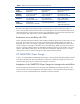
different classes—enterprise value, enterprise mainstream, and enterprise performance. Table 1
summarizes the endurance characteristics for each class.