
An Overview of Analog Dialup Modem Performance, Environments, and Impairments.

REVISED 7/20/98 5
DOC. NUM. PRT/005A/0798
From this model, an industry-standard test method was derived and documented in TIA (Telecom-
munications Industry Association) bulletin TSB-38. Using this type of testing, it is possible to pre-
dict how well a modem may perform over a variety of network conditions, and makes it possible to
perform meaningful comparisons between different modem products. The test consists of estab-
lishing a modem connection over each of the 168 different line conditions, and then measuring the
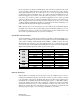
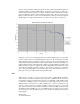
data throughput as a test file is transmitted from one modem to the other. Here is a sample plot:
In this plot, you can see how the throughput steps down as the line impairments grow worse, and the
modems connect at a lower speed and transmit data at a lower rate. By observing the points where
the throughput steps down, a percentage of network coverage at a given speed can be inferred. For
instance, this plot would indicate that the modem would be capable of connecting at 33.6Kbps on a
relatively small percentage of the telephone line conditions present in the PSTN. It should be noted
that this model is not a perfect or complete representation of the PSTN, and actual end-user connect
speeds will vary depending on their line conditions. These results are interpreted to mean that a
given connect speed will be likely over a certain percentage of line conditions taken as a whole – not
that a given connect speed will be possible at any particular location.
SNR
SNR is the ratio of signal to noise, and is expressed in decibels. A high SNR value indicates a
cleaner and more noise-free line. Modems can operate at very low SNR levels, but in order to reach
the maximum possible speed, the phone lines must have a very high SNR – usually 36dBm or better
is required for a 33.6Kbps connection. A typical test for modems being developed is to test the
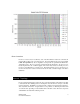
SNR performance of the modem via so-called ‘waterfall curves’. This type of testing forces the
modem to connect at a fixed speed, and then the SNR is varied from a very noisy to a very clean
value, and the performance of the modem is evaluated by measuring the BER, or Bit Error Rate.
The SNR level where the BER drops to zero is the SNR level where the modem is said to be able to
connect and pass error-free data at that given speed. An example of a waterfall plot is given in the
following figure.