
Product manual




WARNING:
When servicing, use only identical Harbor Freight Tools
replacement parts. Use of any other parts may create a
hazard or cause product damage.
WARNING:
Always wear safety goggles or safety glasses with side
shields during power tool operation or when blowing
dust. If operation is dusty, also wear a dust mask.
WARNING:
Always release all pressure, disconnect from power
supply, and allow unit to cool to the touch before
cleaning or making repairs on the air compressor.
MAINTENANCE
GENERAL MAINTENANCE
Humidity in the air causes condensate to form in the air
tank. This condensate should be drained daily and/or
every hour, using the instructions found in Draining the
Tank.
The safety valve automatically releases air if the air
receiver pressure exceeds the preset maximum. Check
the safety valve before each use following the instructions
found in Checking the Safety Valve.
Inspect the tank yearly for rust, pin holes, or other
imperfections that could cause it to become unsafe.
Avoid using solvents when cleaning plastic parts. Most
plastics are susceptible to damage from various types of
commercial solvents and may be damaged by their use.
Use clean cloths to remove dirt, dust, oil, grease, etc.
LUBRICATION
All the bearings in this tool are lubricated with a sufficient
amount of high grade lubricant for the life of the unit
under normal operating conditions. Therefore, no further
lubrication of the bearings is required.
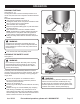
CLEANING THE INTAKE FILTER
The intake filter prevents dust and dirt being drawn in.
It is essential to clean this filter after at least every 100
hours in service. A clogged intake filter will decrease the
compressor’s performance dramatically. Remove the filter
from the compressor and undo the thumb screw on the air
filter. You can then remove the filter from the two halves of
the plastic housing, tap it to remove the dirt, blast it down
with low-pressure compressed air (approx. 3 bar) and re-
insert it.
WARNING:
Do not at any time let brake fluids, gasoline, petroleum-
based products, penetrating oils, etc., come in contact
with plastic parts. Chemical can damage, weaken or
destroy plastic which may result in serious personal
injury. Electric tools used on fiberglass material, wall-
board, spackling compounds, or plaster are subject
to accelerated wear and possible premature failure
because the fiberglass chips and grindings are highly
abrasive to bearings, brushes, commutators, etc.
Consequently, we do not recommend using this tool for
extended work on these type of materials. However, if
you do work with any of these materials, it is extremely
important to clean the tool using compressed air.
Page 14 For technical questions, please call 1-888-866-5797. Item 68066