
Pilot's Guide





Garmin G1000 Pilot’s Guide for the Beechcraft C90A/GT/GTi
190-00663-03 Rev. A342
HAZARD AVOIDANCE
6.2 AIRBORNE COLOR WEATHER RADAR
SYSTEM DESCRIPTION
The Garmin GWX 70 Airborne Color Weather Radar is a solid-state pulsed radar with forty watts of output
power. The radar combines excellent range and adjustable scanning profiles with a high-definition target
display. The GWX 70 has an effective pulse length of 27.31 microseconds (µs), and the system optimizes the
pulse length to maximize resolution at each range setting.
The system uses a 12-inch phased array antenna that is fully stabilized to accommodate 30º of pitch and roll.
To focus radar scanning on specific areas, Sector Scanning offers pilot-adjustable horizontal scan angles. A
vertical scanning function helps to analyze storm tops, gradients, and cell buildup activity at various altitudes.
Radar features include:
• Extended Sensitivity Time Constant (STC) logic that automatically correlates distance of the return echo with
intensity, so cells do not suddenly appear to get larger as they get closer.
• WATCH™ (Weather ATtenuated Color Highlight) helps identify possible shadowing effects of short-range
cell activity, identifying areas where radar return signals are weakened or attenuated by intense precipitation
(or large areas of lesser precipitation) and may not fully reflect the weather behind a storm.
• Weather Alert that looks ahead for intense cell activity in the 80-320 nm range, even if these ranges are not
being monitored.
PRINCIPLES OF PULSED AIRBORNE WEATHER RADAR
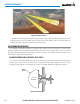
The term RADAR is an acronym for RAdio Detecting And Ranging. Pulsed radar locates targets by transmitting
a microwave pulse beam that, upon encountering a target, is reflected back to the radar receiver as a return
echo. The microwave pulses are focused and radiated by the antenna, with the most intense energy in the
center of the beam and decreasing intensity near the edge. The same antenna is used for both transmitting and
receiving. The G1000 processes the returned signal and displays it on the MFD.
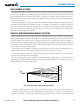
Radar detection is a two-way process that requires 12.36 µs for the transmitted microwave pulses to travel out
and back for each nautical mile of target range. It takes 123.6 µs for a transmitted pulse to make the round trip
if a target is ten nautical miles away.
Airborne weather radar should be used to avoid severe weather, not for penetrating severe weather. The
decision to fly into an area of radar targets depends on target intensity, spacing between the targets, aircraft
capabilities, and pilot experience. Pulse type weather radar detects only precipitation, not clouds or turbulence.
The display may indicate clear areas between intense returns, but this does not necessarily mean it is safe to fly
between them.
Airborne weather radar has other capabilities beyond weather detection. It also has the ability to detect and
provide distance to cities, mountains, coastlines, rivers, lakes, and oceans.
NEXRAD AND AIRBORNE WEATHER RADAR
Both Airborne Weather Radar and NEXRAD measure weather reflectivity in decibels (dB). A decibel is a
logarithmic expression of the ratio of two quantities. Airborne Weather Radar measures the ratio of power
against the gain of the antenna, while NEXRAD measures the energy reflected back to the radar, or the radar
reflectivity ratio.