
User Guide

190-00649-00 Rev. A
Garmin G1000 Pilot’s Guide for the Diamond DA42
2-15
FLIGHT INSTRUMENTS
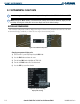
If the NAV radio is the selected bearing source and is tuned to an ILS frequency, the bearing pointer is
removed from the HSI and the frequency is replaced with “ILS”. If the NAV radio is not receiving the tuned
VOR station, the bearing pointer is removed from the HSI and the frequency displayed in the information
window is replaced with “NO DATA”. When NAV1 or NAV2 is the selected bearing source, the frequency is
replaced by the station identifier when the station is within range.
If GPS is the selected bearing source, the active waypoint identifier is displayed in lieu of a frequency. If an
active waypoint is not selected, the bearing pointer is removed from the HSI and “NO DATA” is displayed in
the information window.
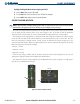
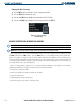
Selecting bearing display and changing sources:
1) Press the PFD Softkey.
2) Press a BRG Softkey to display the desired bearing pointer and information window with a NAV source.
3) Press the BRG Softkey again to change the bearing source to GPS.
4) Select the BRG Softkey a third time to change the bearing source to ADF.
5) To remove the bearing pointer and information window, select the BRG Softkey again
DME INFORMATION WINDOW
NOTE: Refer to the Audio Panel and CNS Section for information on tuning the radios.
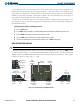
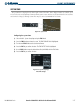
The DME Information Window (Figure 2-22) may be enabled/disabled by pressing the DME Softkey
(a second-level PFD softkey).
The DME Information Window is displayed above the BRG1 Information
Window and shows the DME tuning mode (NAV1, NAV2, or HOLD), frequency, and distance. When a signal
is invalid, the distance is replaced by “–.– – NM”.
Frequency
Tuning Mode
Distance
DME Label
Figure 2-22 HSI with Bearing and DME Information
Bearing 2
Pointer
Bearing 1
Information
Window
Bearing 1
Pointer
Bearing 2
Information
Window
DME
Information
Window
No
Waypoint
Selected
Pointer
Icon
Bearing
Source
Pointer
Icon
Distance to
Bearing Source
Station
Identifier
Bearing
Source