
Managing Faults on Avaya Virtual Services Platform 7200 Series and 8000 Series Version 4.2.1

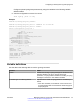
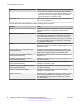
Table Of Contents
- Contents
- Chapter 1: Introduction
- Chapter 2: New in this release
- Chapter 3: Fault management fundamentals
- Chapter 4: Key Health Indicators using ACLI
- Chapter 5: Key Health Indicators using EDM
- Chapter 6: Link state change control using ACLI
- Chapter 7: Link state change control using EDM
- Chapter 8: RMON configuration using ACLI
- Chapter 9: RMON configuration using EDM
- Enabling RMON globally
- Enabling RMON on a port or VLAN
- Enabling RMON1 history
- Disabling RMON1 history
- Viewing RMON1 history statistics
- Creating an RMON1 alarm
- Creating an RMON1 port history alarm
- Viewing RMON1 alarms
- Deleting an RMON1 alarm
- Creating a default RMON1 event
- Creating a nondefault RMON1 event
- Viewing RMON1 events
- Viewing the RMON log
- Deleting an event
- Viewing the protocol directory
- Viewing the data source for protocol distribution statistics
- Viewing protocol distribution statistics
- Viewing the host interfaces enabled for monitoring
- Viewing address mappings
- Viewing the data source for host statistics
- Viewing network host statistics
- Viewing application host statistics
- Chapter 10: Viewing statistics using ACLI
- Chapter 11: Viewing statistics using EDM
- Chapter 12: Log and trap fundamentals
- Chapter 13: Log configuration using ACLI
- Chapter 14: Log configuration using EDM
- Chapter 15: SNMP trap configuration using ACLI
- Chapter 16: SNMP trap configuration using EDM
- Chapter 17: RMON alarm variables
- Glossary

Variable Value
• If the value is circuitless-ip, then for all syslog messages
(in-band or out-of-band), the circuitless IP address is used
in the IP header. If you configure multiple circuitless IPs,
the first circuitless IP configured is used.
max-hosts <1-10> Specifies the maximum number of syslog hosts supported,
from 1–10. The default is 5.
Use the data in the following table to use the syslog host command.
Variable Value
1–10 Creates and configures a host instance. Use the no operator
before this parameter, no syslog host to delete a host
instance.
address WORD <0–46> Configures a host location for the syslog host. WORD <0–
46> is the IPv4 or IPv6 address of the UNIX system syslog
host in the format A.B.C.D or x:x:x:x:x:x:x:x. You can log
system log messages to external system log hosts with both
IPv4 and IPv6 addresses with no difference in functionality
or configuration using ACLI..
enable Enables the syslog host. Use the no operator before this
parameter, no syslog host enable to disable syslog host. The
default is disabled.
facility {local0|local1|local2|local3|local4|
local5|local6|local7}
Specifies the UNIX facility in messages to the syslog host.
{local0|local1|local2|local3|local4|local5|local6|local7} is the
UNIX system syslog host facility. The default is local7.
maperror {emergency|alert|critical|error|
warning|notice|info|debug}
Specifies the syslog severity to use for error messages. The
default is error.
mapfatal {emergency|alert|critical|error|
warning|notice|info|debug}
Specifies the syslog severity to use for fatal messages. The
default is emergency.
mapinfo {emergency|alert|critical|error|
warning|notice|info|debug}
Specifies the syslog severity level to use for information
messages. The default is info.
mapwarning {emergency|alert|critical|error|
warning|notice|info|debug}
Specifies the syslog severity to use for warning messages.
The default is warning.
severity <info|warning|error|fatal> Specifies the severity levels for which to send syslog
messages. The default is info.
udp-port <514-530> Specifies the User Datagram Protocol port number on which
to send syslog messages to the syslog host. This value is
the UNIX system syslog host port number from 514–530.
The default is 514.
Log configuration using ACLI
84 Managing Faults on Avaya VSP 7200 Series and 8000 Series June 2015
Comments on this document? infodev@avaya.com