
Admin Guide
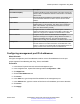




Table Of Contents
- Contents
- Chapter 1: Introduction
- Chapter 2: New in this release
- Chapter 3: Basic administration
- Chapter 4: System startup fundamentals
- Chapter 5: Boot parameter configuration using ACLI
- Chapter 6: Run-time process management using ACLI
- Chapter 7: Chassis operations
- Chassis operations fundamentals
- Chassis operations configuration using ACLI
- Enabling jumbo frames
- Configuring port lock
- Configuring SONMP
- Viewing the topology message status
- Associating a port to a VRF instance
- Configuring an IP address for the management port
- Configuring Ethernet ports with Autonegotiation
- Enabling channelization
- Configuring serial management port dropping
- Controlling slot power
- Chassis operations configuration using EDM
- Editing system information
- Editing chassis information
- Configuring system flags
- Configuring channelization
- Configuring basic port parameters
- Viewing the boot configuration
- Configuring boot flags
- Enabling Jumbo frames
- Configuring the date and time
- Associating a port to a VRF instance
- Configuring CP Limit
- Configuring an IP address for the management port
- Editing the management port parameters
- Configuring the management port IPv6 interface parameters
- Configuring management port IPv6 addresses
- Auto reactivating the port of the SLPP shutdown
- Editing serial port parameters
- Enabling port lock
- Locking a port
- Viewing power information
- Viewing power status on VSP 8400
- Viewing fan information
- Viewing topology status information
- Viewing the topology message status
- Configuring a forced message control pattern
- Chapter 8: Hardware status using EDM
- Chapter 9: Domain Name Service
- Chapter 10: Licensing
- Chapter 11: Network Time Protocol
- Chapter 12: Secure Shell
- Chapter 13: System access
- System access fundamentals
- System access configuration using ACLI
- Enabling ACLI access levels
- Changing passwords
- Configuring an access policy
- Specifying a name for an access policy
- Allowing a network access to the switch
- Configuring access policies by MAC address
- System access security enhancements using ACLI
- Displaying the boot config flags status
- Enabling enhanced secure mode
- Creating accounts for different access levels
- Deleting accounts in enhanced secure mode
- Configuring a password for a specific user
- Returning the system to the factory defaults
- Configuring the password complexity rule
- Configuring the password length rule
- Configuring the change interval rule
- Configuring the reuse rule
- Configuring the maximum number of sessions
- Configuring the maximum age rule
- Configuring the pre- and post-notification rule
- System access configuration using EDM
- Chapter 14: ACLI show command reference
- Access, logon names, and passwords
- Basic switch configuration
- Current switch configuration
- CLI settings
- Ftp-access sessions
- Hardware information
- NTP server statistics
- Power summary
- Power information for power supplies
- System information
- System status (detailed)
- Telnet-access sessions
- Users logged on
- Port egress COS queue statistics
- CPU queue statistics
- Chapter 15: Port numbering and MAC address assignment reference
- Chapter 16: Supported standards, RFCs, and MIBs
- Glossary

Name Description
NmmLstChg Specifies the value of sysUpTime, the last time an entry in the network
management MIB (NMM) topology table was added, deleted, or modified, if
the table did not change since the last cold or warm start of the agent.
NmmMaxNum Specifies the maximum number of entries in the NMM topology table.
NmmCurNum Specifies the current number of entries in the NMM topology table.
Viewing the topology message status
About this task
View topology message status to view the interconnections between Layer 2 devices in a network.
Procedure
1. In the navigation tree, open the following folders: Configuration > Edit > Diagnostics.
2. Click Topology.
3. Click the Topology Table tab.
Topology Table field descriptions
Use the data in the following table to use the Topology Table tab.
Name
Description
Slot Specifies the slot number in the chassis that received the topology
message.
Port Specifies the port that received the topology message.
SubPort Specifies the channel of a channelized 40 Gbps port that received the
topology message.
IpAddr Specifies the IP address of the sender of the topology message.
SegId (RemPort) Specifies the segment identifier of the segment from which the remote
agent sent the topology message. This value is extracted from the
message.
MacAddr Specifies the MAC address of the sender of the topology message.
ChassisType Specifies the chassis type of the device that sent the topology message.
BkplType Specifies the backplane type of the device that sent the topology message.
Avaya Virtual Services Platform uses a backplane type of 12.
LocalSeg Indicates if the sender of the topology message is on the same Ethernet
segment as the reporting agent.
CurState Specifies the current state of the sender of the topology message. The
choices are
• topChanged—Topology information recently changed.
Table continues…
Chassis operations configuration using EDM
October 2015 Administering Avaya VSP 7200 Series and 8000 Series 107
Comments on this document? infodev@avaya.com