
Admin Guide


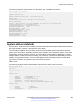

Table Of Contents
- Contents
- Chapter 1: Introduction
- Chapter 2: New in this document
- Chapter 3: Basic administration
- Chapter 4: System startup fundamentals
- Chapter 5: Boot parameter configuration using ACLI
- Chapter 6: Run-time process management using ACLI
- Chapter 7: Chassis operations
- Chassis operations fundamentals
- Chassis operations configuration using ACLI
- Enabling jumbo frames
- Configuring port lock
- Configuring SONMP
- Viewing the topology message status
- Associating a port to a VRF instance
- Configuring an IP address for the management port
- Configuring Ethernet ports with Autonegotiation
- Enabling channelization
- Configuring serial management port dropping
- Controlling slot power
- Enabling or disabling the USB port
- Chassis operations configuration using EDM
- Editing system information
- Editing chassis information
- Configuring system flags
- Configuring channelization
- Configuring basic port parameters
- Viewing the boot configuration
- Configuring boot flags
- Enabling Jumbo frames
- Configuring the date and time
- Associating a port to a VRF instance
- Configuring CP Limit
- Configuring an IP address for the management port
- Editing the management port parameters
- Configuring the management port IPv6 interface parameters
- Configuring management port IPv6 addresses
- Auto reactivating the port of the SLPP shutdown
- Editing serial port parameters
- Enabling port lock
- Locking a port
- Viewing power information
- Viewing power status on VSP 8400
- Viewing fan information
- Viewing topology status information
- Viewing the topology message status
- Configuring a forced message control pattern
- Chapter 8: Hardware status using EDM
- Chapter 9: Domain Name Service
- Chapter 10: Licensing
- Chapter 11: Network Time Protocol
- Chapter 12: Secure Shell
- Secure Shell fundamentals
- Secure Shell configuration using ACLI
- Downloading the software
- Enabling the SSHv2 server
- Changing the SSH server authentication mode
- Setting SSH configuration parameters
- Verifying and displaying SSH configuration information
- Connecting to a remote host using the SSH client
- Generating user key files
- Managing an SSL certificate
- Disabling SFTP without disabling SSH
- Enabling SSH rekey
- Configuring SSH rekey data-limit
- Configuring SSH rekey time-interval
- Displaying SSH rekey information
- Downgrading or upgrading from releases that support different key sizes
- Secure Shell configuration using Enterprise Device Manager
- Chapter 13: System access
- System access fundamentals
- System access configuration using ACLI
- Enabling ACLI access levels
- Changing passwords
- Configuring an access policy
- Specifying a name for an access policy
- Allowing a network access to the switch
- Configuring access policies by MAC address
- System access security enhancements
- Displaying the boot config flags status
- Enabling enhanced secure mode
- Creating accounts for different access levels
- Deleting accounts in enhanced secure mode
- Configuring a password for a specific user
- Returning the system to the factory defaults
- Configuring the password complexity rule
- Configuring the password length rule
- Configuring the change interval rule
- Configuring the reuse rule
- Configuring the maximum number of sessions
- Configuring the maximum age rule
- Configuring the pre- and post-notification rule
- System access configuration using EDM
- Chapter 14: ACLI show command reference
- Access, logon names, and passwords
- Basic switch configuration
- Current switch configuration
- CLI settings
- Ftp-access sessions
- Hardware information
- NTP server statistics
- Power summary
- Power information for power supplies
- System information
- System status (detailed)
- Telnet-access sessions
- Users logged on
- Port egress COS queue statistics
- CPU queue statistics
- Chapter 15: Port numbering and MAC address assignment reference
- Chapter 16: Supported standards, RFCs, and MIBs
- Glossary

H/W Config : none
NumSlots : 1
NumPorts : 50
BaseMacAddr : 24:d9:21:e2:e0:00
MacAddrCapacity : 256
--More-- (q = quit)
Telnet-access sessions
Use the show telnet-access command to display to show the total sessions allowed. The
syntax for this command is as follows.
show telnet-access
The following example shows output from the show telnet-access command.
Switch:1#show telnet-access
max ipv4 sessions : 8
Users logged on
Use the show users command to display a list of users currently logged on to the system. The
syntax for this command is as follows.
show users
The following example shows output from the show users command.
Switch:1#show users
SESSION USER ACCESS IP ADDRESS
Telnet0 rwa rwa 192.0.2.24 (current)
Console none ----------
Port egress COS queue statistics
Use the show qos cosq-stats interface <PT_PORT> to retrieve the port egress COS queue
statistics. The syntax for this command is as follows:
show qos cosq-stats interface <PT_PORT>
The following example shows output from the show qos cosq-stats interface <PT_PORT>
command.
Switch:1#show qos cosq-stats interface 1/42
================================================================================
ACLI show command reference
January 2017 Administering Avaya VSP 7200 Series and 8000 Series 230
Comments on this document? infodev@avaya.com