
Admin Guide
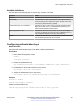




Table Of Contents
- Contents
- Chapter 1: Introduction
- Chapter 2: New in this document
- Chapter 3: Basic administration
- Chapter 4: System startup fundamentals
- Chapter 5: Boot parameter configuration using ACLI
- Chapter 6: Run-time process management using ACLI
- Chapter 7: Chassis operations
- Chassis operations fundamentals
- Chassis operations configuration using ACLI
- Enabling jumbo frames
- Configuring port lock
- Configuring SONMP
- Viewing the topology message status
- Associating a port to a VRF instance
- Configuring an IP address for the management port
- Configuring Ethernet ports with Autonegotiation
- Enabling channelization
- Configuring serial management port dropping
- Controlling slot power
- Enabling or disabling the USB port
- Chassis operations configuration using EDM
- Editing system information
- Editing chassis information
- Configuring system flags
- Configuring channelization
- Configuring basic port parameters
- Viewing the boot configuration
- Configuring boot flags
- Enabling Jumbo frames
- Configuring the date and time
- Associating a port to a VRF instance
- Configuring CP Limit
- Configuring an IP address for the management port
- Editing the management port parameters
- Configuring the management port IPv6 interface parameters
- Configuring management port IPv6 addresses
- Auto reactivating the port of the SLPP shutdown
- Editing serial port parameters
- Enabling port lock
- Locking a port
- Viewing power information
- Viewing power status on VSP 8400
- Viewing fan information
- Viewing topology status information
- Viewing the topology message status
- Configuring a forced message control pattern
- Chapter 8: Hardware status using EDM
- Chapter 9: Domain Name Service
- Chapter 10: Licensing
- Chapter 11: Network Time Protocol
- Chapter 12: Secure Shell
- Secure Shell fundamentals
- Secure Shell configuration using ACLI
- Downloading the software
- Enabling the SSHv2 server
- Changing the SSH server authentication mode
- Setting SSH configuration parameters
- Verifying and displaying SSH configuration information
- Connecting to a remote host using the SSH client
- Generating user key files
- Managing an SSL certificate
- Disabling SFTP without disabling SSH
- Enabling SSH rekey
- Configuring SSH rekey data-limit
- Configuring SSH rekey time-interval
- Displaying SSH rekey information
- Downgrading or upgrading from releases that support different key sizes
- Secure Shell configuration using Enterprise Device Manager
- Chapter 13: System access
- System access fundamentals
- System access configuration using ACLI
- Enabling ACLI access levels
- Changing passwords
- Configuring an access policy
- Specifying a name for an access policy
- Allowing a network access to the switch
- Configuring access policies by MAC address
- System access security enhancements
- Displaying the boot config flags status
- Enabling enhanced secure mode
- Creating accounts for different access levels
- Deleting accounts in enhanced secure mode
- Configuring a password for a specific user
- Returning the system to the factory defaults
- Configuring the password complexity rule
- Configuring the password length rule
- Configuring the change interval rule
- Configuring the reuse rule
- Configuring the maximum number of sessions
- Configuring the maximum age rule
- Configuring the pre- and post-notification rule
- System access configuration using EDM
- Chapter 14: ACLI show command reference
- Access, logon names, and passwords
- Basic switch configuration
- Current switch configuration
- CLI settings
- Ftp-access sessions
- Hardware information
- NTP server statistics
- Power summary
- Power information for power supplies
- System information
- System status (detailed)
- Telnet-access sessions
- Users logged on
- Port egress COS queue statistics
- CPU queue statistics
- Chapter 15: Port numbering and MAC address assignment reference
- Chapter 16: Supported standards, RFCs, and MIBs
- Glossary

• VSP 7200
• VSP 9000
Outbound connections
The SSHv2 client supports SSHv2 DSA public key authentication and password authentication.
Note:
You must enable SSH globally before you can generate SSH DSA user keys.
The SSHv2 client is a secure replacement for outbound Telnet. Password authentication is the
easiest way to use the SSHv2 client feature.
Instead of password authentication, you can use DSA public key authentication between the VSP
SSHv2 client and an SSHv2 server. Before you can perform a public key authentication, you must
generate the key pair files and distribute the key files to all the SSHv2 server systems. Because
passphrase encrypts and further protects the key files, you must provide a passphrase to decrypt
the key files as part of the DSA authentication.
To attempt public key authentication, the SSHv2 client looks for the associated DSA key pair files in
the /intflash/.ssh directory. If no DSA key pair files are found, the SSHv2 client automatically
prompts you for password authentication. If the SSHv2 client succeeds with the authentication, then
a new secured SSHv2 session is established to the remote SSHv2 server. For more information,
see
Table 38: DSA authentication access level and file name on page 156.
Important:
If you configure the DSA user key with a passphrase but you do not supply the correct passphrase
when you try to make the SSHv2 connection, then the system defaults back to the password
authentication. If the SSHv2 client succeeds with the authentication, then a new secured SSHv2
session is established to the remote SSHv2 server.
SSH version 2
SSH version 2 (SSHv2) protocol is a complete rewrite of the SSHv1 protocol. In SSHv2 the
functions are divided among three layers:
• SSH Transport Layer (SSH-TRANS)
The SSH Transport Layer manages the server authentication and provides the initial
connection between the client and the server. Once the connection is established, the
Transport Layer provides a secure, full-duplex connection between the client and server.
• SSH Authentication Protocol (SSH-AUTH)
The SSH Authentication Protocol runs on top of the SSH Transport Layer and authenticates
the client-side user to the server. SSH-AUTH defines three authentication methods: public key,
host-based, and password. SSH-AUTH provides a single authenticated tunnel for the SSH
connection protocol.
• SSH Connection Protocol (SSH-CONN)
The SSH Connection Protocol runs on top of the SSH Transport Layer and user authentication
protocols. SSH-CONN provides interactive logon sessions, remote execution of commands,
forwarded TCP/IP connections, and forwarded X11 connections. These services are
multiplexed into the single encrypted tunnel provided by the SSH transport layer.
The following figure shows the three layers of the SSHv2 protocol.
Secure Shell
January 2017 Administering Avaya VSP 7200 Series and 8000 Series 150
Comments on this document? infodev@avaya.com