
Service manual

LTR-NET OVERVIEW
6-5
November 2001
Part No. 001-7240-001
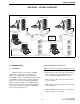
6.2.5 CALL PROCESSOR
The Call Processor is a Windows NT-based
personal computer running switch management soft-
ware. The Call Processor serves as an interface
between the switch and the System and Subscriber
Manager (see next section). It contains the database
used to process calls on the switch and also logs call
information from the switch. The Call Processor
performs such tasks as processing wide area calls,
subscriber unit registration, and Interrogate and Reas-
sign requests. One Call Processor is required per
switch, and it is connected to the switch by two 19,200
baud data links.
6.2.6 SYSTEM AND SUBSCRIBER MANAGER
The System and Subscriber Manager (SSM) is
also a Windows NT-based personal computer. It runs
the software which provides overall system control.
One or more SSMs may be used to control the system.
This allows, for example, the system administrator to
have overall system control and then permit other
operators limited control privileges. Access is by pass-
word only, and only functions authorized to a partic-
ular user can be accessed. This ensures that only
authorized personnel can modify and monitor system
resources.
Some SSM functions are as follows:
• Set up and authorize auxiliary and telephone inter-
connect calls on a unique ID basis. Also authorize
group calls on a locality/home/group basis.
• Track the location of individual LTR-Net subscriber
units by unique ID.
• Control wide area auxiliary calls by unique ID.
• Track wide area group calls by locality/home/group
or unique ID.
• Set up command calls such as Reassign, Interrogate,
Mobile Disable, and others.
• Monitor and display information on system activity.
• Record information on individual subscriber unit
system usage in a standard database format. This
information can then be exported and used by
billing software to generate customer billing.
6.3 STANDARD GROUP CALLS
Standard group calls are between subscriber units
at the same locality and use ID codes 1-239 that are
assignable on each home repeater. A group ID can be
assigned to one subscriber unit or a group of
subscriber units as desired. To place a standard group
call, all the user does is select the group programmed
for the group being called and press the PTT switch.
No number is dialed using a DTMF keypad as with
special calls described in Section 6.5.
Selectable groups used to make standard group
calls are programmed with a group ID code, and the
selectable system is programmed with a home repeater
number. This home repeater/ID code form the
“address” of the group call. Since each selectable
system can be programmed with a different home
repeater, standard group calls can be placed to any
group in a locality.
Standard group calls hold a repeater for only the
duration of a transmission, not for the entire call. This
provides maximum system efficiency because the time
between transmissions can be used by others.
6.4 WIDE AREA GROUP CALLS
The wide area group calling feature allows stan-
dard group calls from LTR or LTR-Net subscriber
units to be routed to any locality in the LTR-Net
system.
Specific locality/home/group ID combinations
can be programmed in the SSM (see Section 6.2.6) for
wide area calls. Then when a standard group call is
detected on one of these combinations, it is automati-
cally routed to the specified localities as well as occur-
ring on the home locality. The home/group can be
different on each wide area locality if desired.
Each wide area locality/home/group involved in a
wide area call can be programmed as follows:
• The call is always routed to the specified locality,
home, and group (if resources are available).