
Service manual

LTR-NET OVERVIEW
6-3
November 2001
Part No. 001-7240-001
• Typical access time for group calls is the same as
with LTR operation.
• Priority access, automatic emergency calls, status
messaging, and system security keys are not
available.
6.1.4 DEFINITIONS
The following are some terms that are used
frequently when describing LTR-Net operation:
Group
- A subscriber unit has selectable systems and
groups. Each system can have several groups. The
group selects the call type and the subscriber unit or
units which receive the call. Refer to Section 2.3.12
for more information.
Home Repeater
- Each selectable system of LTR and
LTR-Net subscriber units has one of the locality
repeaters assigned as their “home” repeater. This is the
repeater from which “free” and “channel-in-use”
information is received (see Section 6.6). In addition,
with standard group calls, the home repeater number
and a group ID form the “address” of the recipient of a
call.
Locality
- A group of co-located repeaters typically
connected by a common data bus. Refer to Sections
6.2.3 and 2.3.12 for more information.
LTR Signaling
- This popular EFJohnson radio
trunking system provides the basis for the LTR-Net
system. For a complete description of LTR trunking,
refer to the LTR Application Note, Part No. 009-0001-
002, Revision 8 or later.
Mobile
- A transceiver mounted in a vehicle. This term
may also be used generically to refer to any trans-
ceiver, either mobile or portable, since both operate
basically the same. See also “Subscriber Unit”.
Portable
- A small handheld transceiver usually battery
powered and carried by a person. See also “Subscriber
Unit”.
Site
- See “Locality”.
Status Repeater
- The repeater at a locality designated
to provide home channel backup. It transmits call
information for all subscriber units on that locality.
Refer to Section 6.6 for more information.
System, Radio
- This refers to the radio equipment and
other infrastructure that is accessed when a call is
placed.
System, Selectable
- A subscriber unit has selectable
systems and groups. Each selectable system consists
or one or more groups and is programmed with a
unique home repeater (see Section 2.3.12 for more
information). A radio system refers to the radio equip-
ment that is accessed when calls are placed.
Subscriber Unit
- A generic term referring to both the
mobile and portable transceivers being used in the
radio system.
Trunked Radio System
- A radio system which utilizes
multiple radio channels and automatic channel
switching to allow all users equal access to any
channel not in use. This results in minimum waiting to
make a call and maximum utilization of the available
radio channels.
Unique ID
- A unique number from 1-65503 assigned
to each subscriber unit. Although this number is
assignable on a per locality basis, the same number is
typically assigned on each locality a subscriber unit
can access.
6.2 SYSTEM ARCHITECTURE
6.2.1 INTRODUCTION
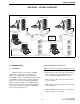
A diagram of a typical LTR-Net system is shown
in Figure 6-1. The number or localities, repeaters per
locality, number of 3000-series switches, and other
system parameters are determined by the require-
ments of the particular system. The following is more
information on the components shown in Figure 6-1.
6.2.2 SUBSCRIBER UNITS
Subscriber units operating in an LTR-Net locality
must be the LTR-Net or LTR type. They may be the
mounted in a vehicle (mobiles) and or carried
(portables). The features available with each type are
as follows: