
Service manual


OPERATION
2-19
November 2001
Part No. 001-7240-001
can be programmed as not interruptible. This has the
same affect as programming it with a “1” priority.
However, if this was done instead of programming it
as not interruptible, calls on that group would interrupt
all other lower priority calls which may not be
desirable.
The transceiver displays the system and group of
the priority call while it is being received. The
programming of the “Scan Revert Mode” parameter
(see Section 2.6.10) determines if the change to the
priority group is temporary or permanent and if a
transmission occurs on the priority group.
With LTR-Net operation, incoming call informa-
tion is received on the repeater to which a mobile is
trunked as well as the home and status repeaters.
Therefore, priority calls are detected when the trans-
ceiver is trunked to other repeaters.
With LTR operation, incoming call information is
received on only the home repeater. Therefore, priority
calls are not detected while trunked to some other
repeater. To reach most mobiles with a priority
message in this case, the operator can key the trans-
mitter and then not begin speaking for several seconds.
This allows trunked-out mobiles time to finish the
transmission and return to the home repeater.
This operation still may not reach mobiles
making telephone calls because they hold a repeater
for the duration of a conversation (instead of the dura-
tion of the transmission as with dispatch calls). Other
times when priority calls could be missed with both
types of operation are when transmitting and when
some other system not programmed with the priority
ID is being monitored.
2.8.3 BLOCK ID CODES AND ACCESS
PRIORITY
This transceiver does not use blocks of ID codes.
However, with up to 99 groups programmable per
system and group scanning, it is usually possible to
program the transceiver to receive all desired calls.
Access priority to control which transceivers can
access the system during busy periods is not available
with this transceiver (all transceivers have equal
access). The preceding section describes receive
priority which controls what calls are received.
2.8.4 TRANSMIT INHIBIT
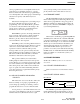
The Transmit Inhibit feature prevents the trans-
mitter from keying if the mobile being called is busy
with a call not programmed for any group position.
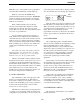
When the transmitter is disabled by this feature, the
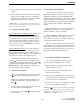
intercept tone sounds and “TX INHIB” is displayed
(see following illustration).
This feature is enabled by programming LTR-Net
and LTR systems with a block of transmit inhibit ID
codes that can include all 239 or 250. If a code within
this block is detected up to 5 seconds before the PTT
switch is pressed, the transmitter is disabled as just
described. Even though the 5-second timer counts
down while the PTT switch is pressed, it is not
possible to access the system without first releasing
the PTT switch. A similar Transmit Disable On Busy
feature is available on conventional systems (see
Section 2.11.3).
2.9 LTR-NET FEATURES
NOTE: Other LTR-Net features are described in
Section 2.8.
2.9.1 LTR-NET STANDARD CALLS
Refer to Section 2.8.1 for information on these
calls.
2.9.2 LTR-NET SPECIAL CALLS
Introduction
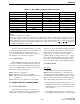
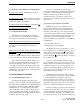
The LTR-Net special calls originated by the
mobile include Telephone and Auxiliary as shown
above. Most other special calls such as Interrogate,
Special
Telephone
Auxiliary
Directed Group
Unique ID