
Reference Guide


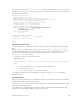

7. Create a service class and associate the threshold weight of the shared buffer with each of the
queues per port in the egress direction.
INTERFACE mode
Dell(conf-if-te-0/8)#Service-class buffer shared-threshold-weight queue5 4
queue7 6
Classifying Layer 2 Traffic on Layer 3 Interfaces
To process Layer 3 packets that contain Dot1p — (IEEE 802.1p) Packet classification (Layer 2 headers),
configure VLAN tags on a physical Layer 3 interface (that is configured with an IP address and is not
associated with any VLAN). You can also configure a VLAN subinterface over a physical underlying
interface and classify packets using the dot1p value.
To apply an input policy map to Layer 3 physical interfaces, use the service-policy input policy-
name layer 2 command in Interface Configuration mode.
To apply a Layer 2 policy on Layer 3 interfaces, perform the following:
1. Configure an interface with an IP address or a VLAN subinterface
CONFIGURATION mode
Dell(conf)# int fo 0/0
INTERFACE mode
Dell(conf-if-fo-0/0)# ip address 90.1.1.1/16
2. Configure the Layer 2 policy with Layer 2 (Dot1p or source MAC-based) classification rules.
CONFIGURATION mode
Dell(conf)# policy-map-input l2p layer2
3. Apply the Layer 2 policy on the Layer 3 interface.
INTERFACE mode
Dell(conf-if-fo-0/0)# service-policy input l2p layer2
Managing Hardware Buffer Statistics
Bufffer statistics tracking utility is supported on the S6000 platform.
The memory management unit (MMU) on S6000 platform is 12.2 MB in size. It contains approximately
60,000 cells, each of which is 208 bytes in size. MMU also has another portion of 3 MB allocated to it.
The entire MMU space is shared across a maximum of 104 logical ports to support the egress admission-
control functionality to implement scheduling and shaping on per-port and per-queue levels. Also, the
MMU buffer cells can be used by each port or queue either as a static partition or as a dynamic partition.
With dynamic mode, you can specify the percentage of available buffer that is utilized by a queue. This
dynamic partition or block is set to be two-thirds of the available buffers for all unicast queues and one-
fifth of the available buffers for all multicast queues on these platforms.
The maximum number of ports, including fan-out, supported is 104 and the maximum number of queues
supported is 21. Analyzing and evaluating buffer statistics enables monitoring of resources and tuning of
allocation of buffers. Max Use count mode provides the maximum values of counters accumulated over a
Quality of Service (QoS)
711