
User manual





Preventive Maintenance
ProMaster 2500 User Manual 5-19
Programming
Electronics Boards
and Assemblies
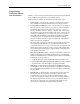
The PE is composed of two main units that are mounted on the underside
of the handler’s main plate at the programming station.
The PE’s major assemblies are described in the following section.
•
Power Supply
—The input AC generates +15V DC that is routed to
the controller/waveform board’s internal power supply circuits.
•
Controller/waveform Board
—Uses +15V (from the power supply) to
generate a precise +10V reference. This reference acts as an input to
12-bit DACs that help generate numerous voltages (+/- 5V DC, +/-
8V DC, +10V REF, +13V DC, -15V DC, +25V DC, and +36V DC) for
use primarily on the pin driver board(s). The center of the controller
circuitry is a 68000 microprocessor that controls system operation
using 64K of Flash EPROM, system RAM, and 8 MB of user RAM.
Two RS-232C ports are located on this board and use the PE’s
SmartPort software feature to toggle the cables DTE and DCE lines
until a connection is established.
The floppy disk controller provides the signal interface between the
main system and the disk drive. A special circuit called the pin
control unit (PCU) acts as a coprocessor that controls read/write and
timing signals to the pin driver boards. A 68-pin and a 50-pin cable
carry control signals and supply voltages from the control unit base
to the pin driver board(s).
•
Mass Storage Module
(MSM) — The internal hard drive. Under the
default configuration for the 2500, algorithm files are automatically
installed on the MSM when you update system software. The MSM is
partitioned into 4 logical drives:
•
User data drives C
and
D:
31MB and 512 maximum files each.
•
System data drives H
and
I
: 7MB and 10MB respectively with 320
maximum files each. Reserved for operating system files.
•
Disk Drive
—Double-sided, quad-density (1.44 MB formatted), 3.5-
inch disk drive reads the PE system disk to load updated commands
into system RAM and the MSM. It can also be used to load data files
into user RAM.
•
Relay Board
—Controls the flow of signals between the controller/
waveform board and the pin driver board(s). Cables from the
controller unit connect to the pin driver head through the relay
board. These signals are routed to the pin driver board(s) and then
through the relay board to the device to be programmed. Relays on
this board are energized to provide hard V
CC
and GND levels to
device pins as required by the programming algorithm.