
Datasheet






4.3. Sonar Board
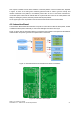
The Sonar Board, depicted in Figure 13, will be used to control the firing of up to 16 sonars. This
board is connected to the Sensor&Management Board through an I2C connection. The information
provided from this board can be used to create low-level behaviours, for example reducing the
velocity of the robot in the presence of an obstacle.
The system uses the SRM400 sonar transducers that are able to detect an obstacle at a distance of
up to 2 m.
The board design allows the users to configure the sonar sampling and also to connect or disconnect
the sonar readings or power.
Some of the modes that can be used allow the individual fire and reading of all or some of the sonars
or the fire of all the sonars at the same time and the individual reading making a radar-like sensor.
4.4. Charger Docking Station
One important capability of the robot is the possibility to work without human intervention. To achieve
this point the robot must be able to manage the onboard power and autonomously charge itself. One
charger docking station is being developed and to be installed in a service area, where the robot can
enter and plug itself in. This docking station will provide the necessary power that the onboard battery
charger needs to charge the batteries. The Docking Station is a passive power station: control of the
charging process is managed by the onboard Sensor&Charger Board. The Docking Station will be
equipped with a 480W switch mode power supply able to power all the onboard equipment and at the
same time provide about 2,.5A of current for each of the 8 battery chargers.
FROG – FP7 STREP nr. 288235
Deliverable: D1.4 – Platform User and Developer Manual 22
Figure 13: Sonar Processor Board
Figure 14: FROG Docking Station