
User guide





8 Document No. 001-64846 Rev. *A Getting Started with CapSense®
2. CapSense Technology
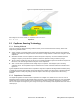
Cypress’s CapSense controllers use changes in capacitance to detect the presence of a finger on or near a touch
surface, as shown in Figure 2-1. This capacitive sensor example illustrates a touch sensor replacement for a
mechanical button. This sensing function is achieved using a combination of hardware and firmware. The following
section provides an overview of capacitive sensing technology and CapSense solutions.
Figure 2-1. Illustration of a Capacitance Sensor Application
2.1 Capacitive Sensing Methods
Capacitance can be measured between two points using either self capacitance or mutual capacitance.
Figure 2-2. Self-Capacitance and Mutual-Capacitance Methods
Z
V
x
+
_ C
x
Self Capacitance
Tx Rx
V
1
+
_
Mutual Capacitance
C
x
V
2
+
_
I
2.1.1 Self Capacitance
Self capacitance uses a single pin and measures the capacitance between that pin and ground. A self-capacitance
sensing system operates by driving current on a pin connected to a sensor and measuring the voltage. When a finger
is placed on the sensor it increases the measured capacitance. The self-capacitance effect is best suited for single-
touch sensors, such as buttons and sliders
Cypress’s CapSense solutions use self-capacitance sensing. This approach makes more efficient use of pins for
single touch sensors and sliders.