
User guide





44 Document No. 001-64846 Rev. *A Getting Started with CapSense®
3.4.5 Event Based Filter
Event-based filters involve a special filtering method where a pattern observed in the sensor data causes a
predefined response in the CapSense system. The pattern in the data is triggered by an event, such as a handheld
product being placed into a pocket, or V
dd
2.4.1 Signal-to-Noise Ratio (SNR)
dropping suddenly in a camera phone when the camera flash circuit is
being charged. One common response used with event-based filter is to block CapSense data transmission until the
pattern returns to normal. Another common response is to reset the level of the Baseline reference defined in section
.
3.4.6 Rule Based Filter
Rule-based filters are another special filtering method where a pattern observed in the sensor data causes a rule-
based response in the CapSense system. Unlike the event-based filter, the rule-based filter acts on patterns in the
sensor data that are encountered during normal operation of the touch surface. The rule-based filter takes into
account special scenarios on how sensors will be used. For example, with a set of radio channel selection buttons,
two buttons can be pressed accidentally, but only one should be selected. The rule-based filter will sort out this kind
of situation in a predefined way.
3.5 Power Consumption
Minimizing power consumption is an important design goal. For many CapSense systems extending battery life is
critical to the success of the product. In systems that do not utilize batteries, power consumption still plays a role in
optimizing power supply designs in order to reduce costs and PCB area.
3.5.1 Active and Sleep Current
Active current is the current consumed by the device when all selected analog and digital blocks are enabled and the
CPU is running. In typical applications, the CapSense controller does not need to be in the active state all the time.
The device can be put into the sleep state to stop the CPU and the major blocks of the device. Current consumed by
the device in sleep state is called sleep current. Sleep current is much lower than the active current.
3.5.2 Average Current
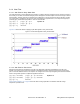
In typical applications, sleep state can be invoked periodically to reduce power consumption. This means that during
a preset time period, the CapSense controller wakes up from sleep state, performs all necessary operations in the
active state (scan all sensors, update all baselines, check if any sensor is in the TOUCH state, etc), and then returns
to sleep state. The resulting instantaneous current graph is shown in Figure 3-22.
Figure 3-22. Instantaneous Current
I(t)
t
I
Act
I
Slp
t
Act
t
Slp
T
Where:
I(t) = Instantaneous current
I
Act
I
= Active current
Slp
t
= Sleep current
Act
t
= Active time
Slp
T = Time period of a cycle
= Sleep time