
User guide




14 Document No. 001-64846 Rev. *A Getting Started with CapSense®
2.4.1 Signal-to-Noise Ratio (SNR)
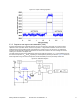
Figure 2-10. Signal and Noise
One of the main goals of tuning a CapSense system is to reliably discriminate between TOUCH and NO TOUCH
sensor states. The signal is the change in the sensor response when a finger is placed on the sensor. The change in
the sensor response refers to a trend in the raw counts called the Baseline. This reference level is continuously
updated when a finger is not on the sensor. For the signal-to-noise measurement, the Baseline reference level is the
average raw count level with no finger present. For the purpose of signal-to-noise ratio calculation, the noise is the
peak-to-peak variation in the sensor response when a finger is not present (internal noise). There is also noise
present when a finger touches the sensor surface, but this is a combination of internal noise and noise injected via
the finger. The noise introduced by the finger can affect the performance of the sensor, but, by definition, it is not part
of the signal-to-noise ratio calculation. For reliable CapSense performance, signal strength needs to be significantly
larger than noise. Figure 2-10 shows an example of signal and noise levels using real sensor data. In this example,
the signal is a 135 count difference and the noise is a 27 count difference, so the signal-to-noise ratio (SNR) is
135:27, or 5:1.
2.4.2 SmartSense™ Auto-Tuning
Tuning the touch sensing user interface is a critical step in ensuring proper system operation and a pleasant user
experience. The typical design flow entails tuning the sensor interface in the initial design phase, during system
integration, and finally production fine-tuning before the production ramp. Tuning is an iterative process and can be
time consuming. SmartSense auto-tuning was developed to simplify the user interface development cycle. It is easy
to use and significantly reduces the design cycle time by eliminating the tuning process throughout the entire product
development cycle, from prototype to mass production. SmartSense tunes each CapSense sensor automatically at
power up and then monitors and maintains optimum sensor performance during run time. This technology adapts for
manufacturing variation in PCBs, overlays, and noise generators such as LCD inverters, AC line noise, and switch
mode power supplies and automatically tunes them out. In systems with special requirements or very high C
P
, auto-
tuning may not be the ideal solution.