
Technical information



Macro-Tech 600/1200/2400 Power Amplifiers
Page 13
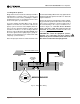
Fig. 3.6 Parallel-Mono Wiring
PARALLEL-MONO MODE
CH-2 CH-1
CH-2 CH-1
STEREO
BRIDGE
MONO
PARALLEL
MONO
INPUTS
OUTPUTS
INPUT INPUT
CH-2 CH-1
FX
CAUTION:
TURN OFF AMPLIFIER
BEFORE CHANGING THIS SWITCH!
STEREO
BRIDGE
MONO
PARALLEL
MONO
MIXER
ONLY USE THE CHANNEL 1 INPUTS
Macro-Tech Amplifier
LOUDSPEAKER
ADD A 14 GAUGE
OR LARGER
JUMPER BETWEEN
THE CHANNEL 1
AND 2 RED (+)
BINDING POSTS.
–
+
PUSHPUSH
THE CHANNEL 2
INPUTS ARE
NOT USED.
P
R
E
S
S
R
E
S
E
T
P
R
E
S
S
R
E
S
E
T
3.3.3 Parallel-Mono Operation
Parallel-Mono mode is intended for driving loads with a
net impedance of less than 4 ohms. (See Bridge-Mono
if the load is 4 ohms or greater.) Installing the amp in
Parallel-Mono mode is very different from the other
modes and requires special attention.
CAUTION: Do not attempt to operate in Stereo or
Bridge-Mono mode until the Parallel-Mono jumper
is first removed. Failure to do so will result in high
distortion and excessive heating.
To put the amplifier in Parallel-Mono mode, turn it off
and slide the stereo/mono switch to the left (as you
face the back panel). Connect the input signal to Chan-
nel 1 only. The Channel 2 input and level control are
bypassed in this mode, so they should not be used.
Note: It is normal for the IOC indicator of Channel 2 to
stay on in Parallel-Mono mode.
Install a jumper wire between the red binding posts of
both Channel 1 and 2 that is at least 14 gauge in size.
Then, connect the load to the output of Channel 1 as
shown in Figure 3.6. The positive lead from the load
connects to the red binding post of Channel 1 and the
negative lead from the load connects to the black bind-
ing post of Channel 1.
CAUTION: Remove the jumper wire before chang-
ing to Stereo or Bridge-Mono mode.