
Technical data

CHALLENGE/Onyx Diagnostic Road Map 5-13
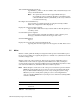
Turn off individual banks of memory:
Type disable x y, where x is the slot number of the selected memory board
and y is the bank number.
Note: The system must be left with enough enabled memory to
successfully boot. If you attempt to disable too much memory, the
command will fail. If memory is disabled, use the reconf command
to reset the interleaving.
Reconfigure the enabled memory:
Type reconf to reconfigure the memory using the currently enabled
banks. The configuration will be displayed.
Display the cache error register contents:
Typeecc. This command can only isolate the fault to either the primary or
secondary caches.
Clear the Memory Error registers:
Type clear. Use this command when POD is cycling a memory error
message, to determine whether the message is old or new.
Start the PROM Monitor:
Type io.
Display the reason why the system entered POD mode:
Type why. Use when the original error message has scrolled off the screen.
5.5 Niblet
Niblet is a small, symmetric multiprocessing kernel with separate virtual address spaces
for its processes. Niblet was originally designed as a verification tool, but has been found
useful for testing boards.
Niblet is composed of 13 separate tests. These tests are, in turn, combined in various
combinations to form 13 test sets (supertests). When Niblet is invoked, it attempts to
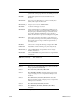
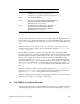
execute all of the tests in the selected set (Niblet cannot run individual tests). Table 5-1 lists
each of the basic Niblet tests, and Table 5-2lists the available supertests.
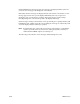
Note: Niblet attempts to run its tests on all of the processors that were present when the
PROM set up the machine. If one or more processors are forced into POD mode,
they are still included in Niblet’s processor count, causing the system to hang.
Niblet may not run correctly if the system processors are running different
versions of the IP19 PROM. However, if the processors launch successfully, Niblet
will run as intended
.
Test Description
INVALID Invalidates random TLB entries to cause more varied
interactions.
Table 5-1 Basic Niblet Tests