
Manual



51
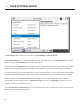
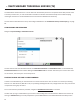
These sengs determine how the CrossLock reliability layer behaves. Most users should leave these sengs as default.
Enable - Allow CrossLock connecons in general. Default is yes. Note that this does not guarantee
connecons will be made with CrossLock. Other requirements (CrossLock capable codec on far end,
compable rmware, etc.) must be met for CrossLock to funcon.
- CrossLock automacally provides an extra “Retransmit Cushion” that provides
some me to make ARQ error correcon eecve. The default amount of me is twice the
measured round trip delay of the network (2xRTT). This has been shown to be most eecve on
most networks, but can be altered lower (1xRTT, none) or higher (3xRTT) using this menu.
- Default is o. Most users of portable codecs will prefer the default
“Bonding” mode, which sums the capabilies of networks together. Redundancy disables that
feature, and instead puts all network data simultaneously on all available networks. This is the
preferred mode if your networks are of known high quality and unmetered. In the case of one
network being completely lost, Redundant mode can result in less audio disrupon (although in
many cases Bonding mode achieves this as well).
- Allow CrossLock to signal that the local encoder should reduce data rate. Default
is yes.