
User`s manual




SCIOPTA - Real-Time Kernel
User’s Manual Manual Version 4.1 7-1
SCIOPTA - Real-Time Kernel
7 Pools
7Pools
7.1 Introduction
Messages are the main data object in SCIOPTA. Messages are allocated by processes from message pools. If a
process does not need the messages any longer it will be given back (freed) by the owner process.
There can be up to 127 pools per module for a standard kernel (32-bit) and up to 15 pools for a compact kernel (16-
bit). Please consult chapter
4 “Modules” on page 4-1 for more information about the SCIOPTA module concept.
The maximum number of pools will be defined at module creation. A message pool always belongs to the module
from where it was created.
The size of a pool will be defined when the pool will be created. By killing a module the corresponding pool will
also be deleted.
Pools can be created, killed and reset freely and at any time.
The SCIOPTA kernel is managing all existing pools in a system. Messages are maintained by double linked list in
the pool and SCIOPTA controls all message lists in a very efficient way therefore minimizing system latency.
7.2 Message Pool size
The minimum message pool size is the size of the maximum number of messages which ever are allocated at the
same time plus the pool control block (pool_cb).
The pool control block (pool_cb) can be calculated according to the following formula:
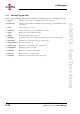
pool_cb = 68 + n * 20 + stat * n * 20
where:
n Number of buffer sizes (4, 8 or 16)
stat process statistics or message statistics are used (1) or not used (0)