
User manual


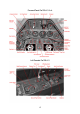


Fw 190 A-5
Changes in fighter tactics required more and more the use of external drop tanks to
increase flight duration, the now more widely use of the Fw190 as a fighter bomber
naturally led to an increased use of externally carried bombs.
In order to keep the Centre of Gravity intact when flying with external payloads the engine
was moved forward by 152 millimetres (apr. 5 inch) on the Fw 190 A-5 and all following
“Anton's”. Many think this change did a lot to the overall visual appearance of the plane.
With the A-5 blind flying and radio navigation equipment was introduced to the Fw 190
increasing the aircraft's capabilities to meet the requirements for a broader range of
mission profiles.
The pilot could now relate on an artificial horizon and a radio beacon indicator, the AFN-2,
though those changes were initially not well liked by the crews, being trained and used to
pure VFR flying. The artificial horizon was build into a housing combining a turn
coordinator ('Wendezeiger'), a slipball ('Libelle') and an artificial horizon ('künstlicher
Horizont') into a single instrument, the Wendehorizont. Three different types of the
Wendehorizont from different manufacturers can be identified in the Fw 190 A, all three
being technically identical, just differing in visual appearance.
A number of modifications were tested with A-5 airframes under different “U”
designations, amongst them MW-50 Methanol-Water injection, a “wet “emergency power
to increase performance for a limited period of time. Trials proofed unsatisfactory so that
MW50 was never used operational in a BMW 801- equipped Fw190 serial production
aircraft.
Production of the A-5 began by November 1942, approximately 1752 left the factories until
August 1943.
Fw 190 A-8
The replacement of the drum-fed outboard MGFF cannons with the belt-fed Mg 151/20 E
led to the introduction of the Fw 190 A-6 by June 1943.
The weak fire-power of the 7.92mm Mg 17 – contemptuously nick-named “Luftwaffe-
Anklopf-Gerät” by the crews (Luftwaffe-knock-on-the-door-apparatus) was consequently
replaced with the more vital 13mm Mg 131 as it became available, leading to the Fw 190 A-7
production beginning by November 1943.
Two more major changes were introduced when the A-8 production began by February
1944:
The FuG 16 ZE radio was replaced by the improved FuG 16 ZY and an internally stored
auxiliary tank was added, carrying 115 litres (30 gallons) of extra fuel aft of the pilot. The
additional tank required the ETC 501 rack to be re-located 200mm forward to keep the
Centre of Gravity intact. The Aux Tank could also be adopted to carry GM-1, an oxygen
mixture that improved combustion above the engine's critical altitude. However, there is
currently only proof for 11 aircraft being build to so-called “R4” conditions so “wet”
emergency power continued to play no role with the BMW 801 equipped Fw 190 A.
The pitot tube was re-located outboard to the right wing tip.
Some other changes were implemented during the production run, all of which are
erroneously associated with the A-9 only or the F-8 fighter bomber in older literature:
A solid metal roll bar was implemented into the canopy, nick-named “Furchenzieher”
(furrow puller), requiring a redesign of the canopy's plexi glass to a more bulged shape
which was instantly well received by the crews.
The metal propeller was more and more replaced by a wooden “paddle blade”.
13