
Specifications



Cisco Unified SIP SRST Feature Overview
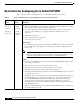
Restrictions for Configuring Cisco Unified SIP SRST
10
Cisco Unified SIP SRST 4.0 System Administrator Guide
Restrictions for Configuring Cisco Unified SIP SRST
Table 3 provides a history of restrictions from Cisco SIP SRST 3.0 to the present version.
Table 3 History of Restrictions from Cisco SIP SRST Version 3.0 to the Present Version
Cisco SRST
Version
Cisco IOS
Release Restrictions
Version 4.0
Version 3.4
Version 3.2
Version 3.1
Version 3.0
12.4(4)XC
12.4(4)T
12.3(11)T
12.3(7)T
12.2(15)ZJ
12.3(4)T
Not Supported
• Music on hold (MOH) is not supported for a call hold invoked from a SIP phone. A caller
hears only silence when placed on hold by a SIP phone.
• As of Cisco IOS Release 12.4(4)T, bridged call appearance, find-me, incoming call
screening, paging, SIP presence, call park, call pickup, and SIP location are not
supported.
• SIP-NAT is not supported.
• Cisco Unity Express is not supported.
• Transcoding is not supported.
Phone Features
• For call waiting to work on the Cisco ATA and Cisco IP Phone 7912 and Cisco Unified IP
Phone 7905G with a 1.0(2) build, the incoming call leg should be configured with the
G.711 codec.
Note Cisco Unified IP Phone 7905G, Cisco Unified IP Phone 7912G, and Cisco Analog
Telephone Adaptor (ATA) 186 are not capable of dual registration; thus they are not
supported and have limited functionality with Cisco Unified SIP SRST.
General
• Call detail records (CDRs) are only supported by standard IOS RADIUS support; CDRs
are not supported otherwise.
• All calls must use the same codec, either G.729r8 or G.711.
• Calls that have been transferred cannot be transferred a second time.
• URL dialing is not supported. Only number dialing is supported.
• The SIP registrar functionality provided by Cisco Unified SIP SRST provides no security
or authentication services.
• SIP IP phones that do not support dual concurrent registration with both their primary and
their backup SIP proxy or registrar may be unable to receive incoming calls from the
Cisco Unified SIP SRST gateway during a WAN outage. These phones may take a
significant amount of time to discover that their primary SIP proxy or registrar is
unreachable before they initiate a fallback registration to their backup proxy or registrar
(the SIP SRST gateway).
• SIP-phone-to-SIP-trunk support requires Refer and 302/300 Redirection to be supported
by the SIP trunk (Version 3.0).