
Network Router User Manual

7-2
Cisco VPN Solutions Center: MPLS Solution User Guide
78-10548-02
Chapter 7 MPLS VPN Solution Troubleshooting Guide
3. Question: Which of the error states are due to provisioning and which are due to auditing?
Answer: Requested (after provisioning), Invalid, and Failed Deploy are due to error conditions in
provisioning. Pending (after auditing), Lost, and Broken are due to error conditions in auditing.
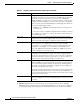
Failed Deploy After provisioning occurred, the service request failed to download the
configlets to the router. A service request moves to Failed Deploy if an error
was detected during the deployment process by the Cisco IP Manager
(CIPM). If CIPM is not being used to download configlets, and the product
is simply exporting configlets to a directory, there is no way to distinguish
between a service request in the Failed Deploy and Pending states. There are
two causes for Failed Deploy status:
• CIPM reports to VPIM that the download failed (lost connection, bad
password, etc.).
• The object could not establish configuration-level verification of intent.
If the configlets are exported to a directory, the service request cannot move
into a Failed Deploy state.
Functional A service request moves to Functional when the Auditor finds the VPN
routing and forwarding tables (VRF) for this service and they match with the
service intent. This state requires configuration-level verification.
Invalid Indicates that the service request information is incorrect in some way. A
service request moves to Invalid if the request was either internally
inconsistent or not consistent with the rest of the existing network/router
configurations (for example, no more interfaces were available on the
router). The VPN Provisioning Inventory Manager (VPIM) server cannot
generate configlets to service this request.
Lost A service request moves to Lost when the Auditor cannot find a
configuration-level verification of intent in the router configuration files.
The service request was deployed, but now some or all router configuration
information is missing. A service request can move to the Lost state only
when the service request had been Deployed or Functional.
Pending A service request moves to Pending when the VPN Provisioning Inventory
Manager (VPIM) server determines that the request looks consistent and was
able to generate the required configlets for this request. Pending indicates
that the service request has generated the configlets and the configlets are
successfully downloaded to the routers.
The Auditor regards pending service requests as new requests and begins the
audit. If the service has been freshly provisioned and not yet audited, it is not
an error (pending audit). However, if an audit is done and the service is still
pending, it is in an error state.
Requested If the service is newly entered and not yet deployed, it is not an error.
However, if a Deploy is done and it remains Requested, the service is in an
error state.
Table 7-1 Summary of MPLS VPN Service Request Types (continued)
Service Request Type Description