
Network Router User Manual

A-23
Cisco 7304 Router MIB Specifications Guide
OL-4925-02
Appendix A Using MIBs
Monitoring Quality of Service
Manage cases in which a customer interface does not have a service policy attached to it.
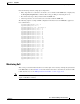
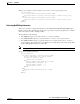
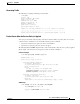
FOR each ifEntry DO
IF (!servicePolicyAssociated[ifIndex].transmit) THEN
Perform processing for customer interface without a transmit service policy.
END-IF
IF (!servicePolicyAssociated[ifIndex].receive) THEN
Perform processing for customer interface without a receive service policy.
END-IF
END-FOR
Retrieving QoS Billing Information
This section describes a sample algorithm that uses the CISCO-CLASS-BASED-QOS-MIB for QoS
billing operations. The algorithm periodically retrieves post-policy input and output statistics, combines
them, and sends the result to a billing database.
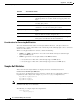
The algorithm uses the following:
• One SNMP get request per customer interface—to retrieve the ifAlias.
• Two SNMP get-next requests per customer interface—to retrieve service policy indexes.
• Two SNMP get-next requests per customer interface for each object in the policy—to retrieve
post-policy bytes. For example, if there are 100 interfaces and 10 objects in the policy, the algorithm
requires 2000 get-next requests (2 x 100 x 10).
Note This algorithm is for informational purposes only. Your application needs may be different.
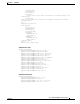
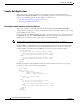
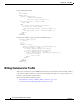
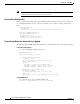
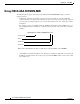
Set up customer billing information.
FOR each ifEntry DO
IF (ifEntry represents a customer interface) THEN
status = snmp-getnext (id = ifAlias.ifIndex);
IF (status != ‘noError’) THEN
Perform error processing.
ELSE
billing[ifIndex].isCustomerInterface = TRUE;
billing[ifIndex].customerID = id;
billing[ifIndex].transmit = 0;
billing[ifIndex].receive = 0;
END-IF
ELSE
billing[ifIndex].isCustomerInterface = FALSE;
END-IF
END-FOR