
Specifications




CINTERION
®
BGS12 Hardware Interface Description
Contents
63 of 109
Page
BGS12 HID_V00.915
Confidential / Released
2019
-
01
-
07
The distance between the antenna RF_OUT pad (#59) and its neighboring GND pads (#58,
#60) has been optimized for best possible impedance. On the application PCB, special atten-
tion should be paid to these 3 pads, in order to prevent mismatch.
The wiring of the antenna connection line, starting from the antenna pad to the application an-
tenna should result in a 50Ω line impedance. Line width and distance to the GND plane needs
to be optimized with regard to the PCB’s layer stack. Some examples are given in Section 4.2 .
To prevent receiver desensitization due to interferences generated by fast transients like high
speed clocks on the application PCB, it is recommended to realize the antenna connection line
using embedded Stripline rather than Micro-Stripline technology. Please see Section 4.2.1 for
an example.
For type approval purposes, the use of a 50Ω coaxial antenna connector (U.FL-R-SMT) might
be necessary. In this case the U.FL-R-SMT connector should be placed as close as possible
to BGS12‘s antenna pad.
4.2 RF Line Routing Design
4.2.1 Line Arrangement Examples
Several dedicated tools are available to calculate line arrangements for specific applications
and PCB materials - for example from http://www.polarinstruments.com/ (commercial software)
or from http://web.awrcorp.com/Usa/Products/Optional-Products/TX-Line/ (free software).
4.2.1.1
Embedded Stripline
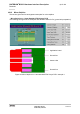
This below figure shows a line arrangement example for embedded stripline with 65µm FR4
prepreg (type: 1080) and 710µm FR4 core (4-layer PCB).
Figure 39: Embedded Stripline with 65µm prepreg (1080) and 710µm core