
Instruction manual





MOTION OF THE STARS
The daily motion of the Sun across the sky is
familiar to even the most casual observer. This
daily trek is not the Sun moving as early astrono-
mers thought, but the result of the Earth’s rota-
tion. The Earth’s rotation also causes the stars
to do the same, scribing out a large circle as the
Earth completes one rotation. The size of the
circular path a star follows depends on where
it is in the sky. Stars near the celestial equator
form the largest circles rising in the east and set-
ting in the west. Moving toward the north ce-
lestial pole, the point around which the stars in
the northern hemisphere appear to rotate, these
circles become smaller. Stars in the mid-celes-
tial latitudes rise in the northeast and set in the
northwest. Stars at high celestial latitudes are
always above the horizon, and are said to be cir-
cumpolar because they never rise and never set.
You will never see the stars complete one circle
because the sunlight during the day washes out
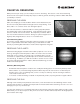
the starlight. However, part of this circular mo-
tion of stars in this region of the sky can be seen
by setting up a camera on a tripod and opening
the shutter for a couple hours. The timed expo-
sure will reveal semicircles that revolve around
the pole. (This description of stellar motions also
applies to the southern hemisphere except all
stars south of the celestial equator move around
the south celestial pole.)
14
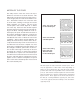
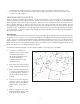
Figure 4-2
All stars appear to rotate around the celestial poles. How-
ever, the appearance of this motion varies depending on
where you are looking in the sky. Near the north celestial
pole the stars scribe out recognizable circles centered on the
pole (1). Stars near the celestial equator also follow circular
paths around the pole. But, the complete path is interrupted
by the horizon. These appear to rise in the east and set in
the west (2). Looking toward the opposite pole, stars curve
or arc in the opposite direction scribing a circle around the
opposite pole (3).
Stars seen near the
north celestial pole
Stars seen near the
celestial equator
Stare seen looking
in the opposite
direction of the
north celestial pole