
Owner's Manual




DO NOT PLACE LARGE QUANTITIES OF OIL INTO THE ACTION.
A LARGE EXCESS OF OIL WILL RUN BACK INTO THE WOOD OF THE
STOCK AND CAUSE SOFTENING OF THE WOOD, WITH CONSEQUENTIAL
LOOSENING OF THE STOCK.
1 Be certain the chamber and magazine are completely unloaded,
the lever is down, and the ejection port is open. Again, to unload
your rifle, eject any live cartridge in the chamber by operating
the lever downward. Remove the magazine and unload it by
pushing forward on the base of each cartridge until it clears the
retaining lips.
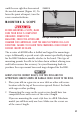
2 Place the bolt in the open position to allow the rod and patch to
go completely through the bore and partly into the receiver. Use
a muzzle rod guide and a cleaning rod with a tip and patch large
enough for a snug fit in the bore. Insert the rod and patch into the
barrel at the muzzle end and run back and forth several times.
Take care that the cleaning rod or handle does not strike the crown
of the muzzle, as damage to this area can adversely affect the
accuracy of the rifle.
3 Inspect the chamber and bore for powder fouling. A normal
amount of powder residue can be expected and is not serious.
Residue can usually be removed by repeating step 2, using a
patch saturated with nitro-solvent. If, or when, fouling should
become heavy, it can be removed with a brass bore brush.
Dip the brush in nitro-solvent and scrub the chamber and bore
until the fouling is removed. To prevent brass bristles from
breaking off, the brush should be pushed completely through the
bore before being withdrawn.
MOST SOLVENTS ARE HIGHLY FLAMMABLE. WEAR EYE PROTECTION
AND PRACTICE APPROPRIATE SAFETY MEASURES WHEN WORKING
WITH SOLVENTS TO AVOID SERIOUS INJURY.
27