
User Guide


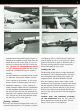


(See page 11 for instructions on unloading). Af-
ter assuring yourself that the rifle is completely
empty, again, open the bolt and remove it from
the receiver (as described in “Removing the
Bolt” on page 6). Look through the barrel to he
sure it is clear of any obstruction. If an obstruc-
tion is seen, no matter how small it may be,
clean the bore with a cleaning rod and patch as
described in “Cleaning and Maintenance Sugges-
tions” on page 12. Before the first firing, clean
the bore with a cleaning rod and patch, and
wipe away any anti-rust compounds in the ac-
tion/chamber areas.
7
ALWAYS UNLOAD YOUR RIFLE WHEN NOT IN
USE. REFER TO PAGE 11 OF THIS INSTRUC-
TlON BOOKLET EXPLAINING THE UNLOADING
OF YOUR RIFLE.
As a safety precaution, it is preferable to disas-
semble your gun for storage. Store your gun and
ammunition separately-well beyond the reach
of children. Take all safeguards to ensure your
rifle does not become available to untrained,
inexperienced or unwelcome hands.
8
USE THE PROPER AMMUNITION.
The barrel and action of this rifle have been
made with substantial safety margins over the
pressures developed by established American
commercial loads. Nevertheless, Browning as-
sumes no liability for incidents which occur
through the use of cartridges of nonstandard di-
mensions which develop pressures in excess of
commercially available ammunition which has
been loaded in accordance with standards estab-
lished by the Sporting Arms and Ammunition
Manufacturers‘ Institute (SAAMI).
BE ALERT TO THE SIGNS OF AMMUNITION
MAL FUNCTION.
If you detect an off sound or light recoil when a
cartridge is fired,
DO NOT LOAD ANOTHER CAR-
TRIDGE INTO THE CHAMBER.
Open the action
and remove all cartridges from the magazine,
chamber and action areas. With the action open,
glance down the barrel to make sure that an ob-
struction does not remain in the barrel. If there
is an obstruction, completely clear the barrel be-
fore loading and firing again. Failure to follow
these instructions can cause extensive damage to
your gun and possible serious injury to yourself
and others.,
9
DO NOT SNAP THE FIRING PIN ON AN EMPTY
CHAMBER — THE CHAMBER MAY NOT BE
EMPTY!
Treat every gun with the respect due a loaded
gun, even though you are certain the gun is un-
loaded.
10
KEEP YOUR FINGERS AWAY FROM THE
TRIGGER WHILE UNLOADING, LOADING, UNTIL
YOU ARE READY TO SHOOT.
11 BE SURE OF YOUR TARGET AND BACKSTOP.
Particularly during low light periods. Know the
range of your ammunition. Never shoot at water
or hard objects.
12
ALWAYS UNLOAD YOUR RIFLE’S CHAMBER
BEFORE CROSSING A FENCE, CLIMBING A
TREE, JUMPING A DITCH OR NEGOTIATING
OTHER OBSTACLES.
Refer to page 11 of this instruction book for in-
structions on the unloading of your rifle. Never
place your rifle on or against a fence, tree, car,
or other similar object.
13 WEAR EYE AND EAR PROTECTION WHEN
SHOOTING.
Unprotected, repeated exposure to
gunfire can cause hearing damage. Wear ear
protectors (shooting ear plugs or muffs) to guard
against such damage. Wear shooting glasses to
protect your eyes from flying particles. Always
keep a safe distance between the muzzle of
your firearm and any persons nearby, as muzzle
blast, debris and ejecting shells could inflict
serious injury, Also, wear eye protection when
disassembling and cleaning your shotgun to
prevent the possibility of springs, spring-
tensioned parts, solvents or other agents from
contacting your eyes.
14
DROPPING A LOADED GUN CAN CAUSE AN
ACCIDENTAL DISCHARGE
even with the
“safety” in the “on safe” position. Be extremely
careful while hunting or during any shooting
activity, to avoid dropping any firearm.
15
IF YOUR RIFLE FAILS TO FIRE, KEEP THE
MUZZLE POINTED IN A SAFE DIRECTION.