
User`s guide


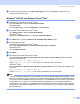


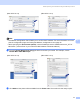


Table Of Contents
- NETWORK USER’S GUIDE
- Table of Contents
- 1 Introduction
- 2 Configuring your machine for a network
- Overview
- IP addresses, subnet masks and gateways
- Step by step chart
- Setting the IP address and subnet mask
- Changing the print server settings
- Using the BRAdmin Light utility to change the print server settings
- Using the BRAdmin Professional 3 utility to change print server settings (Windows®)
- Using the control panel to change the print server settings
- Using Web Based Management (web browser) to change the print/scan server settings
- Using Remote Setup to change the print server settings (Not available for Windows Server® 2003/2008) (Not available for DCP-8085DN)
- Using other methods to change print server settings
- 3 Control panel setup
- 4 Driver Deployment Wizard (Windows® only)
- 5 Network printing from Windows®: basic TCP/IP Peer-to-Peer printing
- 6 Internet printing for Windows®
- 7 Network printing from Macintosh using the BR-Script 3 driver
- 8 Web Based Management
- Overview
- How to configure the machine settings using Web Based Management (web browser)
- Password information
- Secure Function Lock 2.0 (Not available for MFC-8370DN)
- Changing the Scan to FTP configuration using a web browser
- Changing the Scan to Network configuration using a web browser
- Changing the LDAP configuration using a web browser (For MFC-8880DN)
- 9 LDAP operation (For MFC-8880DN)
- 10 Internet fax and Scan to E-mail (E-mail server) (For MFC-8880DN)
- Internet fax Overview
- Getting connected
- Control panel key functions
- Sending an Internet fax
- Manually entering text
- Receiving E-mail or Internet fax
- Receiving an Internet fax to your computer
- Forwarding received E-mail and fax messages
- Relay broadcasting
- TX Verification Mail
- Setup Mail TX
- Setup Mail RX
- Error mail
- Important information on Internet fax
- Scan to E-mail (E-mail server) overview
- Internet fax Overview
- 11 Security features
- 12 Troubleshooting
- Appendix A
- Using services
- Other ways to set the IP address (for advanced users and administrators)
- Using DHCP to configure the IP address
- Using BOOTP to configure the IP address
- Using RARP to configure the IP address
- Using APIPA to configure the IP address
- Using ARP to configure the IP address
- Using the TELNET console to configure the IP address
- Using the Brother Web BRAdmin server software for IIS to configure the IP address
- Installation when using web services (Windows Vista®)
- Installation when using a Network Print Queue or Share (printer driver only)
- Appendix B
- Appendix C
- Index

Internet printing for Windows
®
58
6
g When you click Next, Windows
®
2000/XP and Windows Server
®
2003 will make a connection with the
URL that you specified.
If the printer driver has already been installed:
You will see the printer selection screen in the Add Printer Wizard.
If the appropriate printer driver is already installed on your computer, Windows
®
2000/XP and
Windows Server
®
2003 will automatically use that driver. In this case, you will simply be asked if you
wish to make the driver the default printer, after which the Add Printer wizard will complete. You are
now ready to print.
Go to step l.
If the printer driver has NOT been installed:
One of the benefits of the IPP printing protocol is that it establishes the model name of the printer
when you communicate with it. After successful communication you will see the model name of the
printer automatically. This means that you do not need to inform Windows
®
2000/XP and Windows
Server
®
2003 about the type of printer driver to be used.
Go to step h.
h The driver installation starts automatically.
Note
If the printer driver that you are installing does not have a Digital Certificate you will see a warning
message. Click Continue Anyway
1
to continue with the installation.
1
Yes for Windows
®
2000 users
i (Windows
®
XP and Windows Server
®
2003)
Click Have Disk. You will then be asked to insert the driver disk.
(Windows
®
2000)
Click OK when you see the Insert Disk screen.
j Click Browse and choose the appropriate Brother printer driver that is contained on the CD-ROM or in
the network share.
For example, choose the “X:\\driver\win2kxpvista
1
\your language” folder (where X is your drive
letter). Click Open.
1
winxpx64vista64 for 64-bit OS users
k Click OK.
l Check Yes if you want to use this printer as the default printer. Click Next.
m Click Finish and the printer is now configured and ready to print. To test the printer connection, print a
test page.