Multi-Protocol On-board Ethernet Multi-function Print Server and Wireless (IEEE 802.11b/g) Ethernet Multi-function Print Server NETWORK USER’S GUIDE MFC-7840W Please read this manual thoroughly before using this machine on your network. You can view this manual in HTML format from the CD-ROM at any time, please keep the CD-ROM in a convenient place for quick and easy reference at all times. You can also download the manual in PDF format from the Brother Solutions Center (http://solutions.brother.com).
Definitions of notes We use the following icon throughout this User’s Guide: Notes tell you how you should respond to a situation that may arise or give tips about how the operation works with other features. Trademarks Brother and the Brother logo are registered trademarks and BRAdmin Light and BRAdmin Professional are trademarks of Brother Industries, Ltd. UNIX is a registered trademark of The Open Group. Apple and Macintosh are registered trademarks and Safari is a trademark of Apple Inc.
IMPORTANT NOTE This product is approved for use in the country of purchase only. Do not use this product outside the country of purchase as it may violate the wireless telecommunication and power regulations of that country. Windows® XP in this document represents Windows® XP Professional, Windows® XP Professional x64 Edition and Windows® XP Home Edition. Windows® Server 2003 in this document represents Windows® Server 2003 and Windows® Server 2003 x64 Edition.
Brother numbers IMPORTANT For technical and operational assistance, you must call the country where you purchased the machine. Calls must be made from within that country. For Customer Service In USA 1-877-BROTHER (1-877-276-8437) In Canada 1-877-BROTHER In Brazil helpline@brother.com.br In Europe Visit http://www.brother.com for contact information on your local Brother office.
Internet address Brother Global Web Site: http://www.brother.com For Frequently Asked Questions (FAQs), Product Support, Driver Updates and Utilities: http://solutions.brother.com Ordering accessories and supplies In USA: 1-877-552-MALL (1-877-552-6255) 1-800-947-1445 (fax) http://www.brothermall.com In Canada: 1-877-BROTHER http://www.brother.
Table of Contents 1 Introduction 1 Overview....................................................................................................................................................1 Network features........................................................................................................................................2 Network printing...................................................................................................................................
Confirm your wireless network setup method..........................................................................................26 Configuration using the machine’s control panel Setup Wizard to configure your wireless network machine .........................................................................................................................................26 Configuration using the SES/WPS/AOSS control panel menu (Automatic Wireless mode) (Infrastructure mode only) ........................
7 Driver Deployment Wizard (Windows® only) 88 Overview..................................................................................................................................................88 Connection methods................................................................................................................................88 Peer-to-peer ......................................................................................................................................
13 Troubleshooting 115 Overview................................................................................................................................................115 General problems ..................................................................................................................................115 Network print software installation problems .........................................................................................116 Printing problems........................
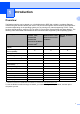
1 Introduction 1 1 Overview 1 The Brother machine can be shared on a 10/100 Mb wired or IEEE 802.11b/802.11g wireless Ethernet network using the internal network print server. The print server supports various functions and methods of connection depending on the operating system you are running on a network supporting TCP/IP. These functions include printing, scanning, PC Fax send, PC Fax receive, Remote Setup and Status Monitor.
Introduction Network features 1 1 Your Brother machine has the following basic network features. Network printing 1 The print server provides printing services for Windows® 2000/XP, Windows Vista® and Windows Server® 2003 supporting the TCP/IP protocols and Macintosh® (Mac OS® X 10.2.4 or greater) supporting the TCP/IP protocols. Network scanning 1 You can scan documents over the network to your computer (See Network Scanning in the Software User’s Guide).
Introduction BRAdmin Professional (for Windows®) 1 1 BRAdmin Professional is a utility for more advanced management of network connected Brother devices. This utility can search for Brother products on your network, view the status and configure the network settings from a computer running Windows®. BRAdmin Professional has additional features from BRAdmin Light. For more information and to download the software, visit us at http://solutions.brother.
Introduction Types of network connections 1 1 Network connection example 1 Generally there are two types of network connections: Peer-to-Peer and Network Shared environment. Peer-to-Peer printing using TCP/IP 1 In a Peer-to-Peer environment, each computer directly sends and receives data to each device. There is no central server controlling file access or printer sharing.
Introduction Network Shared printing 1 In a Network Shared environment, each computer sends data via a centrally controlled computer. This type of computer is often called a “Server” or a “Print Server”. Its job is to control the printing of all print jobs. 1 Client computer 2 Also known as “Server” or “Print server” 3 TCP/IP or USB (where available) 4 Printer (your machine) In a larger network, we recommend a Network Shared printing environment.
Introduction Wireless network connection examples 1 1 Connected to a computer with an access point on the network (Infrastructure mode) 1 This type of network has a central access point at the heart of the network. The access point can also act as a bridge or a gateway to a wired network. When the Brother wireless machine (your machine) is part of this network, it receives all print jobs via an access point.
Introduction Protocols 1 1 TCP/IP protocols and functionalities 1 Protocols are the standardized sets of rules for transmitting data on a network. Protocols allow users to gain access to network connected resources. The print server used on this Brother product supports the TCP/IP (Transmission Control Protocol/Internet Protocol) protocol. TCP/IP is the most popular set of protocols used for communication such as Internet and E-mail.
Introduction IPP 1 1 The Internet Printing Protocol (IPP Version 1.0) allows you to print documents directly to any accessible printer via the internet. mDNS 1 mDNS allows the Brother print server to automatically configure itself to work in a Mac OS® X Simple Network Configured system. (Mac OS® X 10.2.4 or greater). TELNET 1 The Brother print server supports TELNET server for command line configuration.
Introduction IPv6 1 1 This machine is compatible with IPv6, the next generation internet protocol. For more information on the IPv6 protocol, visit http://solutions.brother.com. Other protocol 1 LLTD 1 The Link Layer Topology Discovery protocol (LLTD) lets you locate the Brother machine easily on the Windows Vista® network map. Your Brother machine will be shown with a distinctive icon and the node name. The default setting for this protocol is Off.
2 Configuring your machine for a network 2 Overview 2 2 Before using your Brother machine in a network environment, you must install the Brother software and also configure the appropriate TCP/IP network settings on the machine itself. In this chapter, you will learn the basic steps required to print over the network using TCP/IP protocol.
Configuring your machine for a network How the IP address is assigned to your print server: 2 If you have a DHCP/BOOTP/RARP server in your network (typically a UNIX®/Linux or Windows® 2000/XP, Windows Vista® or Windows Server® 2003 network) the print server will automatically obtain its IP address from the DHCP server and register its name with any RFC 1001 and 1002-compliant dynamic name services. Note On smaller networks, the DHCP server may be the router.
Configuring your machine for a network Step by step chart a 2 Configure the TCP/IP settings.
Configuring your machine for a network Setting the IP address and subnet mask 2 Using the BRAdmin Light utility to configure your machine as a network printer 2 BRAdmin Light 2 The BRAdmin Light utility is designed for initial setup of the Brother network connected devices. It also can search for Brother products in a TCP/IP environment, view the status and configure basic network settings, such as IP address.
Configuring your machine for a network c Double-click the unconfigured device. Windows® Macintosh® 2 Note • If the print server is set to its factory default settings without using a DHCP/BOOTP/RARP server, the device will appear as Unconfigured in the BRAdmin Light utility screen. • You can find the node name and Ethernet address (MAC address) by printing the Network Configuration List. See Printing the Network Configuration List on page 87. d Choose STATIC from Boot Method.
Configuring your machine for a network Using the control panel to configure your machine for a network 2 You can configure your machine for a network using the control panel LAN menu. See Control panel setup on page 74. 2 Using other methods to configure your machine for a network 2 You can configure your machine for a network using other methods. See Other ways to set the IP address (for advanced users and administrators) on page 125.
Configuring your machine for a network Changing the print server settings 2 Note For wireless network users, you need to configure the wireless settings to change the print server settings. See Configuring your machine for a wireless network on page 29. Using the BRAdmin Light utility to change the print server settings a 2 2 Start the BRAdmin Light utility. For Windows® 2000/XP, Windows Vista® and Windows Server® 2003 users Click Start / All Programs 1/ Brother / BRAdmin Light / BRAdmin Light.
Configuring your machine for a network Using the BRAdmin Professional utility to change print server settings (for Windows®) 2 Note • Please use the latest version of the BRAdmin Professional utility that is available as a download from http://solutions.brother.com This utility is only available for Windows® users. 2 • Node name: The Node name for each Brother device on the network appears in BRAdmin Professional.
Configuring your machine for a network Using Web Based Management (web browser) to change the print/scan server settings 2 A standard web browser can be used to change your print server settings using the HTTP (Hyper Text Transfer Protocol). See How to configure the print server settings using Web Based Management (web browser) on page 109.
3 Configuring your machine for a wireless network 3 Overview 3 To connect your machine to your wireless network, we recommend you to follow the steps in the Quick Setup Guide using the Setup Wizard from the machine’s control panel LAN menu. By using this method, you can easily connect your machine to your wireless network. Please read this chapter for additional methods on how to configure the wireless network settings.
Configuring your machine for a wireless network Wireless network terms and concepts 3 When you configure your machine for a wireless network, you must ensure that your wireless network machine is configured to match the settings of the existing wireless network. This section provides some of the main terms and concepts of these settings, which may be helpful when you configure your machine for a wireless network.
Configuring your machine for a wireless network WPA-PSK/WPA2-PSK Enables a Wi-Fi® Protected Access Pre-shared key (WPA-PSK/WPA2-PSK), which enables the Brother wireless machine to associate with access points using TKIP for WPA-PSK or AES for WPA-PSK and WPA2-PSK (WPA-Personal). LEAP Cisco®LEAP (Light Extensible Authentication Protocol) has been developed by Cisco Systems, Inc. which uses user ID and password for authentication.
Configuring your machine for a wireless network WPA-PSK/WPA2-PSK and TKIP or AES Uses a Pre-Shared Key (PSK) that is 8 or more characters in length, up to a maximum of 63 characters. LEAP Uses User ID and Password.
Configuring your machine for a wireless network Step by step chart for wireless network configuration 3 For Infrastructure mode a 3 Confirm your network environment. See page 25 3 Infrastructure mode Ad-hoc mode Connected to a computer with an access point b or See page 24 Connected to a wireless capable computer without an access point Confirm your wireless network setup method.
Configuring your machine for a wireless network For Ad-hoc mode a 3 Confirm your network environment. See page 25. Ad-hoc mode Infrastructure mode Connected to a wireless capable computer without an access point b or Connected to a computer with an access point Confirm your wireless network setup method. See page 26. Using the Setup Wizard from the control panel (Recommended) c See page 23 Using the Brother installer application Configure your machine for a wireless network.
Configuring your machine for a wireless network Confirm your network environment 3 Connected to a computer with an access point in the network (Infrastructure mode) 3 3 1 4 2 3 1 Access point 2 Wireless network printer (your machine) 3 Wireless capable computer connected to the the access point 4 Wired computer which is not wireless capable connected to the access point with an Ethernet cable Connected to a wireless capable computer without an access point in the network (Ad-hoc mode) 3 This type
Configuring your machine for a wireless network Confirm your wireless network setup method 3 There are four methods to configure your machine for a wireless network; by using the machine’s control panel (recommended), using SES, WPS or AOSS from the control panel menu (Automatic Wireless mode), using the PIN Method of Wi-Fi Protected Setup™ or using the Brother installer application. The setup process will be different depending on your network environment.
Configuring your machine for a wireless network Configuration using the PIN Method of Wi-Fi Protected Setup™ (Infrastructure mode only) 3 If your wireless access point (A) supports Wi-Fi Protected Setup™, you can also configure using the PIN Method of Wi-Fi Protected Setup™. See Using the PIN Method of Wi-Fi Protected Setup™ on page 34.
Configuring your machine for a wireless network Configuration using the Brother installer application on the CD-ROM to configure your wireless network machine 3 You can also use the Brother installer application on the CD-ROM we have provided with the printer. You will be guided by the on-screen instructions until you are able to use your Brother wireless network machine. You must know your wireless network settings before you proceed with this installation.
Configuring your machine for a wireless network Configuring your machine for a wireless network 3 IMPORTANT • If you are going to connect your Brother machine to your network, we recommend that you contact your system administrator prior to installation. You must know your wireless network settings before you proceed with this installation.
Configuring your machine for a wireless network g If the following message appears, press 1 to choose On. The wired network interface will become inactive with this setting. WLAN Enable ? 1.On 2.Off h The machine will search for your network and display a list of available SSIDs. You should see the SSID you wrote down earlier. If the machine finds more than one network use a or b key to choose your network, then press OK. Go to l.
Configuring your machine for a wireless network o If you want to change the key you chose in n, press 1 to choose Change. Press OK. Go to p. If you want to keep the key you chose in n, press 2 to choose Keep. Press OK. Go to t. KEY1:*********** 1.Change 2.Keep p Enter a new WEP key. Press OK. Go to t. (To manually enter the text, see Entering Text on page 140) WEP: q 3 Choose the Encryption type, TKIP or AES using a or b. Press OK. Go to s. Encryption Type? TKIP r Enter the user name and press OK.
Configuring your machine for a wireless network Using the SES/WPS/AOSS control panel menu to configure your machine for a wireless network (Automatic Wireless mode) 3 If your wireless access point supports either SecureEasySetup™, Wi-Fi Protected Setup™ (PBC 1) or AOSS™, you can configure the machine easily without a computer. Your Brother machine has the SES/WPS/AOSS menu on the control panel.
Configuring your machine for a wireless network f If the LCD shows Connected, the machine has successfully connected to your router or access point. You can now use your machine in a wireless network. If the LCD shows Incorrect Mode, session overlap is detected. The machine has detected more than one router or access point on your network with the Wi-Fi Protected Setup™ mode or AOSS™ mode enabled.
Configuring your machine for a wireless network (For Macintosh®) You have completed the wireless network setup. If you would like to continue installing drivers and software necessary for operating your device, please choose Start Here OSX from CD-ROM menu. Using the PIN Method of Wi-Fi Protected Setup™ 3 3 If your wireless access point supports Wi-Fi Protected Setup™ (PIN Method), you can configure the machine easily without a computer.
Configuring your machine for a wireless network Note To use a Windows Vista® computer as a Registrar, you need to register it to your network in advance. See the instruction manual that came with your access point / router. f 1 Click Start and then Network. 2 Click Add a wireless device. 3 Choose your printer and click Next. 4 Input the PIN which the LCD shows in d on page 34 and then click Next. 5 Choose your network that you want to connect to, and then click Next. 6 Click Close.
4 Wireless configuration for Windows® using the Brother installer application 4 IMPORTANT • The following instructions will install your Brother machine in a network environment using the Brother installer application for Windows® found on the CD-ROM we have provided with the machine. • You can also setup your Brother machine using the machine’s control panel (recommended). You can find instructions in the supplied Quick Setup Guide or see Configuring your machine for a wireless network on page 19.
Wireless configuration for Windows® using the Brother installer application d The CD-ROM main menu will appear. Click Install Other Drivers or Utilities. (For USA) (For UK) 4 Note If this window does not appear, use Windows® Explorer to run the start.exe program from the root folder of the Brother CD-ROM. e Click Wireless LAN Setup Wizard.
Wireless configuration for Windows® using the Brother installer application f Choose Step by Step install (Recommended) and then click Next. 4 g Choose With cable (Recommended) and then click Next.
Wireless configuration for Windows® using the Brother installer application h Connect the Brother wireless device to your access point using a network cable and click Next. 4 i Choose the machine you wish to configure, and click Next. If the list is blank, check if the access point and the machine are powered on, and then click Refresh. Note The default Node name is “BRNxxxxxxxxxxxx”.
Wireless configuration for Windows® using the Brother installer application j The wizard will search for wireless networks available from your machine. Choose the access point you wish to associate the machine with, and then click Next. 4 Note • "SETUP" is the default SSID of the machine. Do not choose this SSID. • If the list is blank, check that the access point has power and is broadcasting the SSID, and then see if the machine and the access point are within range for wireless communication.
Wireless configuration for Windows® using the Brother installer application l If your network is configured for Authentication and Encryption, the following screen will appear. When configuring your Brother wireless machine, you must ensure that it is configured to match the Authentication and Encryption settings of your existing wireless network. Choose the Authentication Method and Encryption Mode from the pull-down list in each setting box.
Wireless configuration for Windows® using the Brother installer application n Disconnect the network cable between your access point (hub or router) and the machine, and click Next. 4 o Check the box after you confirm that you have completed the wireless settings, and then click Finish. You have completed the wireless network setup. If you would like to continue installing drivers and software necessary for operating your device, please choose Install MFL-Pro Suite from the CD-ROM menu.
Wireless configuration for Windows® using the Brother installer application Configuration using the SES/WPS/AOSS control panel menu (Automatic Wireless mode) 4 IMPORTANT • If you are going to connect your Brother machine to your network, we recommend that you contact your system administrator prior to installation. You must know your wireless network settings before you proceed with this installation.
Wireless configuration for Windows® using the Brother installer application f Click Wireless LAN Setup Wizard. 4 g Choose Automatic install (Advanced) and click Next. h Confirm the on-screen message and click Next.
Wireless configuration for Windows® using the Brother installer application i Press Menu, 5, 2, 3 for SES/WPS/AOSS. This feature will automatically detect which mode (SecureEasySetup™, Wi-Fi Protected Setup™ or AOSS™) your access point uses to configure your machine. Note If your wireless access point supports Wi-Fi Protected Setup™ (PIN Method) and you want to configure your machine using the PIN (Personal Identification Number) Method, see Using the PIN Method of Wi-Fi Protected Setup™ on page 34.
Wireless configuration for Windows® using the Brother installer application LCD messages when using the SES/WPS/AOSS control panel menu LCD shows Connection status Action Searching or accessing the access point, and downloading settings from the access point — Connecting the access point — Connected Connection succeeded. — Incorrect Mode Session overlap is detected.
Wireless configuration for Windows® using the Brother installer application Configuration in Ad-hoc mode 4 Before configuring the wireless settings 4 IMPORTANT • If you have previously configured the wireless settings of the machine, you must reset the network LAN settings before you can configure the wireless settings again. Press Menu, 5, 0 for Factory Reset, Reset and choose Yes to accept the change. The machine will restart automatically. 4 • If you are using personal Firewall software (e.g.
Wireless configuration for Windows® using the Brother installer application Note If this window does not appear, use Windows® Explorer to run the start.exe program from the root folder of the Brother CD-ROM. f Click Wireless LAN Setup Wizard. 4 g Choose Step by Step install (Recommended) and then click Next. h Choose Without cable (Advanced) and then click Next.
Wireless configuration for Windows® using the Brother installer application i Read the Important Notice. Check the box after you confirm the wireless setting is enabled, and then click Next. 4 j You need to temporarily change your computer’s wireless settings. Follow the on-screen instructions. Make sure you take notes on all the settings such as SSID or channel of your computer. You will need them to return your computer back to its original wireless settings, and then click Next.
Wireless configuration for Windows® using the Brother installer application k To communicate with the un-configured wireless machine, temporarily change the wireless settings on your computer to match the machine’s default settings shown on this screen. Check the box after you confirm these settings, and then click Next.
Wireless configuration for Windows® using the Brother installer application • For Windows® XP SP2 users: You can temporarily change the wireless settings on your computer, following the steps below: 1 Click Start and then Control Panel. 2 Click the Network and Internet Connections icon. 3 Click the Network Connections icon. 4 Select and right click Wireless Network Connection. Click View Available Wireless Networks. 5 You can see the SSID of the wireless printer in the list.
Wireless configuration for Windows® using the Brother installer application m The wizard will search for wireless networks available from your machine. Choose the Ad-hoc network you wish to associate the machine with, and then click Next. 4 Note • If the list is blank, check if the machine is within range for wireless communication. Then, click Refresh. • If your target Ad-hoc network does not appear on the list, you can manually add it by clicking the Add button.
Wireless configuration for Windows® using the Brother installer application n If your network is not configured for Authentication and Encryption, the following screen will appear. To continue configuration, click OK and go to p. 4 o If your network is configured for Authentication and Encryption, the following screen will appear. When configuring your Brother wireless machine, you must ensure that it is configured to match the Authentication and Encryption settings of your existing wireless network.
Wireless configuration for Windows® using the Brother installer application p Click Next. The settings will be sent to your machine. The settings will remain unchanged if you click Cancel. 4 Note If you want to manually enter the IP address settings of your machine, click Change IP Address and enter the necessary IP address settings for your network. q To communicate with the configured wireless device, you must configure your computer to use the same wireless settings.
Wireless configuration for Windows® using the Brother installer application r Check the box after you confirm that you have completed the wireless settings, and then click Finish. 4 You have completed the wireless network setup. If you would like to continue installing drivers and software necessary for operating your device, please choose Install MFL-Pro Suite from the CD-ROM menu.
5 Wireless configuration for Macintosh® using the Brother installer application 5 IMPORTANT • The following instructions will install your Brother machine in a network environment using the Brother installer application for Macintosh® on the CD-ROM we have provided with the machine. • You can also setup your Brother machine using the machine’s control panel (recommended). You can find instructions in the supplied Quick Setup Guide or see Configuring your machine for a wireless network on page 19.
Wireless configuration for Macintosh® using the Brother installer application d Double-click the Utilities icon. 5 e Double-click the Wireless Device Setup Wizard. f Choose Step by Step install (Recommended) and then click Next.
Wireless configuration for Macintosh® using the Brother installer application g Choose With cable (Recommended) and then click Next. 5 h Connect the Brother wireless device to your access point using a network cable and click Next.
Wireless configuration for Macintosh® using the Brother installer application i Choose the machine you wish to configure, and click Next. If the list is blank, check if the access point and the printer are powered on, and then click Refresh. 5 Note The default Node name is “BRNxxxxxxxxxxxx”. j The wizard will search for wireless networks available from your printer. Choose the access point you wish to associate the machine with, and then click Next.
Wireless configuration for Macintosh® using the Brother installer application Note • "SETUP" is the default SSID of the machine. Do not choose this SSID. • If the list is blank, check that the access point has power and is broadcasting the SSID, and then see if the machine and the access point are within range for wireless communication. Then, click Refresh. • If your access point is set to not broadcast the SSID you can manually add it by clicking the Add button.
Wireless configuration for Macintosh® using the Brother installer application l If your network is configured for Authentication and Encryption, the following screen will appear. When configuring your Brother wireless machine, you must ensure that it is configured to match the Authentication and Encryption settings of your existing wireless network. Choose the Authentication Method and Encryption Mode from the pull-down list in each setting box.
Wireless configuration for Macintosh® using the Brother installer application n Disconnect the network cable between your access point (hub or router) and the machine, and click Next. 5 o Check the box after you confirm that you have completed the wireless settings, and then click Finish. You have completed the wireless network setup. If you would like to continue installing drivers and software necessary for operating your device, please choose Start Here OSX from the CD-ROM menu.
Wireless configuration for Macintosh® using the Brother installer application Configuration using the SES/WPS/AOSS control panel menu (Automatic Wireless mode) 5 IMPORTANT • If you are going to connect your Brother machine to your network, we recommend that you contact your system administrator prior to installation. • If you have previously configured the wireless settings of the machine, you must reset the network LAN settings before you can configure the wireless settings again.
Wireless configuration for Macintosh® using the Brother installer application f Double-click the Wireless Device Setup Wizard. 5 g Choose Automatic install (Advanced) and click Next. h Confirm the on-screen message and click Next. i Press Menu, 5, 2, 3 for SES/WPS/AOSS. This feature will automatically detect which mode (SecureEasySetup™, Wi-Fi Protected Setup™ or AOSS™) your access point uses to configure your machine.
Wireless configuration for Macintosh® using the Brother installer application Note If your wireless access point supports Wi-Fi Protected Setup™ (PIN Method) and you want to configure your machine using the PIN (Personal Identification Number) Method, see Using the PIN Method of Wi-Fi Protected Setup™ on page 34. j The machine searches for an access point that supports SecureEasySetup™, Wi-Fi Protected Setup™ or AOSS™ for 2 minutes.
Wireless configuration for Macintosh® using the Brother installer application LCD messages when using the SES/WPS/AOSS control panel menu LCD shows Setting WLAN Connection status Action Searching or accessing the access point, and downloading settings from the access point — Connecting the access point — Connection succeeded. — Connecting SES Connecting WPS Connecting AOSS Connected Incorrect Mode Connection NG Connection error m Session overlap is detected.
Wireless configuration for Macintosh® using the Brother installer application Configuration in Ad-hoc mode 5 Before configuring the wireless settings 5 IMPORTANT • If you have previously configured the wireless settings of the machine, you must reset the network LAN settings before you can configure the wireless settings again. Press Menu, 5, 0 for Factory Reset, Reset and choose Yes to accept the change. The machine will restart automatically.
Wireless configuration for Macintosh® using the Brother installer application f Double-click the Wireless Device Setup Wizard. 5 g Choose Step by Step install (Recommended) and then click Next. h Choose Without cable (Advanced) and then click Next.
Wireless configuration for Macintosh® using the Brother installer application i Read the Important Notice. Check the box after you confirm the wireless setting is enabled, and then click Next. 5 j You need to temporarily change your computer’s wireless settings. Follow the on-screen instructions. Make sure you take notes on all the settings such as SSID or channel of your computer. You will need them to return your computer back to its original wireless settings, and then click Next.
Wireless configuration for Macintosh® using the Brother installer application k To communicate with the un-configured wireless machine, temporarily change the wireless settings on your computer to match the machine’s default settings shown on this screen. Check the box after you confirm these settings, and then click Next. 5 Note You can temporarily change the wireless settings on your computer, following the steps below: 1 Click the AirPort status icon and select Open Internet Connect....
Wireless configuration for Macintosh® using the Brother installer application m The wizard will search for wireless networks available from your printer. Choose the Ad-hoc network you wish to associate the printer with, and then click Next. 5 Note • If the list is blank, check if the printer is within range for wireless communication. Then, click Refresh. • If your target Ad-hoc network does not appear on the list, you can manually add it by clicking the Add button.
Wireless configuration for Macintosh® using the Brother installer application o If your network is configured for Authentication and Encryption, the following screen will appear. When configuring your Brother wireless machine, you must ensure that it is configured to match the Authentication and Encryption settings of your existing wireless network. Choose the Authentication Method and Encryption Mode from the pull-down list in each setting box.
Wireless configuration for Macintosh® using the Brother installer application q To communicate with the configured wireless device, you must configure your computer to use the same wireless settings. Manually change the wireless settings on your computer to match the machine’s wireless settings shown on this screen. Check the box after you confirm these settings, and then click Next. (The settings shown on this screen are for example only. Your settings will not be the same.
6 Control panel setup 6 LAN menu 6 Before using your Brother product in a network environment, you need to configure the correct TCP/IP settings. In this chapter, you will learn how to configure the network settings using the control panel, located on the front of the machine. The LAN menu selections of the control panel allow you to set up the Brother machine for your network configuration. Press Menu, then press a or b to choose LAN. Proceed to the menu selection you wish to configure.
Control panel setup f Press a or b to choose Auto 1, Static 2, RARP 3, BOOTP 4 or DHCP 5. Press OK. If you chose Auto, RARP, BOOTP or DHCP, go to g. If you chose Static, go to h. g Enter how many times the machine tries to obtain the IP address. We recommend you to enter 3 or more. Press OK. h Press Stop/Exit.
Control panel setup IP Address 6 This field displays the current IP address of the machine. If you have chosen a BOOT Method of Static, enter the IP address that you wish to assign to the machine (check with your network administrator for the IP address to use). If you have chosen a method other than Static, the machine will attempt to determine its IP address using the DHCP or BOOTP protocols.
Control panel setup g Enter the Subnet Mask address. Press OK. h Press Stop/Exit. Gateway 6 This field displays the current gateway or router address used by the machine. If you are not using DHCP or BOOTP to obtain the gateway or router address, enter the address you wish to assign. If you do not have a gateway or router, leave this field blank. Check with your network administrator if you are unsure. a b Press Menu. Press a or b to choose LAN. Press OK.
Control panel setup f g Press 1 to choose Change. h Press Stop/Exit. Enter the Node Name. Press OK. WINS Config 6 This selection controls how the machine obtains the IP address of the WINS server. a b Press Menu. Press a or b to choose LAN. Press OK. c (For Wired) Press a or b to choose Wired. (For Wireless) Press a or b to choose WLAN. Press OK. d Press a or b to choose TCP/IP. Press OK. e Press a or b to choose WINS Config. Press OK. f Press a or b to choose Auto or Static. Press OK.
Control panel setup Secondary WINS Server IP Address 6 This field specifies the IP address of the secondary WINS server. It is used as a backup to the Primary WINS server address. If the Primary server is unavailable, the machine still can register itself with a secondary server. If set to a non-zero value, the machine will contact this server to register its name with the Windows® Internet Name Service. If you have a primary WINS server, but no secondary WINS server, simply leave this field blank.
Control panel setup d Press a or b to choose TCP/IP. Press OK. e Press a or b to choose DNS Server. Press OK. f Press a or b to choose Primary or Secondary. Press OK. g h Press 1 to choose Change. i Press Stop/Exit. Enter the DNS Server address. Press OK. 6 APIPA 6 The setting of On will cause the print server to automatically allocate a Link-Local IP address in the range (169.254.1.0 - 169.254.254.
Control panel setup IPv6 6 This machine is compatible with IPv6, the next generation internet protocol. If you want to use the IPv6 protocol, choose On. The default setting for IPv6 is Off. For more information on the IPv6 protocol, visit http://solutions.brother.com. a b Press Menu. Press a or b to choose LAN. Press OK. c (For Wired) Press a or b to choose Wired. (For Wireless) Press a or b to choose WLAN. Press OK. d Press a or b to choose TCP/IP. Press OK. e Press a or b to choose IPv6.
Control panel setup e Press a or b to choose Auto, 100B-FD, 100B-HD, 10B-FD or 10B-HD. Press OK. f Press Stop/Exit. Setup Wizard (wireless network only) 6 The Setup Wizard guides you through the wireless network configuration. For more information, see the Quick Setup Guide or Using the Setup Wizard from the control panel on page 29.
Control panel setup d Press a or b to choose WLAN Status. Press OK. e Press a or b to choose Status. Press OK. f The current wireless network status will be displayed; Active(11b), Active(11g), Wired LAN Active, WLAN OFF, AOSS Active or Connection NG / Connection error. g Press Stop/Exit. Signal 6 This field displays the current wireless network signal strength; Strong, Medium, Weak or None. a b Press Menu. 6 Press a or b to choose LAN. Press OK. c Press a or b to choose WLAN. Press OK.
Control panel setup g Press Stop/Exit. Comm.Mode 6 This field displays the current wireless network communication mode; Ad-hoc or Infrastructure. a b Press Menu. Press a or b to choose LAN. Press OK. c Press a or b to choose WLAN. Press OK. d Press a or b to choose WLAN Status. Press OK. e Press a or b to choose Comm.Mode. Press OK. f g The current wireless network communication mode will be displayed; Ad-hoc or Infrastructure. 6 Press Stop/Exit.
Control panel setup Wired Enable (wired network only) 6 If you want to use the wired network connection, set Wired Enable to On. a b Press Menu. Press a or b to choose LAN. Press OK. c Press a or b to choose Wired. Press OK. d Press a or b to choose Wired Enable. Press OK. e Press a or b to choose On or Off. Press OK. f Press Stop/Exit. WLAN Enable (wireless network only) 6 6 If you want to use the wireless network connection, set WLAN Enable to On.
Control panel setup Scan to FTP 6 You can choose the default color file type for the Scan to FTP function. a b Press Menu. Press a or b to choose LAN. Press OK. c Press a or b to choose Scan to FTP. Press OK. d Press a or b to choose Color 150 dpi, Color 300 dpi, Color 600 dpi, Gray 100 dpi, Gray 200 dpi, Gray 300 dpi, B&W 200 dpi or B&W 200x100 dpi. Press OK.
Control panel setup Restoring the network settings to factory default 6 If you wish to reset the print server back to its default factory settings (resetting all information such as the password and IP address information), please follow these steps: Note This function restores all wired and wireless network settings to the factory default. a b c d e f Press Menu. Press a or b to choose LAN. Press OK. Press a or b to choose Factory Reset. Press OK. 6 Press 1 to choose Reset.
7 Driver Deployment Wizard (Windows® only) 7 Overview 7 The Driver Deployment Wizard software can be used to ease the installation or even automate the installation of a locally connected or network connected printer. The Driver Deployment Wizard can also be used to create self running executable files which when run on a remote PC, completely automates the installation of a printer driver. The remote PC does not have to be connected to a network.
Driver Deployment Wizard (Windows® only) Network Shared 7 The device is connected to a network and a central print queue is used to manage all print jobs.
Driver Deployment Wizard (Windows® only) How to install the Driver Deployment Wizard software a Put the supplied CD-ROM into your CD-ROM drive. If the model name screen appears, choose your machine. If the language screen appears, choose your language. b c The CD-ROM main menu will appear. Click Install Other Drivers or Utilities. 7 Choose the Driver Deployment Wizard installation program. Note For Windows Vista®, when the User Account Control screen appears, click Continue.
Driver Deployment Wizard (Windows® only) Using the Driver Deployment Wizard software a b c d 7 When you run the Wizard for the first time you will see a welcome screen. Click Next. Choose MFC, and then click Next. Choose your connection type to the printer that you want to print to. Choose the option you require, and follow the on-screen instructions. If you choose Brother Peer-to-Peer Network Printer, the following screen is displayed.
Driver Deployment Wizard (Windows® only) e Choose the printer driver if you wish to install. If the printer driver you wish to use is installed on your computer: Check the box of Currently installed drivers and choose the printer you wish to install, and then click Next. If the driver you wish to use is not installed on your computer: Click Have Disk and then specify the path of the printer driver. 7 f g Click Next after you choose the correct driver. A summary screen will appear.
Driver Deployment Wizard (Windows® only) Note • If you work in a "queue" based network and you create an executable file for another user who does not have access to the same printer queue that you define into the executable file, the driver when installed on the remote computer will default to LPT1 printing. • If you check the box of Currently installed drivers in e, you can change the default settings of the printer driver, such as paper size by clicking Custom.... h Click Finish.
8 Network printing from Windows®: basic TCP/IP Peer-to-Peer printing 8 Overview 8 To connect your printer to your network, you need to follow the steps in the Quick Setup Guide. We recommend that you use the Brother installer application on the CD-ROM which we have provided with the printer. By using this application, you can easily connect your printer to your network and install the network software and printer driver which you need to complete the configuration of your printer for a network.
Network printing from Windows®: basic TCP/IP Peer-to-Peer printing Configuring the standard TCP/IP port 8 Printer driver not yet installed a Put the supplied CD-ROM into your CD-ROM drive. If the model name screen appears, choose your machine. If the language screen appears, choose your language. b c d e f g The CD-ROM main menu will appear. Click Install Other Drivers or Utilities. 8 Click Printer Driver (Only, for Network). Click Next in response to the Welcome message.
Network printing from Windows®: basic TCP/IP Peer-to-Peer printing Other sources of information 8 See Configuring your machine for a network on page 10 to learn how to configure the IP address of the printer.
9 Internet printing for Windows® 9 Overview 9 Windows® 2000/XP, Windows Vista® and Windows Server® 2003 users can print using TCP/IP and the standard Network Printing IPP protocol software built into Windows® 2000/XP, Windows Vista® and Windows Server® 2003 installation. Note • You must configure the IP address on your printer before you proceed with this chapter. If you need to configure the IP address, see Chapter 2 first.
Internet printing for Windows® IPP printing for Windows® 2000/XP, Windows Vista® and Windows Server® 2003 9 Use the following instructions if you wish to use the IPP printing capabilities of Windows® 2000/XP, Windows Vista® and Windows Server® 2003. For Windows Vista® a b c d e 9 Click the Start button, Control Panel, Hardware and Sound, and then Printers. Click Add a printer. Choose Add a network, wireless or Bluetooth printer. Click The printer that I want isn’t listed.
Internet printing for Windows® g If your printer is not in the list of supported printers, click Have Disk. You will then be asked to insert the driver disk. h Click Browse and choose the appropriate Brother printer driver that is contained on the CD-ROM or in the network share. Click Open. i j Click OK. Specify the model name of the printer. Click OK. Note • When the User Account Control screen appears, click Continue.
Internet printing for Windows® For Windows® 2000/XP and Windows Server® 2003 a For Windows® XP and Windows Server® 2003: Click the Start button and choose Printers and Faxes. For Windows®2000: Click the Start button and choose Settings and then Printers. b For Windows® XP and Windows Server® 2003: Click Add a printer to start the Add Printer Wizard. For Windows® 2000: Double click the Add Printer icon to start the Add Printer Wizard.
Internet printing for Windows® g When you click Next, Windows® 2000/XP and Windows Server® 2003 will make a connection with the URL that you specified. If the printer driver has already been installed: 1 You will see the printer selection screen in the Add Printer Wizard. If the appropriate printer driver is already installed on your computer, Windows® 2000/XP and Windows Server® 2003 will automatically use that driver.
Internet printing for Windows® Specifying a different URL 9 Please note that there are several possible entries that you can enter for the URL field. http://printer’s IP address:631/ipp This is the default URL and we recommend that you use this URL. http://printer’s IP address:631/ipp/port1 This is for HP® Jetdirect® compatibility.
10 Network printing from Macintosh® 10 Overview 10 This chapter explains how to configure the BR-Script 3 (PostScript® 3™ language emulation) printer driver on a Network using Mac OS® X 10.2.4 or greater. For more information on how to install the Brother standard printer driver on a Network, see the Quick Setup Guide included with the machine. How to choose the BR-Script 3 printer driver (TCP/IP) For Mac OS® X 10.5 a b c d e 10 10 Turn the power of the machine ON.
Network printing from Macintosh® f Enter the IP address of the printer into the Address box. Note • The Network Configuration List will allow you to confirm the IP address. For more information on how to print the configuration page, see Printing the Network Configuration List on page 87. • When specifying the Queue name, use the value "brnxxxxxxxxxxxx_at". g From the Print Using pull-down list choose Select a driver to use, and then from the printer model pulldown list choose your model.
Network printing from Macintosh® h From the Default Printer pull-down list choose your model to set as the default printer. The printer is now ready. For Mac OS® X 10.2.4 to 10.4.x a b c d e f 10 Turn the power of the machine ON. From the Go menu, choose Applications. Open the Utilities folder. Double click the Printer Setup Utility icon. (Mac OS® X 10.2.x users, click the Print Center icon.) 10 Click Add. (Mac OS® X 10.2.4 to 10.3.x) Choose IP Printing. (Mac OS® X 10.4) Choose IP Printer.
Network printing from Macintosh® g (Mac OS® X 10.2.4 to 10.3.x) Enter the IP address of the printer into the Printer Address box. (Mac OS® X 10.4) Enter the IP address of the printer into the Address box. (Mac OS® X 10.2.4 to 10.3.x) (Mac OS® X 10.4) Note • The Network Configuration List will allow you to confirm the IP address. For more information on how to print the configuration page, see Printing the Network Configuration List on page 87.
Network printing from Macintosh® Other sources of information 10 See Chapter 2 of this User’s Guide to learn how to configure the IP address of the printer.
11 Web Based Management 11 Overview 11 A standard Web Browser can be used to manage your machine using the HTTP (Hyper Text Transfer Protocol). You can get the following information from a machine on your network using a web browser. Printer status information Change Fax configuration items, such as General Setup, Quick-Dial settings and Remote Fax Change network settings such as TCP/IP information.
Web Based Management How to configure the print server settings using Web Based Management (web browser) 11 A standard web browser can be used to change your print server settings using the HTTP (Hyper Text Transfer Protocol). Note To use a web browser, you will need to know the IP address or node name of the print server. a b Start your web browser. Type “http://printer’s IP address/” into your browser.
Web Based Management Password information 11 Web Based Management offers two levels of password access. Users are able to access to the General Setup, Fax Settings and Copy Settings. The default user name for User is “user” (case sensitive) and the default password is “access”. Administrators are able to access all settings. The login name for the Administrator is “admin” (case sensitive) and the default password is “access”.
12 Security features 12 Overview 12 This chapter explains the security features supported by your Brother machine and how to configure them. You can also learn how to manage your network printer securely. Security methods for E-mail notification 12 The Brother print server supports the following security methods for E-mail notification. POP before SMTP (PbS) 12 The user authentication method for sending E-mail from a client.
Security features Using E-mail notification with user authentication 12 To use the E-mail notification function via secure SMTP server that requires a user authentication, you need to use POP before SMTP or SMTP-AUTH method. These methods prevent an unauthorized user from accessing the mail server. You can use Web Based Management (web browser), BRAdmin Professional and Web BRAdmin to configure these settings. Note You need to match the settings of POP3/SMTP authentication with one of the E-mail servers.
Security features g You can configure the POP3/SMTP settings on this page. Note • You can also change the SMTP port number using Web Based Management. This is useful if your ISP (Internet Service Provider) implements the “Outbound Port 25 Blocking (OP25B)” service, and you are not using the ISP’s SMTP server. By changing the SMTP port number to a specific number which your SMTP server decide (for example, port 587), you can still send an E-mail via the SMTP server you currently use.
Security features Managing your network printer securely using BRAdmin Professional (for Windows®) 12 To use the BRAdmin Professional utility securely, you need to follow the points below. We strongly recommend to use the latest version of the BRAdmin Professional utility or Web BRAdmin that are available as a download from http://solutions.brother.com. If you use an older version of BRAdmin 1 to manage your brother devices the user authentication will not be secure.
13 Troubleshooting 13 Overview 13 This chapter explains how to resolve typical network problems you may encounter when using the machine. If, after reading this chapter, you are unable to resolve your problem, please visit the Brother Solutions Center at: http://solutions.brother.
Troubleshooting Windows Vista® users: 13 a Click the Start button, Control Panel, Network and Internet, Windows Firewall and click Change settings. b When the User Account Control screen appears, do the following. Users who have administrator rights: Click Continue. For users who do not have administrator rights: Enter the administrator password and click OK. c d Click the General tab. Make sure that Off (not recommended) is selected. Click OK.
Troubleshooting The upper LED is off: The Speed LED will be off if the print server is connected to a 10BASE-T Ethernet network. The lower LED is green: The Link/Activity LED will be green if the print server is connected to a Ethernet network. The lower LED is off: The Link/Activity LED will be off if the print server is not connected to the network. c Print the Network Configuration List and check if the settings such as IP address settings are correct for your network.
Troubleshooting Printing problems 13 Print job is not printed 13 Make sure the status and configuration of the print server. Check the following: a b Make sure that the machine is powered on, is on-line and ready to print. c Verify that the print server is on your network as follows: Print the Network Configuration List of the machine and check if the settings such as IP address settings are correct for your network. The problem may be the result of mismatched or duplicate IP address.
Troubleshooting Error during printing 13 If you try to print while other users are printing large amounts of data (e.g. many pages or pages with a large amount of graphics at high resolution), the printer is unable to accept your print job until the ongoing printing is finished. If the waiting time of your print job exceeds a certain limit, a time out situation occurs, which causes the error message. In such situations, execute the print job again after the other jobs are completed.
Troubleshooting Scanning and PC Fax problems 13 The network scanning feature does not work in Windows® The network PC Fax feature does not work in Windows® 13 Firewall settings on your PC may be rejecting the necessary network connection. Follow the instructions below to disable the Firewall. if you are using personal Firewall software, see the User’s Guide for your software or contact the software manufacturer.
Troubleshooting i Make sure if the new setting is added and is checked, and then click OK. Note After the Brother software package is installed, enable your Firewall again. Windows Vista® users: 13 a Click the Start button, Control Panel, Network and Internet, Windows Firewall and click Change settings. b When the User Account Control screen appears, do the following. Users who have administrator rights: Click Continue.
Troubleshooting Wireless network troubleshooting 13 Wireless setup problems 13 The Brother print server is not found during setup by the Wireless Device Setup Wizard. a b c 13 Make sure that the machine is powered on, is on-line and ready to print. Move your computer closer to the Brother machine and try again. Reset the print server back to its default factory settings and try again.
Troubleshooting Wireless connection problem 13 The wireless network connection is sometimes disabled. 13 The wireless network connection status is affected by the environment where the Brother printer and other wireless devices are located. The following conditions may cause connection problems: A concrete or metal framed wall is installed between the Brother machine and the access point/router.
Troubleshooting Protocol-specific troubleshooting 13 Windows® 2000/XP, Windows Vista® and Windows Server® 2003 IPP troubleshooting 13 I want to use a different Port number other than 631. 13 If you are using Port 631 for IPP printing, you may find that your firewall may not let the print data through. If this is the case, use a different port number (port 80), or configure your Firewall to allow Port 631 data through.
A Appendix A A Using services A A service is a resource that can be accessed by computers that wish to print to the Brother print server. The Brother print server provides the following predefined services (do a SHOW SERVICE command in the Brother print server remote console to see a list of available services): Enter HELP at the command prompt for a list of supported commands.
Appendix A Using BOOTP to configure the IP address A BOOTP is an alternative to RARP that has the advantage of allowing configuration of the subnet mask and gateway. In order to use BOOTP to configure the IP address make sure that BOOTP is installed and running on your host computer (it should appear in the /etc/services file on your host as a real service; type man bootpd or refer to your system documentation for information). BOOTP is usually started up via the /etc/inetd.
Appendix A Using RARP to configure the IP address A The Brother print server’s IP address can be configured using the Reverse ARP (RARP) facility on your host computer. This is done by editing the /etc/ethers file (if this file does not exist, you can create it) with an entry similar to the following: (“BRN” below is “BRW” for a wireless network.
Appendix A Using ARP to configure the IP address A If you are unable to use the BRAdmin application and your network does not use a DHCP server, you can also use the ARP command. The ARP command is available on Windows® systems that have TCP/IP installed as well as UNIX® systems.
Appendix A Using the TELNET console to configure the IP address A You can also use the TELNET command to change the IP address. TELNET is an effective method to change the machine’s IP address. But a valid IP address must already be programmed into the print server. Type TELNET at the command prompt of the system prompt, where is the IP address of the print server. When you are connected, push the Return or Enter key to get the “#” prompt.
Appendix A Using the Brother Web BRAdmin server software for IIS to configure the IP address A The Web BRAdmin server software is designed to manage all LAN/WAN Brother network connected devices. By installing the Web BRAdmin server software on a computer running IIS 1, administrators with a web browser can connect to the Web BRAdmin server, which then communicates with the device itself.
Appendix A Installation when using web services (For Windows Vista® users) A Note Verify the host computer and print server are either on the same subnet, or that the router is properly configured to pass data between the two devices. a b Click Start, then choose Network. The machine’s Web Services Name will be shown with the printer icon. Right click the machine you want to install.
Appendix A Installation when using a Network Print Queue or Share (printer driver only) A Note If you are going to connect to a shared printer on your network, we recommend that you ask your system administrator about the queue or share name for the printer prior to installation. a b Start the CD-ROM installation menu program according to the Quick Setup Guide. c d e f g Click Printer Driver (Only, for Network).
B Appendix B B Print server specifications B Ethernet wired network B Network Board Model name NC-6600h LAN You can connect your machine to a network for Network Printing, Network Scanning, PC Fax and Remote Setup. 1 2 Support for Windows® 2000 Professional, Windows® XP, Windows® XP Professional x64 Edition, Windows Vista®, Windows Server® 2003 and Windows Server® 2003 x64 Edition 2 Mac OS® X 10.2.
Appendix B Ethernet wireless network B Network board model name NC-7400w LAN You can connect your machine to a network for Network Printing, Network Scanning, PC Fax and Remote Setup 1 2. Support for Windows® 2000 Professional, Windows® XP, Windows® XP Professional x64 Edition, Windows Vista®, Windows Server® 2003 and Windows Server® 2003 x64 Edition Mac OS® X 10.2.
Appendix B Data rates 802.11b 11/5.5/2/1 Mbps 802.11g 54/48/36/24/18/12/11/9/6/5.5/2/1 Mbps Link distance 70m (233 ft.) at lowest data rate (The distance rate will vary upon environment and other equipment location.
Appendix B Function table and default factory settings B The factory settings are shown in Bold with an asterisk. Main Menu Submenu Menu Selections 5.LAN 1.Wired 1.TCP/IP Options 1.BOOT Method Auto* Page 74 Static RARP BOOTP DHCP (If you choose Auto, RARP, BOOTP or DHCP, you will be asked to enter how many times the machine tries to obtain the IP address.) 2.IP Address [000-255].[000-255]. [000-255].[000-255] 76 [000].[000].[000].[000]* 1 3.Subnet Mask [000-255].[000-255]. [000-255].
Appendix B Main Menu Submenu Menu Selections 5.LAN 1.Wired 1.TCP/IP (continued) (continued) (continued) 8.DNS Server Options Page (Primary) 79 [000-255].[000-255]. [000-255].[000-255] [000].[000].[000].[000]* (Secondary) [000-255].[000-255]. [000-255].[000-255] [000].[000].[000].[000]* 9.APIPA On* 80 Off 0.IPv6 On 81 Off* 2.Ethernet — Auto* 81 100B-FD 100B-HD 10B-FD 10B-HD 3.Set to Default 4.Wired Enable 1.Reset — 2.Exit — — On* 84 85 Off 2.WLAN 1.TCP/IP 1.
Appendix B Main Menu Submenu Menu Selections 5.LAN 2.WLAN 1.TCP/IP (continued) (continued) (continued) Options 4.Gateway [000-255].[000-255]. [000-255].[000-255] Page 77 [000].[000].[000].[000]* 5.Node Name BRWxxxxxxxxxxxx 77 (up to 15 characters) 6.WINS Config Auto* 78 Static 7.WINS Server (Primary) 78 [000-255].[000-255]. [000-255].[000-255] [000].[000].[000].[000]* (Secondary) [000-255].[000-255]. [000-255].[000-255] [000].[000].[000].[000]* 8.DNS Server (Primary) 79 [000-255].
Appendix B Main Menu Submenu Menu Selections 5.LAN 2.WLAN 5.WLAN Status (continued) (continued) Options 1.Status Page Active(11b) 82 Active(11g) Wired LAN Active WLAN OFF AOSS Active Connection NG or Connection error 2.Signal Strong 83 Medium Weak None 3.SSID — 83 4.Comm.Mode Ad-hoc 84 Infrastructure 6.Set to Default 7.WLAN Enable 1.Reset — 2.Exit — — On 84 85 Off* 3.
Appendix B Entering Text B When setting certain menu selections, such as the Station ID, you will need to type text characters. The dial pad keys have letters printed on them. The keys: 0, # and l do not have printed letters because they are used for special characters.
C Index C A H Accessories and supplies ...........................................iv Ad-hoc mode .......................................................47, 67 AES ........................................................................... 21 AOSS ...............................................26, 32, 43, 63, 82 AOSS™ .................................................................... 32 APIPA .......................................................... 7, 80, 127 APOP ....................................
Index R C RARP ........................................................... 7, 75, 127 Remote Setup .......................................................1, 18 Restoring the network settings .................................. 87 RFC 1001 ................................................................ 125 S SecureEasySetup™ .........................26, 32, 43, 63, 82 Service .................................................................... 125 Shared key ...............................................