
User Manual



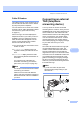
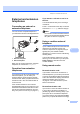

Table Of Contents
- USER’S GUIDEMFC-5890CN MFC-6490CW
- Approval Information and Compilation and Publication Notice
- Table of Contents
- Section I General
- 1 General Information
- 2 Loading paper and documents
- 3 General setup
- 4 Security features
- Section II Fax
- 5 Sending a Fax
- Entering Fax mode
- Broadcasting (Monochrome only)
- Additional sending operations
- Sending faxes using multiple settings
- Contrast
- Changing fax resolution
- Dual access (Monochrome only)
- Real time transmission
- Overseas Mode
- Delayed Faxing (Monochrome only)
- Delayed Batch Transmission (Monochrome only)
- Checking and cancelling waiting jobs
- Setting your changes as a new default
- Restoring all settings to the factory settings
- Sending a fax manually
- Out of Memory message
- 6 Receiving a Fax
- 7 Telephone and External devices
- 8 Dialling and storing numbers
- 9 Printing Reports
- 10 Polling
- 5 Sending a Fax
- Section III Copy
- 11 Making copies
- How to copy
- Copy settings
- Changing copy speed and quality
- Enlarging or reducing the image copied
- Making N in 1 copies or a poster (Page Layout)
- Sorting copies using the ADF
- Adjusting Brightness and Contrast
- Paper Options
- Skew Adjustment (MFC-6490CW only)
- Book Copy
- Watermark Copy
- Setting your changes as a new default
- Restoring all settings to the factory settings
- ‘Out of Memory’ message
- 11 Making copies
- Section IV Direct Photo Printing
- Section V Software
- Section VI Appendixes
- A Safety and Legal
- B Troubleshooting and Routine Maintenance
- C Menu and Features
- D Specifications
- E Glossary
- Index
- brother CHN-ENG

Telephone and External devices
69
7
External and extension
telephones 7
Connecting an external or
extension telephone 7
You can connect a separate telephone to
your machine as shown in the diagram below.
1 Extension telephone
2 External telephone
When you are using an external or extension
telephone, the LCD shows Telephone.
Operation from extention
telephones 7
If you answer a fax call on an extension or an
external telephone, you can make your
machine take the call by using the Remote
Activation Code. When you press the Remote
Activation Code l 51, the machine starts to
receive the fax.
If the machine answers a voice call and
pseudo/double-rings for you to take over, use
the Remote Deactivation Code # 5 1 to take
the call at an extension telephone. (See F/T
Ring Time (Fax/Tel mode only) on page 51.)
If you answer a call and no one is on
the line:
7
You should assume that you're receiving a
manual fax.
Press l 51 and wait for the chirp or until the
LCD shows Receiving, and then hang up.
Note
You can also use the Fax Detect feature to
make your machine automatically take the
call. (See Fax Detect on page 52.)
Using a cordless external
telephone 7
If your cordless telephone is connected to the
telephone line cord (See External and
extension telephones on page 69) and you
typically carry the cordless handset
elsewhere, it is easier to answer calls during
the Ring Delay.
If you let the machine answer first, you will
have to go to the machine so you can press
Photo Capture to send the call to the
cordless handset.
Using remote codes 7
Remote Activation code 7
If you answer a fax call on an extension or
external telephone, you can tell your machine
to receive it by dialling the Remote Activation
Code l 5 1. Wait for the chirping sounds then
replace the handset. See Fax Detect
on page 52. Your caller will have to press
Start to send the fax.
Remote Deactivation code 7
If you receive a voice call and the machine is
in F/T mode, it will start to sound the F/T
(double) ring after the initial ring delay. If you
pick up the call on an extension telephone
you can turn the F/T ring off by pressing # 5 1
(make sure you press this between the rings).
1
2
EXT.
EXT.
LINE
LINE