
User Manual



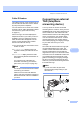
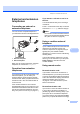

Table Of Contents
- USER’S GUIDEMFC-5890CN MFC-6490CW
- Approval Information and Compilation and Publication Notice
- Table of Contents
- Section I General
- 1 General Information
- 2 Loading paper and documents
- 3 General setup
- 4 Security features
- Section II Fax
- 5 Sending a Fax
- Entering Fax mode
- Broadcasting (Monochrome only)
- Additional sending operations
- Sending faxes using multiple settings
- Contrast
- Changing fax resolution
- Dual access (Monochrome only)
- Real time transmission
- Overseas Mode
- Delayed Faxing (Monochrome only)
- Delayed Batch Transmission (Monochrome only)
- Checking and cancelling waiting jobs
- Setting your changes as a new default
- Restoring all settings to the factory settings
- Sending a fax manually
- Out of Memory message
- 6 Receiving a Fax
- 7 Telephone and External devices
- 8 Dialling and storing numbers
- 9 Printing Reports
- 10 Polling
- 5 Sending a Fax
- Section III Copy
- 11 Making copies
- How to copy
- Copy settings
- Changing copy speed and quality
- Enlarging or reducing the image copied
- Making N in 1 copies or a poster (Page Layout)
- Sorting copies using the ADF
- Adjusting Brightness and Contrast
- Paper Options
- Skew Adjustment (MFC-6490CW only)
- Book Copy
- Watermark Copy
- Setting your changes as a new default
- Restoring all settings to the factory settings
- ‘Out of Memory’ message
- 11 Making copies
- Section IV Direct Photo Printing
- Section V Software
- Section VI Appendixes
- A Safety and Legal
- B Troubleshooting and Routine Maintenance
- C Menu and Features
- D Specifications
- E Glossary
- Index
- brother CHN-ENG

Telephone and External devices
67
7
Caller ID feature 7
The Caller ID feature of this machine lets you
use the Caller ID subscriber service offered
by many local phone companies.
You can view the list or choose one of these
numbers to fax to, add to Speed Dial or delete
from the history. (See Caller ID history
on page 73.)
After a few rings, the screen displays the
telephone number of your caller (or name, if
available). Once you answer the call, the
Caller ID information disappears from the
screen, but the call information remains
stored in the Caller ID memory.
You will see the first 16 characters of the
number or name.
# Unavailable display means call
originates outside your Caller ID service
area.
# Withheld display means the caller
has intentionally blocked transmission of
information.
You can print a list of the Caller ID
information received by your machine.
(See How to print a report on page 82.)
Note
You can print a list of Caller ID information
received by your machine.
Caller ID service varies with different
carriers. Call your local phone company to
determine the kind of service available in
your area.
Connecting an external
TAD (telephone
answering device) 7
You may choose to connect an external
answering device. However, when you have
an external TAD on the same telephone line
as the machine, the TAD answers all calls
and the machine ‘listens’ for fax calling (CNG)
tones. If it hears them, the machine takes
over the call and receives the fax. If it does
not hear CNG tones, the machine lets the
TAD continue playing your outgoing message
so your caller can leave you a voice
message.
The TAD must answer within four rings (the
recommended setting is two rings). The
machine cannot hear CNG tones until the
TAD has answered the call, and with four
rings there are only 8 to 10 seconds of CNG
tones left for the fax ‘handshake’. Make sure
you carefully follow the instructions in this
guide for recording your outgoing message.
We do not recommend using the toll saver
feature on your external answering machine if
it exceeds five rings.
Note
If you do not receive all your faxes,
shorten the Ring Delay setting on your
external TAD.
EXT.
EXT.
LINE
LINE
1
1