PANTONE2728 ® User’s Guide Safety and Legal Basic User’s Guide Advanced User’s Guide
Safety and Legal A (HL-4140CN / 4150CDN / 4570CDW(T) / DCP-9055CDN / MFC-9460CDN / 9465CDN) Please read this booklet before attempting to operate the product, or before attempting any maintenance. Failure to follow these instructions may result in an increased risk of fire, electrical shock, burns or suffocation. Symbols and conventions used in the documentation The following symbols and conventions are used throughout the documentation.
Compilation and Publication A Under the supervision of Brother Industries, Ltd., this manual has been compiled and published, covering the latest product descriptions and specifications. The contents of this manual and the specifications of this product are subject to change without notice.
CAUTION Avoid placing your product in a high-traffic area. DO NOT put the product where the ventilation holes of the product are blocked. Keep a gap of roughly 100 mm between the ventilation holes and the wall. DO NOT connect your product to electrical sockets controlled by wall switches or automatic timers, or to the same circuit as large appliances that might disrupt the power supply. Disruption of power can delete information from the product’s memory.
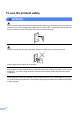
To use the product safely WARNING There are high voltage electrodes inside the product. Before you clean the inside of the product, make sure you have unplugged the telephone line cord first (MFC only) and then the power cord from the electrical socket. Doing this will prevent an electrical shock. DO NOT handle the plug with wet hands. Doing this might cause an electrical shock. Always make sure the plug is fully inserted. This product must be installed near an electrical socket that is easily accessible.
DO NOT use flammable substances near the product. DO NOT use any type of spray to clean the inside or outside of the product. Doing this may cause a fire or electrical shock. See Routine Maintenance in the User's Guide/Basic User's Guide for how to clean the product. DO NOT use a vacuum cleaner to clean up scattered toner. Doing this might cause the toner dust to ignite inside the vacuum cleaner, potentially starting a fire.
• This product is heavy and weighs more than 21.0 kg (46.3 lb) for Printer, and more than 26.5 kg (58.4 lb) for MFC/DCP. To prevent injuries when moving or lifting this product, make sure to use at least two people. Be careful not to pinch your fingers when you set the product back down. • If you use a Lower Tray, carry it separately from your product. (MFC only) Use caution when installing or modifying telephone lines.
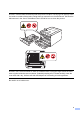
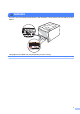
WARNING DO NOT touch the shaded parts shown in the illustration. These rollers may be rotating at high speed. Languages on the label may vary depending on your country.
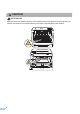
CAUTION HOT SURFACE After you have just used the product, some internal parts of the product will be extremely hot. Wait for the product to cool down before you touch the internal parts of the product.
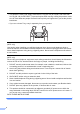
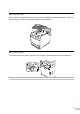
(MFC and DCP only) Some areas of the product can cause injury if covers (shaded) are closed with force. Take care when placing your hand in the areas shown in the illustrations. (MFC and DCP only) To prevent injuries, be careful not to put your fingers in the areas shown in the illustrations.
IMPORTANT DO NOT remove or damage any of the caution or warning labels inside the product.
Important safety instructions A 1 Read all of these instructions. 2 Save them for later reference. 3 Follow all warnings and instructions marked on the product. 4 Unplug this product from the wall socket before cleaning inside of the product. DO NOT use liquid or aerosol cleaners. Use a dry, lint-free soft cloth for cleaning. 5 DO NOT place this product on an unstable cart, stand, or table. The product may fall, causing serious damage to the product.
If the product has been dropped or the casing has been damaged. If the product exhibits a distinct change in performance, indicating a need for service. 16 To protect your product against power surges, we recommend the use of a power protection device (Surge Protector). 17 To reduce the risk of fire, electric shock and injury to people, note the following: DO NOT use this product near appliances that use water, a swimming pool or in a wet basement.
Regulation A Approval Information (MFC only) A THIS EQUIPMENT IS DESIGNED TO WORK WITH A TWO WIRE ANALOGUE PSTN LINE FITTED WITH THE APPROPRIATE CONNECTOR. Brother advises that this product may not function correctly in a country other than where it was originally purchased, and does not offer any warranty in the event that this product is used on public telecommunication lines in another country.
Declaration of Conformity (Europe only) (HL-4140CN / HL-4150CDN / DCP-9055CDN only) A We, Brother Industries, Ltd. 15-1, Naeshiro-cho, Mizuho-ku, Nagoya 467-8561 Japan declare that this product is in compliance with the essential requirements of Directives 2004/108/EC, 2006/95/EC and 2005/32/EC. The Declaration of Conformity (DoC) is on our Website. Please go to http://solutions.brother.com/. i choose region (eg.
Disconnect device A This product must be installed near an electrical socket that is easily accessible. In case of emergencies, you must disconnect the power cord from the electrical socket to shut off power completely. Wiring information (U.K. only) A If you need to replace the plug fuse, fit a fuse that is approved by ASTA to BS1362 with the same rating as the original fuse. Always replace the fuse cover. Never use a plug that does not have a cover. If in any doubt, call a qualified electrician.
EU Directive 2002/96/EC and EN50419 A This equipment is marked with the above recycling symbol. It means that at the end of the life of the equipment you must dispose of it separately at an appropriate collection point and not place it in the normal domestic unsorted waste stream. This will benefit the environment for all.
Trademarks A The Brother logo is a registered trademark of Brother Industries, Ltd. Brother is a registered trademark of Brother Industries, Ltd. Microsoft, Windows, Windows Server and Internet Explorer are registered trademarks of Microsoft Corporation in the United States and/or other countries. Windows Vista is either a registered trademark or a trademark of Microsoft Corporation in the United States and other countries. Apple, Macintosh, Safari and TrueType are trademarks of Apple Inc.
Open Source Licensing Remarks A This product includes open-source software. Please see Open Source Licensing Remarks and Copyright information on the supplied CD-ROM. (For Windows®) “X:\\License.txt” (where X is your drive letter). (For Macintosh) Double-click the CD-ROM icon on your desktop. Then double-click the Utilities icon. License.rtf will appear. Copyright and License A ©2010 Brother Industries, Ltd.
Unlawful use of copying equipment (MFC and DCP only) A It is an offence to make reproductions of certain items or documents with the intent to commit fraud. The following is a non-exhaustive list of documents which it may be unlawful to produce copies of.
BASIC USER’S GUIDE DCP-9055CDN Not all models are available in all countries.
If you need to call Customer Service Please complete the following information for future reference: Model Number: DCP-9055CDN Serial Number: 1 Date of Purchase: Place of Purchase: 1 The serial number is on the back of the unit. Retain this User’s Guide with your sales receipt as a permanent record of your purchase, in the event of theft, fire or warranty service. Register your product on-line at http://www.brother.com/registration/ © 2010 Brother Industries, Ltd.
User's Guides and where do I find it? Which manual? What's in it? Where is it? Safety and Legal Please read the Safety Instructions before you set up your machine. Printed / In the box Quick Setup Guide Read this Guide first. Follow the instructions for setting up your machine and installing the drivers and software for the operating system and connection type you are using. Printed / In the box Basic User's Guide Learn the basic Copy and Scan operations and how to replace consumables.
Table of Contents (BASIC USER’S GUIDE) 1 General information 1 Using the documentation .......................................................................................1 Symbols and conventions used in the documentation ....................................1 Accessing the Advanced User’s Guide, Software User’s Guide and Network User’s Guide.........................................................................................2 Viewing Documentation .................................................
6 How to scan to a computer 29 Scanning a document .......................................................................................... 29 Scanning using the scan key ............................................................................... 29 Scanning using a scanner driver .........................................................................30 A Routine maintenance 31 Replacing the consumable items.........................................................................
D Specifications 122 General ..............................................................................................................122 Document Size ..................................................................................................124 Print media.........................................................................................................125 Copy ..................................................................................................................
Table of Contents (ADVANCED USER’S GUIDE) The Advanced User's Guide explains the following features and operations. You can view the Advanced User's Guide on the Documentation CD-ROM. 1 General Setup Memory storage Automatic daylight savings time Ecology features LCD Contrast User Settings List Network Configuration List 2 Security features Secure Function Lock 2.
vi
1 General information Using the documentation 1 The following symbols and conventions are used throughout the documentation. Bold Bold style identifies keys on the machine control panel or computer screen. Italics Italicized style emphasizes an important point or refers you to a related topic. Courier New Courier New font identifies the messages shown on the LCD of the machine.
Chapter 1 Accessing the Advanced User’s Guide, Software User’s Guide and Network User’s Guide a Turn on your computer. Insert the Documentation CD-ROM into your CD-ROM drive. Note (Windows® users) If the screen does not appear automatically, go to My Computer (Computer), double-click the CD-ROM icon, and then double-click index.html. b 2 (Macintosh users) Double-click the Documentation CD-ROM icon, and then double-click index.html. Click your country.
General information Presto! PageManager User’s Guide (Macintosh) Note • (Windows® users only) Your web browser may display a yellow bar at the top of the page that contains a security warning about Active X controls. For the page to display correctly you must click on the bar, click Allow Blocked Content, then click Yes in the Security Warning dialog box. The complete Presto! PageManager User’s Guide can be viewed from the Help selection in the Presto! PageManager application.
Chapter 1 Accessing Brother Support (Windows®) You can find all the contacts you will need, such as Web support (Brother Solutions Center) on the Installation CD-ROM. 1 Accessing Brother Support (Macintosh) You can find all the contacts you will need, such as Web support (Brother Solutions Center) on the Installation CD-ROM. Click Brother Support on the main menu. The following screen will appear: Double-click the Brother Support icon.
General information 1 5
Chapter 1 Control panel overview 1 1 2 3 4 Contrast:+ Quality :Auto Enlg/Red:100% Tray :MP>T1 Sleep 11 1 COPY keys: Options You can quickly and easily choose temporary settings for copying. Enlarge/Reduce Reduces or enlarges copies. 2 Error LED Blinks in orange when the LCD displays an error or an important status message. 3 Duplex You can choose Duplex to copy on both sides of the paper. 4 5 6 LCD Displays messages to help you set up and use your machine.
General information 4 Contrast:+ Quality :Auto Enlg/Red:100% Tray :MP>T1 Sleep 5 7 1 01 9 9 6 8 SCAN: SCAN Puts the machine in Scan mode. 10 Data LED The LED will flash depending on the machine status. 11 PRINT keys: Secure You can print data saved in the memory when you enter your four-digit password. (For details about using the Secure key, see the Software User's Guide.) When using Secure Function Lock, you can switch restricted users by holding down d as you press Secure.
Chapter 1 Data LED indications 1 The Data LED (light emitting diode) will flash depending on the machine’s status. LED Machine Status Description Ready Mode The machine is ready to print, in sleep mode, there is no print data, or the power switch is off. Receiving Data The machine is either receiving data from the computer, processing data in memory, or printing data. Data Remaining in Memory Print data remains in the machine memory.
General information Volume settings Beeper volume 1 1 1 When the beeper is on, the machine will beep when you press a key or make a mistake. You can choose a range of volume levels, from High to Off. a b Press Menu, 1, 2. c Press Stop/Exit. Press a or b to choose Off, Low, Med or High. Press OK.
2 Loading paper Loading paper and print media 2 When you put paper into the paper tray, note the following: If your application software supports paper size selection on the print menu, you can select it through the software. If your application software does not support it, you can set the paper size in the printer driver or by using the control panel buttons. You can load up to 250 sheets for Tray 1 and 500 sheets for Tray 2.
Loading paper WARNING b DO NOT touch the shaded parts shown in the illustration. These rollers may be rotating at high speed. While pressing the green paper-guide release lever (1), slide the paper guides to fit the paper size you are loading in the tray. Make sure that the guides are firmly in the slots. 2 1 c Fan the stack of paper well to avoid paper jams and misfeeds.
Chapter 2 d Put paper in the tray and make sure: The paper is below the maximum paper mark (b b b) (1). Over filling the paper tray will cause paper jams. The side to be printed on must be face down. The paper guides touch the sides of the paper so it will feed properly. 1 Loading paper in the multipurpose tray (MP tray) You can load up to 3 envelopes or special print media in the MP tray or up to 50 sheets of plain paper.
Loading paper b Pull out the MP tray support and unfold the flap (1). c Put paper in the MP tray and make sure: The paper stays under the maximum paper mark (1). The paper edge is positioned between the arrows (2). The side to be printed on must be face up with the leading edge (top of the paper) in first. 1 1 2 Note When you are using glossy paper, put only one sheet at a time in the MP tray to avoid a paper jam.
Chapter 2 d Lift up the support flap to prevent paper from sliding off the face-down output tray, or remove each page as soon as it comes out of the machine. Printing on envelopes and thick paper from the MP tray Before loading, press the corners and sides of the envelopes to make them as flat as possible. a Open the MP tray and lower it gently. b Pull out the MP tray support and unfold the flap (1).
Loading paper c Lift up the support flap to prevent envelopes and thick sheets of paper from sliding off the face down output tray. If the support flap is closed you should remove each envelope as soon as it comes out of the machine. d Put up to 3 envelopes or up to 25 sheets of thick paper (163 g/m2) in the MP tray. If you add more envelopes or paper it may cause a jam. Make sure: The top of envelope edge is positioned between the arrows (1). The side to be printed on must be face up.
Chapter 2 e Open the back cover (Face-up output tray). i When you have finished printing, open the back cover and reset the two grey levers which are pulled down at step f back to the original position. Note • Remove each printed envelope immediately to prevent a paper jam. • If your thick paper curls during printing, put only one sheet at a time in the MP tray and open the back cover (back output tray) to let the printed pages exit to the back output tray.
Loading paper Scannable area 2 The figures below show unscannable areas for Copying. 2 Document Size 2 Top (1) Left (2) Bottom (1) Right (2) Letter 4 mm 3.96 mm A4 4 mm 2 mm 1 2 1 Note This unscannable area shown above is for a single copy or a 1 in 1 copy using A4 size paper. The area that cannot be scanned will vary by paper size. Unprintable area when printing from a computer 2 When using the printer driver the printable area is smaller than the paper size.
Chapter 2 Paper settings Paper Type Set up the machine for the type of paper you are using. This will give you the best print quality. a Do one of the following: To set the paper type for the MP Tray press Menu, 1, 1, 1, 1. 2 2 Paper Size You can use ten sizes of paper for printing copies: A4, Letter, Legal, Executive, A5, A5 L, A6, B5, B6 and Folio (8.5 in. × 13 in.).
Loading paper Tray Use in copy mode 2 Tray Use in print mode 2 You can change the priority tray that the machine will use for printing copies. You can change the default tray the machine will use for printing from your computer. When you choose Tray#1 Only, MP Only or Tray#2 Only 1, the machine pulls the paper only from that tray. If the selected tray is out of paper, No Paper will appear on the LCD. Insert the paper in the empty tray.
Chapter 2 Acceptable paper and other print media Recommended paper and print media Print quality may vary according to the type of paper you are using. You can use the following types of print media: thin paper, plain paper, thick paper, bond paper, recycled paper, glossy paper, labels or envelopes. For best results, follow the instructions below: DO NOT put different types of paper in the paper tray at the same time because it may cause paper jams or misfeeds.
Loading paper Paper capacity of the paper trays Paper Tray (Tray 1) 2 Paper size Paper types No. of sheets A4, Letter, Legal, B5, Executive, A5, A5 (Long Edge), A6, Plain paper, Thin paper and Recycled paper up to 250 [80 g/m2] 2 B6, Folio 1 Multi-purpose Tray (MP Tray) Optional lower Tray (Tray 2) Width: 69.8 to 216 mm Plain paper, Thin paper, Thick paper, Length: 116 to 406.
Chapter 2 Handling and using special paper The machine is designed to work well with most types of xerographic and bond paper. However, some paper variables may have an effect on print quality or handling reliability. Always test samples of paper before purchasing to ensure desirable performance. Store paper in its original packaging and keep it sealed. Keep the paper flat and away from moisture, direct sunlight and heat.
Loading paper Envelopes 2 Most envelopes designed for laser printers will be suitable for your machine. However, some envelopes may have feed and printquality problems because of the way they have been made. A suitable envelope should have edges with straight, well-creased folds and the leading edge should not be thicker than two sheets of paper. The envelope should lie flat and not be of baggy or flimsy construction.
Chapter 2 Labels 2 The machine will print on most types of labels designed for use with a laser machine. Labels should have an adhesive that is acrylic-based since this material is more stable at the high temperatures in the fuser unit. Adhesives should not come in contact with any part of the machine, because the label stock may stick to the drum unit or rollers and cause jams and print quality problems. No adhesive should be exposed between the labels.
3 Loading documents How to load documents Note 3 You can make copies, and scan from the ADF (Automatic Document Feeder) and the scanner glass. Using the automatic document feeder (ADF) • To scan documents that are not suitable for the ADF, see Using the scanner glass on page 26. • It is easier to use the ADF if you are loading a multiple page document. Length: 147.3 to 356.0 mm Width: 147.3 to 215.
Chapter 3 Using the scanner glass 3 b Using the document guidelines on the left and top, place the document face down in the upper left corner of the scanner glass. c Close the document cover. You can use the scanner glass to copy or scan pages of a book one page at a time. Document Sizes Supported Length: Up to 297.0 mm Width: Up to 215.9 mm Weight: Up to 2.0 kg How to load documents 3 3 Note To use the scanner glass, the ADF must be empty. a Lift the document cover.
4 Making copies How to copy 4 1 01 Enlg/Red (Enlarge/Reduce) 1 Stack/Sort Quality You can enter the number of copies you want by using the numeric keys. Contrast Brightness Do one of the following to load your document: Color Adjust Place the document face up in the ADF. (See Using the automatic document feeder (ADF) on page 25.) Load your document face down on the scanner glass. (See Using the scanner glass on page 26.) b 4 Press a or b to scroll through the copy settings.
5 How to print from a computer Printing a document The machine can receive data from your computer and print it. To print from a computer, install the printer driver. (See Printing for Windows® or Printing and Faxing for Macintosh in Software User's Guide for the details about the print settings.) a Install the Brother printer driver on the Installation CD-ROM. (See the Quick Setup Guide.) b From your application, choose the Print command.
6 How to scan to a computer Scanning a document There are several ways to scan documents. You can use the (SCAN) key on the machine or the scanner drivers on your computer. a To use the machine as a scanner, install a scanner driver. If the machine is on a Network, configure it with a TCP/IP address. 6 Scanning using the scan key a b c (SCAN) key. Choose the scan mode you want. Scan to: E-mail 6 OCR 1 Image FTP Network 1 Load your document. (See How to load documents on page 25.
Chapter 6 Scanning using a scanner driver For more information, see Scanning a document using the TWAIN driver or Scanning a document using the WIA driver in the Software User's Guide. a Start a scanning application and click the Scan button. b Adjust the settings such as Resolution, Brightness and Scan Type in the Scanner Setup dialog box. c Click Start or Scan to begin scanning.
A Routine maintenance A Replacing the consumable items A The following messages appear on the LCD in the Ready mode. These messages provide advanced warnings to replace the consumable items before they reach the end of their life. To avoid any inconvenience, you may want to buy spare consumable items before the machine stops printing. Toner cartridge See Replacing a Toner cartridge on page 35.
LCD messages Consumable item to replace Approximate life How to replace Model name Toner Low Toner cartridge See page 35. TN-320BK 3, Prepare New X Toner Cartridge. X = Black, Cyan, Magenta, Yellow 2,500 pages 1 2 3 TN-325BK 4, TN-320C 3, 4,000 pages 1 2 4 TN-325C 4, TN-320M 3, TN-325M 4, TN-320Y 3, 1,500 pages 1 2 3 TN-325Y 4 3,500 pages 1 2 4 WT Box End Soon Waste toner box 50,000 pages 1 1 A4 or Letter size single-sided pages. 2 Approx.
Routine maintenance You will need to clean the machine regularly and replace the consumable items when the following messages are displayed on the LCD. LCD messages Consumable item to replace Approximate life How to replace Model name Replace Toner Toner cartridge See page 35.
Note • If you choose not to return your used consumable, please discard the used consumable according to local regulations, keeping it separate from domestic waste. If you have questions, call your local waste disposal office. (See EU Directive 2002/96/EC and EN 50419 in the Safety and Legal Booklet.) • We recommend placing used consumable items on a piece of paper to prevent accidentally spilling or scattering the material inside.
Routine maintenance Replacing a Toner cartridge A Toner Low Model Name: For the model name of toner cartridges, see Replacing the consumable items on page 31. Toner Low The Standard toner cartridges can print approximately 2,500 pages (black) or approximately 1,500 pages (cyan, magenta, yellow) 1. The High Yield toner cartridges can print approximately 4,000 pages (black) or approximately 3,500 pages (cyan, magenta, yellow) 1. Actual page count will vary depending on your average type of document.
Replacing the toner cartridge a Make sure that the machine is turned on. b Press the front cover release button and then open the front cover. 36 A c Hold the green handle of the drum unit. Pull the drum unit out until it stops.
Routine maintenance d Hold the handle of the toner cartridge and slightly push it toward the machine to unlock it. Then pull it out of the drum unit. Repeat this for all the toner cartridges. IMPORTANT • We recommend that you place the drum unit and/or the toner cartridge on a clean, flat, level, stable surface with a sheet of disposable paper or cloth underneath it in case you accidentally spill or scatter toner. • Handle the toner cartridge carefully.
e Push to release the latches of the corona wire cover (1), and then open the cover. f Clean the corona wire inside the drum unit by gently sliding the green tab from left to right and right to left several times. 1 1 Note Be sure to return the tab to the home position (a) (1). If you do not, printed pages may have a vertical stripe.
Routine maintenance g Close the corona wire cover. IMPORTANT • Unpack the toner cartridge just before you put it in the machine. If a toner cartridge is left unpacked for a long time, the toner life will be shortened. • If an unpacked drum unit is put in direct sunlight or room light, the unit may be damaged. h Repeat steps e to g to clean each of three remaining corona wires. i Unpack the new toner cartridge.
j Pull off the protective cover. k Hold the handle of the toner cartridge and slide the toner cartridge into the drum unit then slightly pull it toward you until you hear it click into place. Make sure that you match the toner cartridge colour to the same colour label on the drum unit. Repeat this for all the toner cartridges. IMPORTANT Put the toner cartridge in the drum unit immediately after you have removed the protective cover.
Routine maintenance l Push the drum unit in until it stops. Replacing the drum unit A Model name: DR-320CL A new drum unit can print approximately 25,000 A4 or Letter size single-sided pages. IMPORTANT For best performance, use a Brother Original drum unit and Brother Original toner units. Printing with a third-party drum unit or toner unit may reduce not only the print quality but also the quality and life of the machine itself.
Drum Stop Drum Stop We cannot guarantee the print quality. Please replace the drum unit with a new one. We recommend a Brother Original drum unit be installed at this time. After replacement, reset the drum counter by following the instructions included with the new drum unit. 42 A Replacing the drum unit A IMPORTANT • While removing the drum unit, handle it carefully because it may contain toner. If toner scatters on your hands or clothes, wipe or wash it off with cold water at once.
Routine maintenance c Hold the green handle of the drum unit. Pull the drum unit out until it stops. d Turn the green lock lever (1) at the left of the machine anticlockwise to the release position. Holding the green handles of the drum unit, lift the front of the drum unit and remove it from the machine.
IMPORTANT • We recommend that you place the drum unit and/or the toner cartridge on a clean, flat surface with a sheet of disposable paper or cloth underneath it in case you accidentally spill or scatter toner. e Hold the handle of the toner cartridge and slightly push it to unlock it. Then pull it out of the drum unit. Repeat this for all the toner cartridges. • To prevent damage to the machine from static electricity, DO NOT touch the electrodes shown in the illustration.
Routine maintenance IMPORTANT f Unpack the new drum unit and remove the protective cover. • Handle the toner cartridge carefully. If toner scatters on your hands or clothes, wipe or wash it off with cold water at once. • We recommend that you place the drum unit and/or the toner cartridge on a clean, flat surface with a sheet of disposable paper or cloth underneath it in case you accidentally spill or scatter toner.
g Hold the handle of the toner cartridge and slide the toner cartridge into the new unit, then slightly pull it toward you until you hear it click into place. Make sure that you match the toner cartridge colour to the same colour label on the drum unit. Repeat this for all the toner cartridges. h Make sure the green lock lever (1) is in the release position as shown in the illustration.
Routine maintenance j Turn the green lock lever (1) clockwise to the lock position. Resetting the drum counter A When you replace a drum unit with a new one, you need to reset the drum counter by completing the following steps: a b c d Press Menu, 5, 8. Press a or b to choose Drum. Press OK. Press 1 to reset the drum unit counter. Press Stop/Exit. 1 k Push the drum unit in until it stops. A l Close the front cover of the machine.
Replacing the belt unit A Model name: BU-300CL A new belt unit can print approximately 50,000 A4 or Letter size single-sided pages. Replace Belt When the following message appears on the LCD, you need to replace the belt unit: Replace Parts Belt Unit IMPORTANT • DO NOT touch the surface of the belt unit. If you touch it, it could degrade print quality. • Damage caused by incorrect handling of the belt unit may void your warranty. 48 A a Make sure that the machine is turned on.
Routine maintenance c Hold the green handle of the drum unit. Pull the drum unit out until it stops. d Turn the green lock lever (1) at the left of the machine anticlockwise to the release position. Holding the green handles of the drum unit, lift the front of the drum unit and remove it from the machine.
IMPORTANT • We recommend that you place the drum unit and/or the toner cartridge on a clean, flat surface with a sheet of disposable paper or cloth underneath it in case you accidentally spill or scatter toner. • To avoid print quality problems, DO NOT touch the shaded parts shown in the illustrations. • To prevent damage to the machine from static electricity, DO NOT touch the electrodes shown in the illustration. e • Hold the green handles of the drum unit when you carry it.
Routine maintenance IMPORTANT To avoid print quality problems, DO NOT touch the shaded parts shown in the illustration. g Put the new belt unit back in the machine. Make sure the belt unit is level and fits firmly into place. A f Unpack the new belt unit.
h Make sure the green lock lever (1) is in the release position as shown in the illustration. j 1 1 i Turn the green lock lever (1) clockwise to the lock position. k Push the drum unit in until it stops. l Close the front cover of the machine. Match the guide ends (2) of the drum unit to the c marks (1) on both sides of the machine, then gently slide the drum unit into the machine until it stops at the green lock lever.
Routine maintenance Resetting the belt unit counter When you replace a belt unit with a new one, you need to reset the belt unit counter by completing the following steps: a b Press Menu, 5, 8. c d Press 1 to reset the belt unit counter. Press a or b to select Belt Unit. Press OK. Press Stop/Exit. A Replacing the waste toner box A Model name: WT-300CL A new waste toner box can print approximately 50,000 A4 or Letter size single-sided pages.
a Make sure that the machine is turned on. b Press the front cover release button and then open the front cover. 54 c Hold the green handle of the drum unit. Pull the drum unit out until it stops.
Routine maintenance d Turn the green lock lever (1) at the left of the machine anticlockwise to the release position. Holding the green handles of the drum unit, lift the front of the drum unit and remove it from the machine. 1 IMPORTANT • We recommend that you place the drum unit and/or the toner cartridge on a clean, flat surface with a sheet of disposable paper or cloth underneath it in case you accidentally spill or scatter toner.
• To avoid print quality problems, DO NOT touch the shaded parts shown in the illustrations. e 56 Hold the green handle of the belt unit with both hands and lift the belt unit up, then pull it out. IMPORTANT To avoid print quality problems, DO NOT touch the shaded parts shown in the illustration.
Routine maintenance f Remove two pieces of orange packing material and discard them. g Hold the green handle of the waste toner box and remove the waste toner box from the machine. A CAUTION Handle the waste toner box carefully in case you accidentally spill or scatter toner. If toner scatters on your hands or clothes, wipe or wash it off with cold water at once.
h 58 Unpack the new waste toner box and put the new waste toner box in the machine using the green handle. Make sure the waste toner box is level and fits firmly into place. i Put the belt unit back into the machine. Make sure the belt unit is level and fits firmly into place.
Routine maintenance j Make sure the green lock lever (1) is in the release position as shown in the illustration. l Turn the green lock lever (1) clockwise to the lock position. 1 1 m Push the drum unit in until it stops. A k Match the guide ends (2) of the drum unit to the c marks (1) on both sides of the machine, then gently slide the drum unit into the machine until it stops at the green lock lever. 1 2 n Close the front cover of the machine.
Cleaning and Checking the machine Clean the outside and inside of the machine regularly with a dry, lint-free cloth. When you replace the toner cartridge or the drum unit, make sure that you clean the inside of the machine. If printed pages are stained with toner, clean the inside of the machine with a dry, lint-free cloth. Cleaning the outside of the machine A a Turn off the machine. Disconnect all cables, and then unplug the power cord from the electrical socket.
Routine maintenance e Wipe the inside and the outside of the paper tray with a dry, lint-free soft cloth to remove dust. Cleaning the scanner glass A a Turn off the machine. Disconnect all cables, and then unplug the power cord from the electrical socket. b Lift the document cover (1). Clean the white plastic surface (2) and scanner glass (3) underneath it with a soft lint-free cloth moistened with water. 1 2 f Re-load the paper and put the paper tray firmly back in the machine.
c In the ADF unit, clean the white bar (1) and the scanner glass strip (2) underneath it with a soft lint-free cloth moistened with water. Cleaning the laser scanner windows a Turn off the machine. Disconnect all cables, and then unplug the power cord from the electrical socket. b Press the front cover release button and then open the front cover.
Routine maintenance c Hold the green handle of the drum unit. Pull the drum unit out until it stops. d Turn the green lock lever (1) at the left of the machine anticlockwise to the release position. Holding the green handles of the drum unit, lift the front of the drum unit and remove it from the machine.
IMPORTANT e Wipe the four scanner windows (1) with a dry, lint-free cloth. • We recommend that you place the drum unit and/or the toner cartridge on a clean, flat surface with a sheet of disposable paper or cloth underneath it in case you accidentally spill or scatter toner. • To prevent damage to the machine from static electricity, DO NOT touch the electrodes shown in the illustration. 1 f • Hold the green handles of the drum unit when you carry it. DO NOT hold the side of the drum unit.
Routine maintenance g Match the guide ends (2) of the drum unit to the c marks (1) on both sides of the machine, then gently slide the drum unit into the machine until it stops at the green lock lever. i Push the drum unit in until it stops. 1 2 A h Turn the green lock lever (1) clockwise to the lock position. j k Close the front cover of the machine. Plug the machine’s power cord back into the electrical socket first, and connect all cables. Turn on the machine.
Cleaning the corona wires If you have print quality problems, clean the four corona wires as follows: a 66 Press the front cover release button and then open the front cover. A b Hold the green handle of the drum unit. Pull the drum unit out until it stops.
Routine maintenance c Hold the handle of the toner cartridge and slightly push it toward the machine to unlock it. Then pull it out of the drum unit. Repeat this for all the toner cartridges. d Push to release the latches of the corona wire cover (1), and then open the cover.
e Clean the corona wire inside the drum unit by gently sliding the green tab from left to right and right to left several times. f Close the corona wire cover. g Repeat steps d to f to clean each of three remaining corona wires. 1 Note Be sure to return the tab to the home position (a) (1). If you do not, printed pages may have a vertical stripe.
Routine maintenance h Hold the handle of the toner cartridge and slide the toner cartridge into the drum unit then slightly pull it toward you until you hear it click into place. Make sure that you match the toner cartridge colour to the same colour label on the drum unit. Repeat this for all the toner cartridges. i Push the drum unit in until it stops. A C M Y j K C - Cyan M - Magenta Y - Yellow K - Black Close the front cover of the machine.
Cleaning the drum unit If your printout has coloured dots at 94 mm intervals the drum may have something stuck to the drum surface, such as glue from a label. Follow the steps below to solve the problem. a Make sure that the machine is in the Ready mode. Press Menu, 5, 6, then press Mono Start or Colour Start to print the drum dot check sheet. 56.Drum Dot Print Printing b 70 Turn off the machine. Disconnect all cables, and then unplug the power cord from the electrical socket.
Routine maintenance d Hold the green handle of the drum unit. Pull the drum unit out until it stops. e Turn the green lock lever (1) at the left of the machine anticlockwise to the release position. Holding the green handles of the drum unit, lift the front of the drum unit and remove it from the machine.
IMPORTANT • We recommend that you place the drum unit and/or the toner cartridge on a clean, flat surface with a sheet of disposable paper or cloth underneath it in case you accidentally spill or scatter toner. f Hold the handle of the toner cartridge and slightly push it to unlock it. Then pull it out of the drum unit. Repeat this for all the toner cartridges. • To prevent damage to the machine from static electricity, DO NOT touch the electrodes shown in the illustration.
Routine maintenance g Turn the drum unit over by holding the green handles. Make sure that the drum unit gears (1) are on the left hand side. i On the problem colour drum, use the numbered markers next to the drum roller to find the mark. For example, a cyan dot in column 2 on the check sheet would mean that there is a mark on the cyan drum in the "2" region.
j Turn the drum unit gear toward you by hand while looking at the surface of the suspected area. l Hold the handle of the toner cartridge and slide the toner cartridge into the drum unit then slightly pull it toward you until you hear it click into place. Make sure that you match the toner cartridge colour to the same colour label on the drum unit. Repeat this for all the toner cartridges.
Routine maintenance m Make sure the green lock lever (1) is in the release position as shown in the illustration. o Turn the green lock lever (1) clockwise to the lock position. 1 1 p Push the drum unit in until it stops. A n Match the guide ends (2) of the drum unit to the c marks (1) on both sides of the machine, then gently slide the drum unit into the machine until it stops at the green lock lever. 1 2 q Close the front cover of the machine.
r Plug the machine’s power cord back into the electrical socket first, and connect all cables. Turn on the machine. Cleaning the paper pick-up rollers If you have paper feed problems, clean the pick-up rollers as follows: 76 a Turn off the machine. Unplug the power cord from the electrical socket. b Pull the paper tray completely out of the machine.
Routine maintenance c Tightly wring out a lint-free cloth soaked in lukewarm water, and then wipe the separator pad (1) of the paper tray with it to remove dust. 1 Calibration A The output density for each colour may vary depending on the environment the machine is in such as temperature and humidity. Calibration helps you to improve the colour density. a b c d e Press Menu, 3, 6. Press a or b to select Calibrate. Press OK. Press 1 to select Yes. Press Stop/Exit.
Note • If an error message is displayed, press Stop/Exit and try again. (For more information, see Error and maintenance messages on page 80.) • If you print using the Windows® printer driver, the driver will get the calibration data automatically if both Use Calibration Data and Get device data automatically are on. The default settings are on. (See Advanced tab in the Software User's Guide.) • If you print using the Macintosh printer driver, you need to perform the calibration using the Status Monitor.
Routine maintenance Frequency (Colour Correction) A You can set how often the colour correction (Colour Calibration and Auto Registration) occurs. The default setting is Normal. The colour correction process consumes some amount of the toner. a b Press Menu, 3, 9. c Press Stop/Exit. Press a or b to choose Normal, Low or Off. Press OK.
B Troubleshooting Error and maintenance messages As with any sophisticated office product, errors may occur and consumable items may need to be replaced. If this happens, your machine identifies the error or required routine maintenance and shows the appropriate message. The most common error and maintenance messages are shown below. You can clear most errors and perform routine maintenance messages by yourself.
Troubleshooting Error Message Cause Action Cooling Down The temperature of the drum unit or toner cartridge is too hot. The machine will pause its current print job and go into cooling down mode. During the cooling down mode, you will hear the cooling fan running while the LCD shows Cooling Down, and Wait for a while. Make sure that you can hear the fan in the machine spinning and that the exhaust outlet is not blocked by something. Cover is Open The front cover is not completely closed.
Error Message Cause Action Duplex Disabled The back of the machine is not closed completely. Close the back cover of the machine. Although the size of paper in the paper tray matches the paper size that was selected from the control panel or printer driver, the machine has stopped printing when it encountered an additional, different size of paper in the tray.
Troubleshooting Error Message Cause Action No Paper The machine is out of paper or paper is not correctly loaded in the paper tray. Do one of the following: Refill the paper in the paper tray. Remove the paper and load it again. If the problem is not resolved, the paper pick-up roller may need to be cleaned. Clean the paper pick-up roller. (See Cleaning the paper pick-up rollers on page 76.
Error Message Cause Action Registration Registration failed. Press Mono Start or Colour Start and try again. Do one of the following: Turn off the machine’s power switch. Wait a few seconds, then turn it on again. Try Manual Registration, Menu, 3, 8. (See Manual Registration on page 78.) Put in a new belt unit. (See Replacing the belt unit on page 48.) If the problem continues, call your Brother dealer. Replace Parts Belt Unit It is time to replace the belt unit. Replace the belt unit.
Troubleshooting Error Message Cause Action Small paper The paper size specified in the printer driver is too small for the machine to deliver it to the Face-down output tray. Open the back cover to let the printed paper out on the back output tray and then press Mono Start or Colour Start. Toner Error One or more toner cartridges are not installed correctly. Pull out the drum unit. Take out all the toner cartridges, and then put them back into the drum unit.
Document is jammed in the top of the ADF unit B Document is jammed under the document cover a Take out any paper from the ADF that is not jammed. a Take out any paper from the ADF that is not jammed. b c Open the ADF cover. b c Lift the document cover. d e Close the ADF cover. d e Close the document cover. 86 Pull the jammed document out to the left. Pull the jammed document out to the right. Press Stop/Exit. Press Stop/Exit.
Troubleshooting Removing small documents jammed in the ADF a b B Document is jammed at the output tray B Lift the document cover. a Insert a piece of stiff paper, such as cardstock, into the ADF to push any small paper scraps through. Take out any paper from the ADF that is not jammed. b Pull the jammed document out to the right. c Press Stop/Exit. B c d Close the document cover. Press Stop/Exit.
Paper is jammed in the MP tray d B If the LCD shows Jam MP Tray, follow these steps: a b When loading paper in the MP tray, make sure that the paper stays under the maximum paper height guides (1) on both sides of the tray. Remove the paper from the MP tray. Remove any jammed paper from in and around the MP tray. 1 e c 88 Fan the paper stack, and then put it back in the MP tray. Press Mono Start or Colour Start to resume printing.
Troubleshooting Paper is jammed in the Paper Tray 1 or Tray 2 If the LCD shows Jam Tray 1 or Jam Tray 2, follow these steps: a WARNING B DO NOT touch the shaded parts shown in the illustration. These rollers may be rotating at high speed. Pull the paper tray completely out of the machine.
b Use both hands to slowly pull out the jammed paper. Paper is jammed at the back of the machine If the LCD shows Jam Rear, a paper jam occurred behind the back cover. Follow these steps: IMPORTANT If the paper cannot easily be removed in this direction, stop and follow the instructions for Paper is jammed inside the machine on page 92. Note Pulling out the jammed paper downwards allows you to remove the paper easier. c Make sure the paper is below the maximum paper mark (b b b) of the paper tray.
Troubleshooting CAUTION HOT SURFACE c Pull the green tabs (2) at the left and right hand sides toward you and fold down the fuser cover (1). 2 After you have just used the machine, some internal parts of the machine will be extremely hot. Wait for the machine to cool down before you touch the internal parts of the machine.
e Close the fuser cover (1). Paper is jammed inside the machine If the LCD shows Jam Inside, follow these steps: 2 1 2 Note If you print on envelopes, pull down the envelope levers (2) to the envelope position again before closing the back cover. f 92 Fully close the back cover. a Turn off the machine. Disconnect all cables, and then unplug the power cord from the electrical socket. b Press the front cover release button and then open the front cover.
Troubleshooting c Hold the green handle of the drum unit. Pull the drum unit out until it stops. d Turn the green lock lever (1) at the left of the machine anticlockwise to the release position. Holding the green handles of the drum unit, lift the front of the drum unit and remove it from the machine.
IMPORTANT e Pull out the jammed paper slowly. f Make sure the green lock lever (1) is in the release position as shown in the illustration. • We recommend that you place the drum unit and the toner cartridges on a clean, flat surface with a sheet of disposable paper or cloth underneath it in case you accidentally spill or scatter toner. • To prevent damage to the machine from static electricity, DO NOT touch the electrodes shown in the illustration.
Troubleshooting g Match the guide ends (2) of the drum unit to the c marks (1) on both sides of the machine, then gently slide the drum unit into the machine until it stops at the green lock lever. i Push the drum unit in until it stops. 1 2 B h Turn the green lock lever (1) clockwise to the lock position. j Close the front cover of the machine. Note 1 If you turn off the machine during Jam Inside, the machine will print incomplete data from your computer.
Paper is jammed underneath paper tray 1 b If paper is not caught inside the machine, check underneath the paper tray. c Put the paper tray firmly back in the machine. B If the LCD shows Jam Duplex, follow these steps: a Pull the paper tray completely out of the machine. WARNING DO NOT touch the shaded parts shown in the illustration. These rollers may be rotating at high speed.
Troubleshooting Troubleshooting B If you think there is a problem with your machine, check the chart below and follow the troubleshooting tips. Most problems can be easily resolved by yourself. If you need additional help, the Brother Solutions Center offers the latest FAQs and troubleshooting tips. Visit us at http://solutions.brother.com/. If you are having difficulty with your machine B Check the chart below and follow the troubleshooting tips.
Printing difficulties (continued) Difficulties Suggestions The machine prints unexpectedly or it prints garbage. Pull out the paper tray and wait until the machine stops printing. Then turn off the machine and disconnect from the power for several minutes. Check the settings in your application to make sure it is set up to work with your machine. The machine prints the first couple of pages correctly, then some pages have text missing.
Troubleshooting Paper handling difficulties Difficulties Suggestions The machine does not feed paper. If there is no paper, load a new stack of paper into the paper tray. The LCD shows No Paper or a Paper Jam message. If there is paper in the paper tray, make sure it is straight. If the paper is curled, you should straighten it. Sometimes it is helpful to remove the paper, turn the stack over and put it back into the paper tray. Reduce the amount of paper in the paper tray, and then try again.
Network difficulties Difficulties Suggestions Cannot print over a wired Network. If you are having Network problems see the Network User's Guide for more information. Make sure your machine is powered on and is on-line and in the Ready mode. Print the Network Configuration list to see your current Network settings. (See Reports in Chapter 1 of the Advanced User's Guide.) Reconnect the LAN cable to the hub to verify that the cable and network connections are good.
Troubleshooting Improving the print quality B If you have a print quality problem, print a test page first (Menu, 3, 2, 3). If the printout looks good, the problem is probably not the machine. Check the interface cable connections or try printing a different document. If the printout or test page printed from the machine has a quality problem, check the following steps first. And then, if you still have a print quality problem, check the chart below and follow the recommendations.
Examples of poor print quality White streaks or bands down the page Recommendation Wipe the laser scanner windows with a dry lint-free soft cloth. (See Cleaning the laser scanner windows on page 62.) Clean the drum unit. (See Cleaning the drum unit on page 70.) ABCDEFGHIJKLMNOPQRSTUVWXYZ. 0123456789. abcdefghijklmnopqrstuvwxyz. ABCDEFGHIJKLMNOPQRSTUVWXYZ. 0123456789. abcdefghijklmnopqrstuvwxyz. ABCDEFGHIJKLMNOPQRSTUVWXYZ. 0123456789. abcdefghijklmnopqrstuvwxyz. ABCDEFGHIJKLMNOPQRSTUVWXYZ. 0123456789.
Troubleshooting Examples of poor print quality Completely blank or some colours are missing ABCDEFGHIJKLMNOPQRSTUVWXYZ. 0123456789. abcdefghijklmnopqrstuvwxyz. ABCDEFGHIJKLMNOPQRSTUVWXYZ. 0123456789. abcdefghijklmnopqrstuvwxyz. ABCDEFGHIJKLMNOPQRSTUVWXYZ. 0123456789. abcdefghijklmnopqrstuvwxyz. ABCDEFGHIJKLMNOPQRSTUVWXYZ. 0123456789. abcdefghijklmnopqrstuvwxyz. ABCDEFGHIJKLMNOPQRSTUVWXYZ. 0123456789. abcdefghijklmnopqrstuvwxyz. ABCDEFGHIJKLMNOPQRSTUVWXYZ. 0123456789. abcdefghijklmnopqrstuvwxyz.
Examples of poor print quality The colour of your printouts is not what you expected Recommendation Make sure Toner Save mode is off in the control panel of the machine or the printer driver. Perform the calibration. (See Calibration on page 77.) Adjust the colour by using the custom setting in the printer driver and by using the control panel of the machine. Colours the machine can print and colours you see on a monitor are different.
Troubleshooting Examples of poor print quality Uneven density appears periodically across the page ABCDEFGHIJKLMNOPQRSTUVWXYZ. 0123456789. abcdefghijklmnopqrstuvwxyz. ABCDEFGHIJKLMNOPQRSTUVWXYZ. 0123456789. abcdefghijklmnopqrstuvwxyz. ABCDEFGHIJKLMNOPQRSTUVWXYZ. 0123456789. abcdefghijklmnopqrstuvwxyz. ABCDEFGHIJKLMNOPQRSTUVWXYZ. 0123456789. abcdefghijklmnopqrstuvwxyz. Recommendation Perform the calibration. (See Calibration on page 77.) Adjust the contrast or brightness when you are in copy mode.
Examples of poor print quality Poor fixing ABCDEFGHIJKLMNOPQRSTUVWXYZ. 0123456789. abcdefghijklmnopqrstuvwxyz. ABCDEFGHIJKLMNOPQRSTUVWXYZ. 0123456789. abcdefghijklmnopqrstuvwxyz. ABCDEFGHIJKLMNOPQRSTUVWXYZ. 0123456789. abcdefghijklmnopqrstuvwxyz. ABCDEFGHIJKLMNOPQRSTUVWXYZ. 0123456789. abcdefghijklmnopqrstuvwxyz. Recommendation Make sure that the media type settings in the printer driver and in the machine's Paper Type menu matches the type of paper you are using.
Troubleshooting Examples of poor print quality Make sure that the envelope lever is pulled down when you are printing envelopes. EFGHIJKLMN ABCDEFG Envelope creases Recommendation B If creases occur with the envelope levers in the envelope position, print with the back cover opened and feed one envelope at a time from the MP tray.
Machine Information Checking the Serial Number B B You can see the machine’s Serial Number on the LCD. a b Press Menu, 5, 2. How to reset the machine a b Press Menu, 1, 8. c Do one of the following; To reset the settings, press 1 and go to step d. Press Stop/Exit. Reset functions The following reset functions are available: 1 Network To exit without making changes, press 2 and go to step e.
C Menu and features On-screen programming Your machine has been designed to be easy to use. The LCD provides on-screen programming using the menu keys. C How to access the menu mode C C a b Press Menu. Choose an option. Press 1 for General Setup menu. We have created step by step on-screen instructions to help you program your machine. Simply follow the steps as they guide you through the menu selections and programming options. Press 2 for Copy menu. Press 3 for Printer menu.
Menu table C The factory settings are shown in Bold with an asterisk. Choose & OK Choose & OK to accept to exit Level 1 Level 2 Level 3 Level 4 Options Descriptions 1.General Setup 1.Paper 1.Paper Type 1.MP Tray Thin Sets the type of paper in the paper tray. 18 Sets the type of paper in the paper tray. 18 Sets the type of paper in the paper tray. 18 Plain* Page Thick Thicker Recycled Paper Glossy Paper 2.Tray#1 Thin Plain* Thick Thicker Recycled Paper 1 See Advanced User's Guide.
Menu and features Level 1 Level 2 1.General Setup 1.Paper (Continued) Level 3 Level 4 Options Descriptions 2.Paper Size 1.MP Tray A4* Sets the size of the paper in the paper tray. 18 Sets the size of the paper in the paper tray. 18 (Continued) Letter Page Legal Executive A5 A5 L A6 B5 B6 Folio Any 2.Tray#1 A4* Letter Legal Executive A5 A5 L A6 B5 C B6 Folio 3.Tray#2 A4* (This menu only appears if you have the optional tray#2.) Letter Sets the size of the paper in the paper tray.
Level 1 Level 2 Level 3 Level 4 Options Descriptions Page 1.General Setup 3.Ecology 1.Toner Save — On Increases the page yield of the toner cartridge. See 1. (Continued) Off* 2.Sleep Time — Range varies depending on models. Conserves power. 003Min* 4.Tray Use 1.Copy — Tray#1 Only Tray#2 Only Chooses the tray that will be used for Copy mode. 19 Chooses the tray that will be used for Print mode. 19 Adjusts the contrast of the LCD. See 1.
Menu and features Level 1 Level 2 1.General Setup 6.Function Lock Level 3 Level 4 Options Descriptions Page — — — Can restrict selected machine operation for up to 25 individual users and all other non-authorized Public users. See 1. 1.Glass ScanSize — A4* Adjusts the scan area of the scanner glass to the size of the document. See 3. You can set your own default settings of the data compression rate. See 3. Restores all network settings to factory default. 108 (Continued) 7.
Level 1 Level 2 Level 3 Options Descriptions Page 2.Copy 1.Quality — Auto* You can choose the Copy resolution for your type of document. See 1. Text Photo Graph 2.Brightness — -nnnno+ Adjust the brightness for copies. -nnnon+ -nnonn+* -nonnn+ -onnnn+ 3.Contrast — -nnnno+ Adjusts the contrast for copies. -nnnon+ -nnonn+* -nonnn+ -onnnn+ 4.Color Adjust 1.Red -nnnno+ Adjusts the red colour for copies. -nnnon+ -nnonn+* -nonnn+ -onnnn+ 2.
Menu and features Level 1 Level 2 Level 3 Options Descriptions Page 3.Printer 1.Emulation — Auto* Chooses the emulation mode. See 1. HP LaserJet BR-Script 3 2.Print Options 1.Internal Font 1.HP LaserJet 2.BR-Script 3 3.Duplex 2.Configuration — 3.Test Print — Prints a test page. — Off* Enables or disables duplex printing. You can also choose long edge or short edge duplex printing. On(Long Edge) On(Short Edge) 4.Output Color — Auto* Color B&W 5.Reset Printer — 1.Reset 2.Exit 6.
Level 1 Level 2 Level 3 Options Descriptions 3.Printer 8.Manual Regist. 1.Print Chart — Print the chart to manually check the registration of the colours. 2.Set Regist. 1 Magenta Left Sets the correction value on the chart you printed from Print Chart. (Continued) 2 Cyan Left 3 Yellow Left Page 78 4 Magenta Center 5 Cyan Center 6 Yellow Center 7 Magenta Right 8 Cyan Right 9 Yellow Right 9.Frequency — Normal* Low Off 1 See Software User's Guide.
Menu and features Level 1 Level 2 Level 3 Level 4 Options Descriptions 4.Network 1.TCP/IP 1.Boot Method — Auto* Chooses the BOOT method that best suits your needs. Static RARP BOOTP DHCP 2.IP Address — [000-255]. [000-255]. [000-255]. [000-255] Enter the IP address. 3.Subnet Mask — [000-255]. [000-255]. [000-255]. [000-255] Enter the Subnet mask. 4.Gateway — [000-255]. [000-255]. [000-255]. [000-255] Enter the Gateway address. 5.Node Name — BRNXXXXXXXXXXXX Enter the Node name.
Level 1 Level 2 Level 3 Level 4 Options Descriptions 4.Network 2.Ethernet — — Auto* Chooses the Ethernet link mode. (Continued) 100B-FD 100B-HD 10B-FD 10B-HD 3.Status — — Active 100B-FD Active 100B-HD Shows the Ethernet link status. Active 10B-FD Active 10B-HD Inactive 4.MAC Address — — — Shows the MAC address of the machine. 5.Scan To FTP — — Color 100 dpi* Chooses the file format to send the scanned data via FTP.
Menu and features Level 1 Level 2 Level 3 Options Descriptions Page 5.Machine Info. 1.Date&Time 1.Date&Time — Puts the date and time on the LCD. See 2. 2.Auto Daylight On* Changes for Daylight Savings Time automatically. See 1. Off 3.Time Zone UTCXXX:XX Sets the time zone for your country. See 3. 2.Serial No. — — You can check the serial number of your machine. 108 3.Page Counter — Total You can check the number of total pages the machine has printed during its life. See 1.
Entering text C When setting certain menu selections, you will need to type text characters. The numeric keys have letters printed on them. The keys: 0, # and l do not have printed letters because they are used for special characters. Press the appropriate numeric key the number of times shown in this reference table to access the character you want. Press Key one time two times three times four times five times six times seven times eight times nine times 1 @ . / 1 @ .
Menu and features Special characters and symbols Press l, # or 0, then press d or c to move the cursor to the symbol or character you want. Press OK to choose it. The symbols and characters below will appear depending on your menu selection. Press l for (space) ! " # $ % & ’ ( ) l + , - .
D Specifications D General D Printer Type Laser Print Method Electrophotography by semiconductor laser beam scanning Memory Capacity 128 MB LCD (liquid crystal display) 22 characters × 5 lines Power Source Power Consumption 220 - 240 V AC 50/60Hz 1 Peak: 1200 W Copying (Average): Approx. 570 W 2 Deep Sleep (Average): Approx. 1.2 W Ready (Average): Approx.
Specifications Noise level Sound power 1 Operating (Colour Copying): LWAd = 6.68 B (A) Operating (Monochrome Copying): LWAd = 6.67 B (A) Office equipment with LWAd > 6.30 B (A) is not suitable for use in room where people do primarily intellectual work. Such equipment should be placed in separate rooms because of the noise emission. Standby: LWAd = 4.26 B (A) Sound pressure 1 Operating (Printing): LPAm = 57 dB (A) Standby: LPAm = 33 dB (A) Measured in accordance with ISO 9296.
Document Size Document Size (Single-sided) D ADF Width: 147.3 to 215.9 mm ADF Length: 147.3 to 356.0 mm Scanner Glass Max. 215.9 mm Width: Scanner Glass Max.
Specifications Print media Paper Input D Paper Tray Paper Type: Plain paper, Thin paper or Recycled paper Paper Size: Letter, A4, B5 (ISO/JIS), A5, A5 (Long Edge), B6 (ISO), A6, Executive, Legal and Folio Paper Weight: 60 to 105 g/m2 Maximum Paper Tray Capacity: Up to 250 sheets of 80 g/m2 Plain paper Multi-purpose tray (MP tray) Paper Type: Envelope, Env.Thin, Env.
Duplex Printing Manual Duplex: Yes Automatic Duplex: Yes Paper Size (Automatic Duplex): A4 Paper Weight (Automatic Duplex): 60 to 105 g/m2 Paper Type (Automatic Duplex): Plain paper, Thin paper, Recycled paper or Glossy paper 1 For labels, we recommend removing printed pages from the output paper tray immediately after they exit the machine to avoid the possibility of smudging. 2 60 to 105 g/m2 for duplex print.
Specifications Copy D Colour/Black Yes/Yes Copy Width Max.
Scanner D Colour/Black Yes/Yes TWAIN Compliant Yes (Windows® 2000 Professional/Windows® XP/ Windows® XP Professional x64 Edition/Windows Vista ®/ Windows® 7) Mac OS X 10.4.11 – 10.6.x 1 WIA Compliant Yes (Windows® XP/Windows Vista®/Windows® 7) Colour Depth 48 bit internal / 24 bit external colour Resolution Up to 19200 × 19200 dpi (interpolated) 2 Up to 1200 × 2400 dpi (optical) 2 (from Scanner Glass) Up to 1200 × 600 dpi (optical) 2 (from ADF) Scanning Width Max.
Specifications Printer D Automatic 2-sided (Duplex) Print Yes Emulations PCL6, BR-Script3 (PostScript® 3™) Resolution 600 dpi × 600 dpi, 2400 dpi (2400 × 600) quality Print Speed Up to 14 sides/minute (Up to 7 sheets/minute) (Monochrome Duplex) (A4 size) 1 Print Speed (Colour Duplex) Up to 14 sides/minute (Up to 7 sheets/minute) (A4 size) Print Speed (Monochrome) Up to 24 pages/minute (A4 size) 1 Print Speed (Colour) Up to 24 pages/minute (A4 size) 1 First Print Out Time (Monochrome) Less
Interfaces D USB Use a USB 2.0 cable (Type A/B) that is no more than 2.0 meters long. 1 2 Ethernet 3 Use an Ethernet UTP cable category 5 or greater. 1 Your machine has a Hi-Speed USB 2.0 interface. The machine can also be connected to a computer that has a USB 1.1 interface. 2 Third party USB ports are not supported. 3 See Network (LAN) on page 134 and the Network User's Guide for detailed network specifications.
Specifications Computer requirements D Minimum System Requirements and Supported PC Software Functions Computer Platform & Operating System Version Processor Minimum Speed Windows® Operating Windows® 2000 Intel® Pentium® II or equivalent System 1 Professional 4 Minimum Recommended RAM RAM 64 MB 256 MB Hard Disk Space to install For Drivers For Applications 150 MB 500 MB 500 MB 1.
Minimum System Requirements and Supported PC Software Functions Computer Platform & Operating System Version Windows® Operating System 1 Windows ® Server 2003 (print only via network) Windows ® Server 2003 x64 Edition (print only via network) Windows ® Server 2008 (print only via network) Windows ® Server 2008 R2 (print only via network) Macintosh Mac OS X Operating 10.4.11 System 10.5.x Mac OS X 10.6.
Specifications Consumable items Toner Cartridge Life D Starter Toner Cartridge: Black Approx. 2,500 pages (A4) 1 Cyan, Magenta, Yellow Approx. 1,500 pages (A4) 1 Standard Toner Cartridge: TN-320BK (Black): Approx. 2,500 pages (A4) 1 TN-320C (Cyan): Approx. 1,500 pages (A4) 1 TN-320M (Magenta): Approx. 1,500 pages (A4) 1 TN-320Y (Yellow): Approx. 1,500 pages (A4) 1 High Capacity Toner Cartridge: TN-325BK (Black): Approx. 4,000 pages (A4) 1 TN-325C (Cyan): Approx.
Network (LAN) Note For details about the full Network specifications, see Network User's Guide. LAN You can connect your machine to a network for Network Printing and Network Scanning 1. Also included is Brother BRAdmin Light 2 Network Management software. Wired Network Security APOP, POP before SMTP, SMTP-AUTH, SSL/TLS (IPPS, HTTPS, SMTP, POP), SNMP v3, 802.1x (EAP-MD5, EAP-FAST, PEAP, EAP-TLS, EAP-TTLS), Kerberos 1 See Computer requirements on page 131.
E Index A F ADF (automatic document feeder) using .....................................................25 Apple Macintosh See Software User’s Guide. Folio ................................................... 18, 21 B Belt unit replacing ...............................................48 C Cleaning corona wires .........................................66 drum unit ...............................................70 laser scanner windows .........................62 scanner .................................
O S Out of Memory message ..........................83 Scanner glass using ..................................................... 26 Scanning See Software User’s Guide. Secure key ................................................ 7 Serial number how to find See inside front cover Status LED ................................................ 8 P Paper .............................................. 20, 125 how to load ............................................10 in multi-purpose tray .......................
The machine is approved for use in the country of purchase only, local Brother companies or their dealers will only support machines purchased in their own countries.
ADVANCED USER’S GUIDE DCP-9055CDN Not all models are available in all countries.
User's Guides and where do I find it? i Which manual? What's in it? Where is it? Safety and Legal Please read the Safety Instructions before you set up your machine. Printed / In the box Quick Setup Guide Read this Guide first. Follow the instructions for setting up your machine and installing the drivers and software for the operating system and connection type you are using. Printed / In the box Basic User's Guide Learn the basic Copy and Scan operations and how to replace consumables.
Table of Contents 1 General Setup 1 Memory storage..................................................................................................... 1 Automatic daylight savings time ............................................................................ 1 Ecology features.................................................................................................... 2 Toner Save ......................................................................................................
B Options 28 Optional paper tray (LT-300CL)...........................................................................28 Memory board......................................................................................................28 SO-DIMM Types ............................................................................................28 Installing extra memory .................................................................................
1 General Setup Memory storage Your menu settings are stored permanently, and in the event of a power failure will not be lost. Temporary settings (for example, Contrast) will be lost. Also, during a power failure the machine will retain the date and time for up to 60 hours. 1 1 Automatic daylight savings time 1 1 You can set the machine to change automatically for Daylight Savings Time. It will set itself forward one hour in the Spring, and back one hour in the Autumn. a b Press Menu, 5, 1, 2.
Chapter 1 Ecology features Toner Save 1 1 You can save toner using this feature. When you set Toner Save to On, prints appear lighter. The default setting is Off. a b c Press Menu, 1, 3, 1. Press a or b to choose On or Off. Press OK. Press Stop/Exit. Note We do not recommend Toner Save for printing Photo or Greyscale images. Sleep Mode The Sleep Mode Setting can reduce power consumption. When the machine is in Sleep Mode (Power Save mode) it acts as though it were turned off.
General Setup LCD Contrast 1 User Settings List You can change the contrast to make the LCD look lighter or darker. You can print a list of the settings you programmed. a b a b c c Press Menu, 1, 5. Press c to make the LCD darker. Or, press d to make the LCD lighter. Press OK. 1 1 Press Menu, 5, 4. Press Mono Start or Colour Start. Press Stop/Exit. Press Stop/Exit.
Chapter 1 Network Configuration List The Network Configuration List is a report listing the current network configuration including the network print server settings. Note Node name: Node name appears in the Network Configuration List. The default node name is “BRNXXXXXXXXXXXX”. a b c 4 Press Menu, 5, 5. Press Mono Start or Colour Start. Press Stop/Exit.
2 Security features Secure Function Lock 2.0 Secure Function Lock lets you restrict Public access to the following machine functions: Copy Scan PC Print Colour Print This feature also prevents users from changing the Default settings of the machine by limiting access to the Menu settings. Before using the security features you must first enter an administrator password. Access to restricted operations can be enabled by creating a restricted user.
Chapter 2 Changing the password for the administrator 2 a b Press Menu, 1, 6. c Enter the registered four-digit password. Press OK. d Enter a four-digit number for the new password. Press OK. e f 6 Press a or b to choose Set Password. Press OK. If the LCD shows Verify: re-enter the new password. Press OK. Press Stop/Exit. Setting up the public user mode Public user mode restricts the functions that are available for Public users.
Security features Setting up restricted users 2 You can set up users with restrictions and a password for functions that are available to them. You can set up more advanced restrictions, such as by page count or PC user login name, through Web Based Management. (For more information, see the Network User's Guide.) You can set up to 25 restricted users with restrictions and a password. a b Press a or b to choose Setup ID. Press OK. Enter the administrator password. Press OK.
Chapter 2 Switching Users 2 This setting allows you to switch between registered restricted users or Public mode when Secure Function Lock is turned on. Changing to the restricted user Mode a b c Hold down d as you press Secure. • If the function you want to use is restricted for all users, Not Available will appear on the LCD and then the machine will go back to the Ready mode. You cannot access to the function you want to use. Contact your administrator to check your Secure Function Lock Settings.
3 Making copies Copy settings 3 When you want to quickly change the copy settings temporarily for the next copy, use the temporary COPY keys. You can use different combinations. 3 Enlarging or reducing the image copied 3 You can choose the following enlargement or reduction ratios: Press 100%* 97% LTRiA4 94% A4iLTR The machine returns to its default settings one minute after copying. 91% Full Page 85% LTRiEXE To change a setting, press a or b and d or c to scroll through the COPY settings.
Chapter 3 d Do one of the following: Press a or b to choose the enlargement or reduction ratio you want. Press OK. Press a or b to choose Custom(25-400%). Press OK. Use the numeric keys to enter an enlargement or reduction ratio from 25% to 400%. (For example, press 5 3 to enter 53%.) Press OK. e Press Mono Start or Colour Start. Note Page Layout Options 2 in 1 (P), 2 in 1 (L), 2 in 1 (ID), 4 in 1 (P) and 4 in 1 (L) are not available with Enlarge/Reduce.
Making copies Using the Options key 3 Use the Options key to quickly set the following copy settings temporarily for the next copy.
Chapter 3 Sorting copies using the ADF You can sort multiple copies. Pages will be stacked in the order 1 2 3, 1 2 3, 1 2 3, and so on. a b c d e Load your document in the ADF. Use the numeric keys to enter the number of copies (up to 99). Press Options. Press a or b to choose Stack/Sort. Press OK. Press a or b to choose Sort. Press OK. Press Mono Start or Colour Start. 3 Improving copy quality 3 You can choose from a range of quality settings. The default setting is Auto.
Making copies Adjusting Contrast, Colour and Brightness Contrast c Press Options. Press a or b to choose Contrast. Press OK. d Press d or c to increase or decrease the contrast. Press OK. e Press Mono Start or Colour Start. c d Press d or c to make a lighter copy or a darker copy. Press OK. Press Mono Start or Colour Start. a b Press Menu, 2, 2. c Press Stop/Exit. Press d or c to make a lighter copy or a darker copy. Press OK.
Chapter 3 Making N in 1 copies (page layout) You can reduce the amount of paper used when copying by using the N in 1 copy feature. This allows you to copy two or four pages onto one page. If you want to copy both sides of an ID card onto one page, see 2 in 1 ID Copy on page 15. f 3 Flatbed Copy: Next Page? a 1.Yes b 2.No Select ab or OK g Put the next page on the scanner glass. Press OK. Repeat steps f and g for each page of the layout.
Making copies If you are copying from the scanner glass: Insert your document face down in the direction shown below: 2 in 1 (P) 2 in 1 ID Copy 3 3 You can copy both sides of your identification card onto one page, keeping the original card size. Note 2 in 1 (L) You can copy an identification card to the extent permitted under applicable laws. See Unlawful use of copying equipment in the Safety and Legal Booklet.
Chapter 3 Press Mono Start or Colour Start. The machine scans the other side of the card and prints the page. Duplex (2-sided) copying Note If you want to use the automatic duplex copy feature, load your document in the ADF. When 2 in 1 ID Copy is chosen, the machine sets the quality to Photo and the contrast to +2 (-nnnno+.) Tray selection If you get an Out of Memory message while you are making duplex copies, try installing extra memory. (See Installing extra memory on page 29.
Making copies Advanced Duplex Copy (short edge flip) 3 1 sided i 2 sided S Portrait 1 3 1 2 2 Landscape 11 1 2 2 a b Load your document. c Press Duplex and a or b to select 1sidedi2sided S. Press OK. d Press Mono Start or Colour Start to copy the document. Enter the number of copies (up to 99) using the numeric keys.
A Routine maintenance Cleaning and checking the machine Clean the outside and inside of the machine regularly with a dry, lint-free cloth. When you replace the toner cartridge or the drum unit, make sure that you clean the inside of the machine. If printed pages are stained with toner, clean the inside of the machine with a dry, lint-free cloth.
Routine maintenance Replacing periodic maintenance parts A The periodic maintenance parts will need to be replaced regularly to maintain the print quality. The parts listed below will have to be replaced after printing approximately 50,000 pages 1 for PF KitMP and 100,000 pages 1 for PF Kit 1, PF Kit 2, Fuser and Laser. Please call your Brother dealer when the following messages appear on the LCD. 1 A A4 or Letter size single-sided pages.
Packing and shipping the machine Note If for any reason you must ship your machine, carefully repack the machine in the original packaging to avoid any damage during transit. The machine should be adequately insured with the carrier. A WARNING This machine is heavy and weighs approximately 26.5 kg. To prevent possible injuries at least two people should lift the machine. Be careful not to pinch your fingers when you put the machine down.
Routine maintenance a Turn off the machine. Disconnect all cables, and then unplug the power cord from the electrical socket. b Press the front cover release button and then open the front cover. c Hold the green handle of the drum unit. Pull the drum unit out until it stops.
d Turn the green lock lever (1) at the left of the machine anticlockwise to the release position. Holding the green handles of the drum unit, lift the front of the drum unit and remove it from the machine. 1 IMPORTANT • Hold the green handles of the drum unit when you carry it. DO NOT hold the sides of the drum unit. • We recommend that you place the drum unit on a clean, flat surface with a piece of disposable paper underneath it in case you accidentally spill or scatter toner.
Routine maintenance e Hold the green handle of the belt unit with both hands and lift the belt unit up, then pull it out. Note This step is only necessary when you are replacing the waste toner box for the first time, and is not required for the replacement waste toner box. The orange packing pieces are installed at the factory to protect your machine during shipment. g f Remove the waste toner box from the machine using the green handle, and then put it in a plastic bag and seal the bag completely.
h Put the belt unit back into the machine. Make sure the belt unit is level and fits firmly into place. 1 2 i Install orange packing materials to the drum unit as follows: Install one orange packing material (1) to secure the toner cartridges to the drum unit on the left and right sides respectively. Install one orange packing material (2) to the drum’s side surface on the left side only, as viewed from the front.
Routine maintenance j Put a piece of paper (A4 or Letter) on the belt unit to prevent damage to the belt unit. l Match the guide ends (2) of the drum unit to the c marks (1) on both sides of the machine, then gently slide the drum unit into the machine until it stops at the green lock lever. 1 2 k A Make sure the green lock lever (1) is in the release position as shown in the illustration. m Turn the green lock lever (1) clockwise to the lock position.
n Push the drum unit in until it stops. p Put the Styrofoam piece (1) into the carton. Then put the waste toner box in the Styrofoam piece. FRONT q o Wrap the machine with a plastic bag. Put the machine on the Styrofoam piece (1). Close the front cover of the machine.
Routine maintenance r Put the two styrofoam pieces (1) into the carton matching the right of the machine to the "RIGHT" mark on one of the styrofoam pieces, and the left of the machine to the "LEFT" mark on the other styrofoam piece. Put the AC power cord and printed materials in the original carton as shown in the illustration. A LEFT 1 RIGHT 1 s Close the carton and tape it shut.
B Options Optional paper tray (LT-300CL) An optional lower tray can be installed, and it can hold up to 500 sheets of 80 g/m2 paper. When an optional tray is installed, the machine can hold up to 800 sheets of plain paper. B Memory board B DCP-9055CDN has 128 MB of standard memory. The machine has one slot for optional memory expansion. You can increase the memory up to maximum of 384 MB by installing one SO-DIMM (Small Outline Dual In-line Memory Module).
Options Installing extra memory a b B e Turn off the machine. Disconnect the interface cables from the machine, and then unplug the power cord from the electrical socket. Hold the SO-DIMM by the edges and align the notches in the SO-DIMM with the protrusions in the slot. Insert the SO-DIMM diagonally (1), then tilt it toward the interface board until it clicks into place (2). 1 2 Note Be sure to turn off the machine’s power switch before you install or remove the SO-DIMM.
g Plug the machine’s power cord back into the electrical socket first, and then connect the interface cables. h Turn on the machine’s power switch. Note To make sure that you have installed the SO-DIMM properly, you can print the user settings page that shows the current memory size. (See User Settings List on page 3.
C Glossary C This is a comprehensive list of features and terms that appear in Brother manuals. Availability of these features depends on the model you purchased. ADF (automatic document feeder) The document can be placed in the ADF and scanned one page at a time automatically. Beeper Volume Volume setting for the beep when you press a key or make an error. Cancel Job Cancels a programmed print job and clears the machine’s memory.
D Index A M Apple Macintosh See Software User’s Guide. Machine information checking remaining life of parts ............ 18 page counts .......................................... 18 Macintosh See Software User’s Guide. Maintenance, routine ............................... 18 checking the remaining life of parts ...... 18 Memory adding DIMM (option) ........................... 28 installing ............................................ 29 storage ...................................................
R Reducing copies .....................................................9 Restricted users .........................................7 S Scanning See Software User’s Guide. Security Secure function lock administrator password ........................5 Public user mode ................................. 6 restricted users ....................................7 Sleep mode ................................................2 Sort ..........................................................
The machine is approved for use in the country of purchase only, local Brother companies or their dealers will only support machines purchased in their own countries.