
User Manual
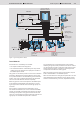
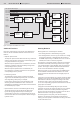
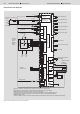

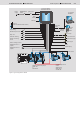
Table Of Contents

8/16 Bosch Rexroth AG Mobile Hydraulics
Dual Path Control DPC
RE 95 325/03.04
Assignment Setpoint
The travel speed is defined by the deflection of the lever.
The travel direction is defined by means of direction switches
(forwards and backwards). These direction switches can either
be integrated into the lever or built into the vehicle as a sepa-
rate switch.
The steering direction is defined separately by a steering
potentiometer.
The maximum travel speed can be limited over a continuously
variable range by means of a potentiometer.
Travel Behavior
Travel behavior is controlled by three variables.
• The set speed is defined by the deflection of the lever.
• The travel direction is defined by the direction switch.
• The acceleration behavior is defined by time ramps. These
variable time ramps determine how quickly the actuation at
the PWM output is altered.
If the lever is in the neutral position, the proportional solenoids
of the pumps (left and right, for both travel directions) are not
actuated by the lever. However, they can be actuated by the
steering potentiometer and the slip steering switch. This allows
steering on the spot.
If the lever is moved to a position outside the zero position,
the current at the relevant PWM outputs increases (for travel
direction forwards or backwards, depending on the direction
switches) according to the position of the lever and the set
time ramp. The corresponding proportional solenoids of the left
and right pumps are actuated. The park brake is released.
When the lever is returned to the neutral position, the park
brake is activated after a user-definable period.
When the travel direction is changed, the park brake is not
activated.
Travel Behavior Modes
There are two modes of travel behavior:
• Transport mode
The travel speed is defined only by the deflection of the lever.
Steering and speed regulation are not active.
The acceleration and deceleration times can be set
separately for both travel directions.
• Work mode
The travel speed is defined by the deflection of the lever and
kept constant by the speed regulation.
The maximum travel speed can be limited over a continuously
variable range by means of a speed limiting potentiometer.
The vehicle can be halted with the stop/go switch, without
changing the deflection of the lever. In that way, after the
halt, travel can continue at the same speed.
A switch on the vehicle is used to switch between the two
travel behavior modes.
Switching between the modes causes the motor displacement
to change. This is only possible with the vehicle at a standstill.