SX914 Digital Projector User Manual
Table of contents Important safety instructions ........................... 3 Introduction .......................... 7 Projector features.....................................7 Shipping contents ......................................8 Projector exterior view...........................9 Controls and functions ..........................10 Positioning your projector.............................. 14 Choosing a location................................14 Obtaining a preferred projected image size................
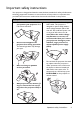
Important safety instructions Your projector is designed and tested to meet the latest standards for safety of information technology equipment. However, to ensure safe use of this product, it is important that you follow the instructions mentioned in this manual and marked on the product. Safety Instructions 1. Please read this manual before you operate your projector. Save it for future reference. 2. Do not look straight at the projector lens during operation.
Safety Instructions (Continued) 7. 10. The lamp becomes extremely hot during operation. Allow the projector to cool for approximately 45 minutes prior to removing the lamp assembly for replacement. 8. Do not operate lamps beyond the rated lamp life. Excessive operation of lamps beyond the rated life could cause them to break on rare occasions. 11. Do not place this product on an unstable cart, stand, or table. The product may fall, sustaining serious damage.
Safety Instructions (Continued) 13. Do not place this projector in any of the following environments. 14. Do not block the ventilation holes. - Do not place this projector on a blanket, bedding or any other soft surface. - Do not cover this projector with a cloth or any other item. - Do not place inflammables near the projector. - Space that is poorly ventilated or confined. Allow at least 50 cm clearance from walls and free flow of air around the projector.
Safety Instructions (Continued) 17. Do not step on the projector or place any objects upon it. Besides probable physical damage to the projector, doing so may result in accidents and possible injury. Ceiling mounting the projector We want you to have a pleasant experience using your BenQ projector, so we need to bring this safety matter to your attention to prevent possible damage to person and property.
Introduction Projector features The projector offers the following features • ECO BLANK saves 70% of lamp power By pressing the ECO BLANK button to hide the image and immediately lower 70% of the lamp power at the same time. • Less than 0.5W in standby condition Less than 0.5W power consumption under standby mode. • Less than 6W in network standby condition Less than 6W power consumption under network standby mode. • Filter Free Filter free design to lower maintenance and operating costs.
Shipping contents Carefully unpack and verify that you have all of the items shown below. If any of these items are missing, please contact your place of purchase. Standard accessories The supplied accessories will be suitable for your region, and may differ from those illustrated. *The warranty card is only supplied in some specific regions. Please consult your dealer for detailed information.
Projector exterior view 1. Front/upper side 1 2 3 4 8 5 6 7 9 10 5 Rear/lower side 11 12 13 14 15 16 17 18 19 2. 3. 4. 5. 6. 7. 8. 9. 10. 11. 12. 13. 14. 15. 16. 17. 18. 19. 20. 20 21 22 23 21. 22. 24 25 23. 24. 25. 26. 26 26 26 26 5 5 External control panel (See "Controls and functions" on page 10 for details.
Controls and functions Projector 1 2 9 10 11 12 13 14 3 4 5 6 7 8 13 1. Focus ring 11. LAMP indicator light 2. Adjusts the focus of the projected image. Zoom ring 3. Adjusts the size of the image Lens shift cover Indicates the status of the lamp. Lights up or flashes when the lamp has developed a problem. 12. AUTO 4. Access to the lens shift knob. MENU/EXIT Turns on the On-Screen Display (OSD) menu. Goes back to previous OSD menu, exits and saves menu settings. 5.
Remote control 6. 1 2 3 4 5 6 7 8 9 10 11 12 6 13 14 15 16 17 18 19 20 21 22 7. 8. 9. 10. 11. 1. 2. 3. 4. 5. Keystone/Arrow keys ( / Up, / Down) Manually corrects distorted images resulting from an angled projection. LASER Emits visible laser pointer light for presentation purposes. ZOOM+/ZOOMMagnifies or reduces the projected picture size. PAGE +/PAGE Operate your display software program (on a connected PC) which responds to page up/ down commands (like Microsoft PowerPoint).
15. MODE/ENTER Selects an available picture setup mode. Activates the selected On-Screen Display (OSD) menu item. 16. SOURCE Displays the source selection bar. 17. MIC/VOL +/MIC/VOL Adjusts the microphone input sound level. 18. ASPECT Selects the display aspect ratio. 19. MUTE Toggles projector audio between on and off. 20. SmartEco The function is not available on this projector. 21. TEST Displays the test pattern. 22. Numeric buttons Enters numbers in network settings.
Replacing the remote control batteries 1. 2. 3. To open the battery cover, turn the remote control over to view its back, push on the finger grip on the cover and slide it up in the direction of the arrow as illustrated. The cover will slide off. Remove any existing batteries (if necessary) and install two AAA batteries observing the battery polarities as indicated in the base of the battery compartment. Positive (+) goes to positive and negative (-) goes to negative.
Positioning your projector Choosing a location Your projector is designed to be installed in one of four possible installation locations: 1. Front Table Select this location with the projector placed on the table in front of the screen. This is the most common way to position the projector for quick setup and portability. 3. Rear Ceiling Select this location with the projector suspended upside-down from the ceiling behind the screen.
Obtaining a preferred projected image size The distance from the projector lens to the screen, the zoom setting, and the video format each factors in the projected image size. Projection dimensions Refer to "Dimensions" on page 61 for the center of lens dimensions of this projector before calculating the appropriate position.
If your measured projection distance is 5.5 m (5500 mm), the closest match in the "Distance from screen [mm]" column is 5633 mm. Looking across this row shows that a 130'' (about 3.3 m) screen is required. All measurements are approximate and may vary from the actual sizes.
• Lens shift adjustment will not result in a degraded picture quality. In the unlikely event that the image distortion is produced, see "Adjusting the projected image" on page 22 for details.
Connection When connecting a signal source to the projector, be sure to: 1. 2. 3. Turn all equipment off before making any connections. Use the correct signal cables for each source. Ensure the cables are firmly inserted. • In the connections shown below, some cables may not be included with the projector (see "Shipping contents" on page 8). They are commercially available from electronics stores. • The connection illustrations below are for reference only.
• The D-Sub output only works when an appropriate D-Sub input is made to the COMPUTER 1 jack. • If you wish to use this connection method when the projector is in standby mode, make sure the Monitor Out function is turned on in the SYSTEM SETUP: Advanced menu. See "Standby Settings" on page 50 for details. Connecting video source devices You need only connect the projector to a video source device using just one of the connecting methods; however, each provides a different level of video quality.
The table below describes the connection methods for different devices, and where the sound is from. Device PC/Component Video Video/S-Video Audio input port AUDIO IN AUDIO IN (L/R) The projector can play the sound from...
Operation Starting up the projector 1. 2. Remove the lens cap. Plug the power cord into the projector and into a power outlet. Turn on the power outlet switch (where fitted). Check that the POWER indicator light on the projector lights orange after power has been applied. Please use the original accessories (e.g. power cord) exclusively with the device to avoid possible dangers such as electric shock and fire. 3. Press POWER or ON to start the projector.
Adjusting the projected image Adjusting the projection angle The projector is equipped with 2 adjuster feet. These adjusters change the image height and projection angle. To adjust the projector, screw the adjuster feet to fine-tune the horizontal angle. To retract the foot, hold up the projector while screwing the adjuster foot in a reverse direction.
Correcting keystone Keystoning refers to the situation where the projected image is noticeably wider at either the top or bottom. It occurs when the projector is not perpendicular to the screen. To correct this, you will need to manually correct it following ONE of these steps. • Using the remote control Press / on the projector or remote control to display the Keystone correction page. Press to correct keystoning at the top of the image. Press to correct keystoning at the bottom of the image. Press / .
Using the menus The projector is equipped with On-Screen Display (OSD) menus for making various adjustments and settings. The OSD screenshots below are for reference only, and may differ from the actual design. Below is the overview of the OSD menu. Main menu icon Main menu DISPLAY Off Wall Color Auto Aspect Ratio Keystone Position Sub-menu Status ENTER Phase 0 H.
Securing the projector Using a security cable lock The projector has to be installed in a safe place to prevent theft. Otherwise, purchase a lock, such as the Kensington lock, to secure the projector. You can locate a Kensington lock slot on the rear side of the projector. See item 25 on page 9 for details. A Kensington security cable lock is usually a combination of key(s) and the lock. Refer to the lock’s documentation for finding out how to use it.
If you forget the password If the password function is activated, you will be asked to enter the six-digit password every time you turn on Password Error the projector. If you enter the wrong password, the Please try again. password error message as pictured to the right appears lasting for 3 seconds, and the INPUT PASSWORD message follows.
Disabling the password function To disable password protection, go back to the SYSTEM SETUP: Advanced > Security Settings > Change Security Settings menu after opening the OSD menu system. Press MODE/ENTER. The message “INPUT PASSWORD” appears. Enter the current password. i. If the password is correct, the OSD menu returns to the Security Settings page. Press to highlight Power On Lock and press / to select Off. You will not have to enter the password next time when turning on the projector.
2. Press to highlight Color Space Conversion and press color space. This function is only available when the HDMI input port is in use.
Magnifying and searching for details If you need to find the details on the projected picture, magnify the picture. Use the direction arrow keys for navigating the picture. • Using the remote control 1. Press Digital Zoom+/- to display the Zoom bar. Press Digital Zoom+ to magnify the center of the picture. Press the key repeatedly until the picture size is suitable for your need. 2. Use the directional arrows ( , , , ) on the projector or remote control to navigate the picture. 3.
About the aspect ratio • In the pictures below, the black portions are inactive areas and the white portions are active areas. • OSD menus can be displayed on those unused black areas. 1. Auto: Scales an image proportionally to fit 4. the projector's native resolution in its horizontal or vertical width. This is suitable for the incoming image which is neither in 4:3 nor 16:9 and you want to make most use of the screen without altering the image's aspect ratio.
Optimizing the image Using Wall Color In the situation where you are projecting onto a colored surface such as a painted wall which may not be white, the Wall Color feature can help correct the projected picture’s colors to prevent possible color difference between the source and projected pictures. To use this function, go to the DISPLAY > Wall Color menu and press / to select a color which is closest to the color of the projection surface.
6. Press to select a menu item to be changed and adjust the value with "Fine-tuning the image quality in user modes" below for details. / . See Fine-tuning the image quality in user modes According to the detected signal type and selected picture mode, some of the functions listed below may not be available. Based on your needs, you can make adjustments to these functions by highlighting them and pressing / on the projector or remote control.
Setting a preferred color temperature To set a preferred color temperature: 1. 2. 3. 4. Highlight Color Temperature and select Warm, Normal or Cool by pressing / on the projector or remote control. Press to highlight Color Temperature Fine Tuning and press MODE/ ENTER. The Color Temperature Fine Tuning page appears. Press / to highlight the item you want to change and adjust the values by pressing / . • R Gain/G Gain/B Gain: Adjusts the contrast levels of Red, Green, and Blue.
Please refer to the illustration to the right for how the colors relate to one another. 5. For example, if you select Red and set its range at 0, only pure red in the projected picture will be selected. Increasing its range will include red that is close to yellow and red that is close to magenta. Press to highlight Saturation and adjust its values to your preference by pressing / . Every adjustment made will reflect to the image immediately.
4. Press to highlight Timer Position and set the timer position by pressing Center 5. 7. 8. Top-Right Bottom-Right . Bottom-Left Press to highlight Timer Counting Direction and select your desired counting direction by pressing / . Selection Count Up Count Down 6. Top-Left / Description Increases from 0 to the preset time. Decreases from the preset time to 0. Press to highlight Sound Reminder and decide if you want to activate sound reminder by pressing / .
Hiding the image In order to draw the audience's full attention to the presenter, you can use BLANK on the projector or ECO BLANK on the remote control to hide the screen image. When this function is activated with an audio input connected, the audio can still be heard. You can set the blank time in the SYSTEM SETUP: Basic > Operation Settings > Blank Timer menu to let the projector return the image automatically after a period of time when there is no action taken on the blank screen.
heating. In such cases, you should switch to High Altitude mode to solve these symptoms. However, this is not to state that this projector can operate under any and all harsh or extreme conditions. Adjusting the sound The sound adjustments made as below will have an effect on the projector speaker(s). Be sure you have made a correct connection to the projector audio input. See "Connection" on page 18 for how the audio input is connected. Activating SRS To activate SRS: 1. 2. 3.
Using the test pattern The projector is capable of displaying the grid test pattern. It can be used to assist you with the adjustment of image size and focus, ensuring that the projected image is free from distortion. To display the test pattern, open the OSD menu and go to the SYSTEM SETUP: Advanced > Test Pattern and press / to select On.
Using the teaching templates The projector provides several preset patterns for various teaching purposes. To activate the pattern: 1. 2. Open the OSD menu and go to the DISPLAY > Teaching Template and press / to select Blackboard or Whiteboard. Press / to choose the pattern you need. 3. Press MODE/ENTER to activate the pattern.
Shutting down the projector 1. Press you. POWER or OFF and a confirmation message will appear prompting If you don't respond in a few seconds, the message will disappear. 2. Press POWER or OFF a second time. The POWER indicator light flashes orange, the projection lamp shuts down, and the fans will continue to run for approximately 90 seconds to cool down the projector. To protect the lamp, the projector will not respond to any commands during the cooling process.
Menu operation Menu system Please note that the on-screen display (OSD) menus vary according to the signal type selected and the projector model you are using. Main menu Sub-menu Options Off/Light Yellow/Pink/Light Green/Blue/Blackboard Auto/Real/4:3/16:9/16:10 Wall Color 1. DISPLAY Aspect Ratio Keystone Position Phase H.
Main menu Sub-menu Options Timer Period Timer Display Presentation Timer Timer Position 1~240 minutes Always/3 min/2 min/1 min/ Never Center/Top-Left/Top-Right/ Bottom-Right/Bottom-Left Timer Counting Count Down/Count Up Direction Sound Reminder On/Off On/Off Language 4.
Main menu Sub-menu 5.
Main menu Sub-menu 5. SYSTEM SETUP: Advanced 6.
Description of each menu Function Description Wall Color Corrects the projected picture’s color when the projection surface is not white. See "Using Wall Color" on page 31 for details. There are several options to set the image's aspect ratio depending on your input signal source. See "Selecting the aspect ratio" on page 29 for details. Corrects any keystoning of the image. See "Correcting keystone" on page 23 for details. Displays the position adjustment page.
Function Picture Mode Reference Mode Brightness Contrast Color 2. PICTURE menu Tint Sharpness Description Pre-defined picture modes are provided so you can optimize your projector image set-up to suit your program type. See "Selecting a picture mode" on page 31 for details. Selects a picture mode that best suits your need for the image quality and further fine-tune the image based on the selections listed on the same page below. See "Setting the User 1/User 2 mode" on page 31 for details.
Function Description 3. SOURCE 4. SYSTEM SETUP: Basic menu Quick Auto Search See "Switching input signal" on page 27 for details. Color Space Conversion See "Changing Color Space" on page 27 for details. Presentation Timer Reminds the presenter to finish the presentation within a certain time frame. See "Setting the presentation timer" on page 34 for details. Language Sets the language for the On-Screen Display (OSD) menus. See "Using the menus" on page 24 for details.
Function Description Direct Power On Allows the projector to turn on automatically once the power is fed through the power cord. Signal Power On Sets whether to turn the projector directly on without pressing POWER or ON when the projector is in standby mode and the signal is feed through the VGA cable. Auto Power Off Allows the projector to turn off automatically if no input signal is detected after a set period of time. See "Setting Auto Power Off" on page 53 for details. 4.
Function Description High Altitude Mode A mode for operation in high altitude areas. See "Operating in a high altitude environment" on page 36 for details. Audio Settings See "Adjusting the sound" on page 37 for details. Lamp Mode See "Setting Lamp Mode as Economic" on page 53 for details. 5. SYSTEM SETUP: Advanced menu Lamp Settings Security Settings Baud Rate Reset Lamp Timer See "Resetting the lamp timer" on page 56 for details.
Function Description Network Selecting On enables the function. The projector is able to provide the network function when it is in standby mode. Microphone Selecting On enables the function. The projector can output the microphone signal when it is in standby mode and all the necessary equipment is correctly connected. See "Playing sound through the projector" on page 19 for details. 5.
Function Description Source Shows the current signal source. 6. INFORMATION menu Picture Mode Shows the selected mode in the PICTURE menu. Resolution Shows the native resolution of the input signal. Current System Status Lamp Mode Shows the current lamp mode. 3D Format Shows the current 3D mode. Color System Shows input system format: NTSC, PAL, SECAM, YUV, or RGB. Equivalent Lamp Displays the number of hours the lamp has been used. Firmware Version Shows the firmware version of your projector.
Maintenance Care of the projector Your projector needs little maintenance. The only thing you need to do on a regular basis is to keep the lens and case clean. Never remove any parts of the projector except the lamp. Contact your dealer if other parts need replacing. Cleaning the lens Clean the lens whenever you notice dirt or dust on the surface. Please be sure to turn off the projector and let it cool down completely before cleaning the lens. • • • Use a canister of compressed air to remove dust.
Lamp information Getting to know the lamp hour When the projector is in operation, the duration (in hours) of lamp usage is automatically calculated by the built-in timer. See "Setting Lamp Mode as Economic" below for more information on Economic mode. To obtain the lamp hour information: 1. Press MENU/EXIT and then press / to highlight the SYSTEM SETUP: Advanced menu. 2. Press to highlight Lamp Settings and press MODE/ENTER. The Lamp Settings page appears. 3.
Timing of replacing the lamp When the Lamp indicator lights up red or a message appears suggesting it is time to replace the lamp, please install a new lamp or consult your dealer. An old lamp may cause malfunction in the projector, and in some instances, the lamp may explode. Go to http://www.benq.com for a replacement lamp. The LAMP indicator light and TEMPerature warning light will light up if the lamp becomes too hot. Turn the power off and let the projector cool for 45 minutes.
Replacing the lamp • To reduce the risk of electrical shock, always turn the projector off and disconnect the power cord before changing the lamp. • To reduce the risk of severe burns, allow the projector to cool for at least 45 minutes before replacing the lamp. • To reduce the risk of injuries to fingers and damage to internal components, use caution when removing lamp glass that has shattered into sharp pieces.
6. Use the handle to slowly pull the lamp out of the projector. • Pulling it too quickly may cause the lamp to break and scatter broken glass in the projector. • Do not place the lamp in locations where water might splash on it, children can reach it, or near flammable materials. • Do not insert your hands into the projector after the lamp is removed. If you touch the optical components inside, it could cause color unevenness and distortion of the projected images. 7.
13. After the startup logo, open the On-Screen Display (OSD) menu. Go to the SYSTEM SETUP: Advanced > Lamp Settings menu. Press MODE/ENTER. The Lamp Settings page appears. Highlight Reset Lamp Timer. A warning message appears asking if you want to reset the lamp timer. Highlight Reset and press MODE/ENTER. The lamp time will be reset to “0”. Do not reset if the lamp is not new or replaced as this could cause damage.
Indicators Light Status & Description Power events Off Off Stand-by mode. Off Off Powering up. Off Off Normal operation.
Troubleshooting The projector does not turn on. Cause Remedy Plug the power cord into the AC power jack on the projector, and plug the power cord into the There is no power from the power cord. power outlet. If the power outlet has a switch, make sure that it is switched on. Attempting to turn the projector on again Wait until the cooling down process has during the cooling process. completed. No picture Cause Remedy The video source is not turned on or connected correctly.
Specifications Projector specifications All specifications are subject to change without notice. Optical Control Resolution 1024 x 768 XGA Display system 1-CHIP DMD Lens F/Number F = 2.1-2.63, f = 21.70-34.94 mm Lamp 350 W lamp RS-232 serial control 9 pin x 1 IR receiver x 2 LAN control RJ45 x 1 12V trigger x 1 (Max.
Dimensions 446 mm (W) x 152 mm (H) x 336 mm (D) 446 336 152 78.5 74 Ceiling mount installation 273.70 30.24 23.52 29.48 109.57 Ceiling Mount screw: M4 (Max L = 25 mm; Min L = 20 mm) 538.11 577.70 322.90 402.70 7.15 Unit: mm 144.02 227.02 444.
Timing chart Supported timing for PC input Resolution Mode VGA_60* VGA_72 640 x 480 VGA_75 VGA_85 720 x 400 720 x 400_70 SVGA_60* SVGA_72 SVGA_75 800 x 600 SVGA_85 SVGA_120** (Reduce Blanking) XGA_60* XGA_70 XGA_75 1024 x 768 XGA_85 XGA_120** (Reduce Blanking) 1152 x 864 1152 x 864_75 BenQ 1024 x 576 Notebook_timing BenQ 1024 x 600 Notebook_timing 1280 x 720 1280 x 720_60* 1280 x 768 1280 x 768_60* WXGA_60* WXGA_75 1280 x 800 WXGA_85 WXGA_120** (Reduce Blanking) SXGA_60*** 1280 x 1024 SXGA_75 SXGA_85 1280
• The timings listed above may not be supported due to EDID file and VGA graphic card limitations. It is possible that some timings cannot be chosen.
• The timings listed above may not be supported due to EDID file and VGA graphic card limitations. It is possible that some timings cannot be chosen.
Warranty and Copyright information Limited warranty BenQ warrants this product against any defects in material and workmanship, under normal usage and storage. Proof of purchase date will be required with any warranty claim. In the event this product is found to be defective within the warranty period, BenQ's only obligation and your exclusive remedy shall be replacement of any defective parts (labor included).